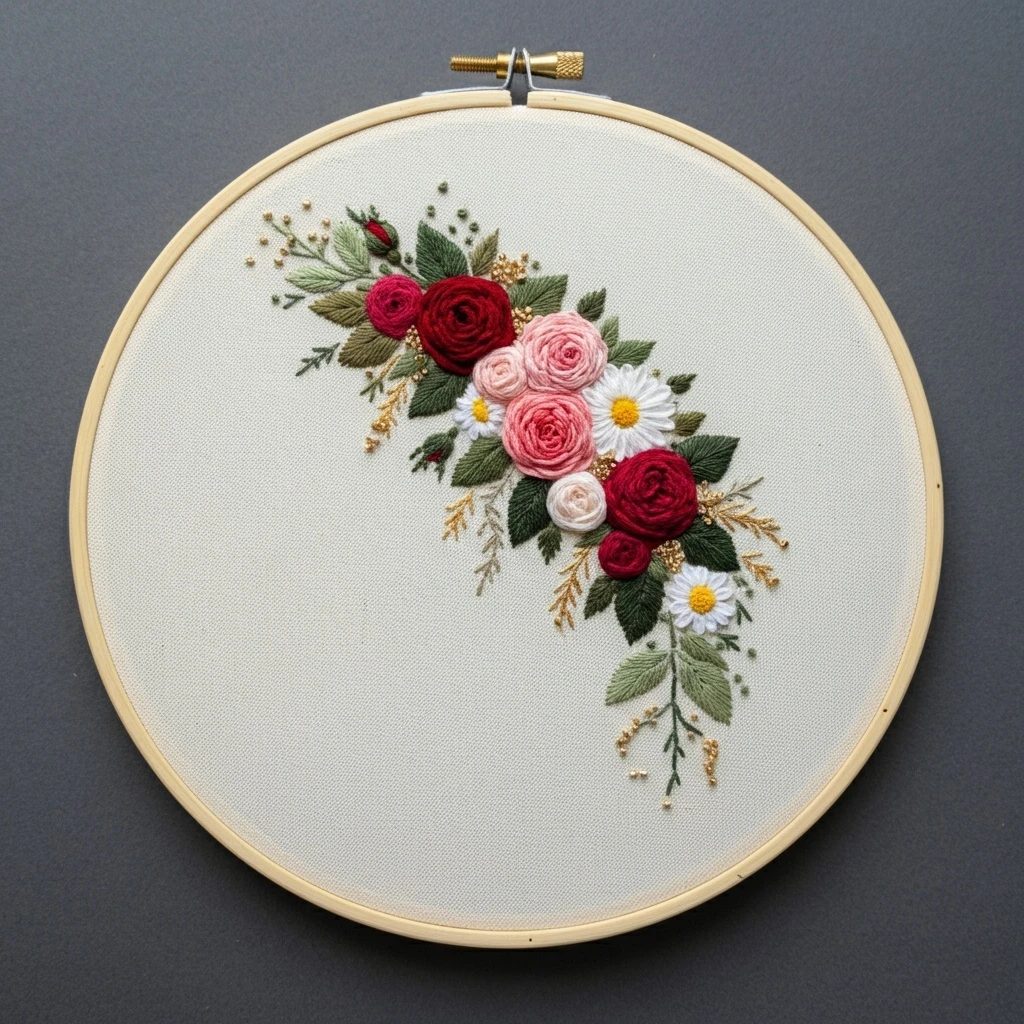


Elegant Cascading Roses Daisies
A graceful DMC floss plan for a flowing floral composition of cascading rose clusters, bright daisy faces, small buds, soft greenery, and airy botanical movement. The palette balances romantic pinks and corals with warm creams, golden centers, and natural leaf greens.
Suggested DMC Color Palette
Use the deeper rose shades at the tucked undersides of petals, keep the daisies creamy rather than stark white, and let the greens move from olive shadow to fresh leaf highlights so the cascade feels natural.
Deep rose shadows inside folded petals and the lower side of cascading blossoms.
Rich pink rose outlines, petal bases, and color depth where blooms overlap.
Main rose-petal fill, soft outer petals, and midtone blending between deep and pale pink.
Light petal rims, tiny rosebuds, and gentle highlights on the upper cascade.
Warm peachy accents in rose centers and a few lively transition stitches.
Daisy petals and bright petal tips; softer and warmer than pure white.
Tiny highlights on daisy petals, pale blossoms, and small sparkle stitches.
Daisy centers, pollen dots, and sunny accents that brighten the floral cluster.
Shaded daisy-center knots and warm depth under yellow seed stitches.
Dark leaf bases, deep stem turns, and shaded greenery behind flowers.
Main stems, midtone leaves, and balanced foliage around rose clusters.
Leaf highlights, small sprigs, and the airy tips of the cascading stems.
Stitching Suggestions
Choose stitches that show direction: roses need curved petal movement, daisies need clean radiating petals, and the cascade needs flexible stems that guide the eye downward.
Layered roses
Work each petal from the outer edge toward the center. Use 3689 at the lightest rims, 3688 for the body, and 3803 or 3685 at tucked inner folds.
Small rosebuds
For tiny rounded buds, stitch a small split-stitch base, then fill with 2 strands of 3688 and add one or two 3685 shadow strokes at the base.
Daisy petals
Use 746 for the main petal and a single strand of 3865 on the top edge. Keep petals slightly irregular so the daisies look natural rather than mechanical.
Daisy centers
Cluster 743 knots over a 782 shadow base. One-wrap knots are flatter; two-wrap knots create a raised, pollen-like center.
Cascading stems
Use 3052 for most flowing stems. Add 3051 on the underside of curves and whip select lines with 3053 for a polished raised vine effect.
Leaves
Start with a center vein in 3051, then alternate 3052 and 3053 outward. This creates simple shading without complicated thread painting.
Fine outlines
Outline only the areas that need definition: lower rose petals, crossing stems, and the outer edge of pale daisy petals against light fabric.
Soft filler blossoms
Add small blush filler flowers with 3689 and 352. Keep them loose and airy so they support the cascade without overcrowding the roses.
Thread Count, Blending & Texture
Blending Map
Use these combinations to keep the floral cascade soft and dimensional.
Practical Beginner Tips
The design looks refined when the stitch direction follows the cascade and the pale petals stay clean.
- Stitch the largest roses first, then add daisies, leaves, and small filler flowers so the layers feel intentional.
- For each rose, mark a tiny center point and angle all stitches toward it; this instantly improves petal realism.
- Keep daisy petals simple: one clean detached-chain or satin petal is better than overfilling with too many strands.
- Use shorter thread lengths for pale colors so 746 and 3865 do not pick up fuzz or dye from darker floss.
- When the design feels busy, reduce thread count rather than changing colors: 1-strand details make the cascade lighter and more elegant.
- Press from the back on a folded towel so French knots and padded rose centers keep their raised texture.
Finishing Notes
After stitching, check the balance of the cascade from a distance. Add only a few final highlight stitches to rose rims and daisy tips, then secure the fabric in the hoop with even tension so the downward floral flow remains smooth.