
Elegant Floral Fan
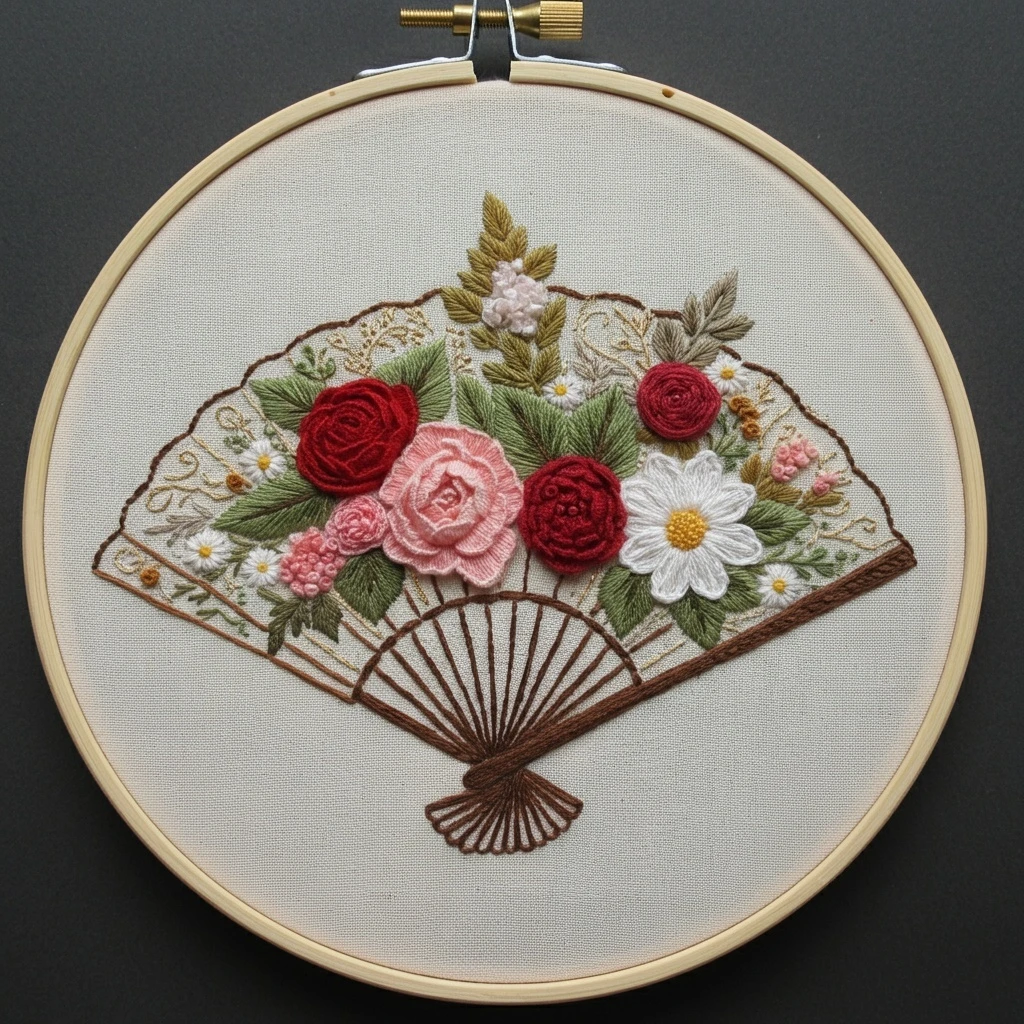
A refined hand-embroidery guide for a decorative fan motif filled with graceful floral sprays, soft petals, leafy accents, and delicate rib lines. The palette leans romantic and polished: blush rose, dusty mauve, cream highlights, sage greens, and warm antique-gold structure.
Design reading
The design is best treated as a decorative fan first and a floral arrangement second. Keep the fan ribs crisp and evenly spaced, then let the flowers sit softly over the structure with rounded petals, tiny buds, and airy stems. A slightly darker outline around the fan edge gives the motif definition, while lighter petal highlights keep the arrangement elegant rather than heavy.
Work from the structural fan lines outward: ribs and outer arc first, main blossoms next, then leaves, buds, accents, and final highlights.
clean stem stitch or back stitch in warm beige-gold.
soft satin, fishbone, lazy daisy, woven roses, or long-and-short.
French knots, seed stitch, and single-strand highlights.
Suggested DMC palette
Stitch suggestions
- Fan ribs: use stem stitch for graceful curved ribs; back stitch works well for beginners who want sharper geometry.
- Outer fan arc: couch a 2-strand line with 1-strand tacking stitches for a smooth decorative border.
- Roses: try woven wheel roses with 2–3 strands, then add one-strand straight-stitch highlights in 818 or 746.
- Open petals: long-and-short stitch with 818, 152, and 3727 creates soft botanical shading.
- Leaves: fishbone stitch gives quick dimension; add a single dark vein in 3051 where leaves overlap flowers.
- Small buds: lazy daisy petals with French-knot centers keep the floral spray light and balanced.
- Texture dots: scatter French knots in 3828 and 746 near flower centers and along the fan base for a jewelry-like finish.
Practical stitching order
Use a fine removable pen or pale pencil. Mark fan ribs carefully because they guide the whole composition.
Complete the fan ribs and outer arc before bulky flowers so your needle path stays clean.
Work larger roses and main petals with 2 strands, keeping stitches angled toward the flower center.
Place darker green leaves under pink petals and lighter green leaves at the outer edges.
Use 1 strand for veins, petal glints, dots, and decorative seed stitches.
After stitching, place the embroidery face-down on a towel and press gently to preserve raised roses and knots.
Beginner-friendly notes
For the cleanest result, avoid filling every petal completely. Leaving a little fabric breathing room between fan ribs, stems, and blossoms helps the design feel airy and elegant. Use shorter satin stitches on curved petals to prevent snagging, and rotate the hoop often so your stitches naturally follow each petal direction. If the bouquet begins to look too pink, add a few cream knots and sage leaves before choosing more dark thread.
Best fabric pairing: natural linen, cotton-linen blend, or a warm ivory cotton. Use a 6–7 inch hoop for comfortable handling and a sharp embroidery needle sized 7–9 for most details.