
DMC palette & embroidery guide
Elegant Monogram Hoop With Roses And Foliage
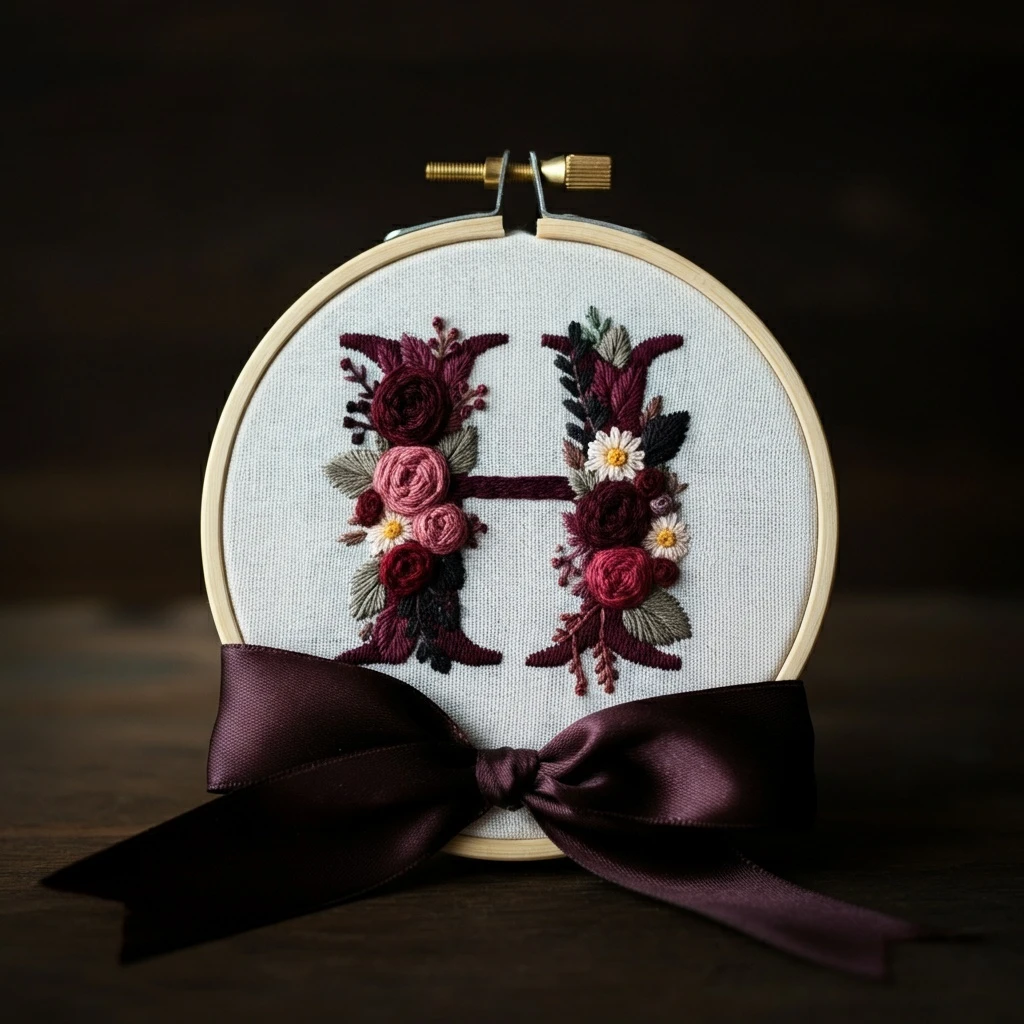
A refined hoop design built around a deep burgundy monogram, dimensional roses, petite daisies, muted grey-green foliage, and a dramatic wine ribbon finish. The palette below keeps the piece elegant while giving enough contrast for readable lettering and layered floral texture.
Color story observed from the design
The image reads as an ornate burgundy letter framed by rose clusters on both sides. The darkest accents are almost black-plum, the rose centers shift from wine to dusty pink, the leaves are subdued olive-grey, and the small daisy details add warm cream and yellow highlights. Use the light linen ground as part of the design so the letter and flowers remain crisp.
Use 2 strands for the letter body; 1 strand for fine inner shadow lines.
Blend with 814 where petals tuck underneath.
Great for raised rose edges and berry sprigs.
Use in outer petals to soften the burgundy palette.
Add tiny arcs on the top-facing petals only.
Use sparingly under flowers and on the lowest foliage.
Ideal for the muted veins and shaded leaf sides.
Work over 645 for a natural dusty botanical finish.
Keep daisy petals clean with 1 strand and short straight stitches.
French knots give small flower centers a raised look.
Use only where the letter meets dark florals; avoid heavy outlines everywhere.
Useful if adding a stitched hoop rim or soft grounding stitches.
Stitch plan by design element
Monogram letter
Work the large letter first so the florals sit neatly on top. Use satin stitch or long-and-short stitch in DMC 814, with DMC 815 placed along the upper-left or center strokes for gentle light. For narrow serifs, switch to split stitch or stem stitch so the corners stay sharp.
Roses
For dimensional roses, use woven wheel roses with 3 strands for larger blooms and 2 strands for smaller buds. Start with 814 or 815 in the center, then wrap with 777, 335, or 899 toward the outside. Keep the wrapping slightly loose for a lush rose surface.
Daisies and tiny blossoms
Use detached chain stitches or small straight stitches in 3865 for petals. Add 725 French knots in the centers. A single 3371 or 645 seed stitch beside the yellow center can add depth without muddying the flower.
Foliage and sprigs
Use fishbone stitch for larger leaves, alternating 645 and 647 for a grey-green variegated effect. Use 934 at the base of leaves that tuck behind roses. For berry stems and delicate sprays, use stem stitch with 1 strand and add colonial knots in 815 or 777.
Thread-count and blending guidance
Recommended strands
- 1 strand: leaf veins, tiny stems, daisy outlines, inner rose shadows.
- 2 strands: monogram edges, most satin sections, medium leaves, small flowers.
- 3 strands: woven roses, bold berry knots, raised floral accents.
- 4 strands: only for very plush roses on larger hoops; test first to avoid crowding.
Blending combinations
- Letter depth: 1 strand 814 + 1 strand 815 for a rich but readable burgundy stroke.
- Rose transition: 1 strand 777 + 1 strand 335 for dusty raspberry petals.
- Soft foliage: 1 strand 645 + 1 strand 647 for muted, natural leaves.
- Shadowed greenery: 1 strand 934 + 1 strand 645 under dense flower clusters.
Beginner-friendly working order
Stabilize the fabric. Hoop the linen firmly and keep the weave straight. Because the design has raised roses, avoid over-tightening finished areas as you rotate the hoop.
Stitch the monogram foundation. Outline the letter with split stitch in 814, then fill with satin or long-and-short stitch. Use short stitches around curves and serifs for a smooth edge.
Add the largest roses next. Place woven wheel roses after the letter is complete. Anchor each spoke securely and keep rose centers compact so the bloom does not look loose.
Layer leaves behind and between flowers. Work darker leaves first, lighter veins last. This creates the look of foliage tucked underneath the blooms.
Finish with small flowers, berries, and accents. Add daisies, French knots, and fine trailing sprigs at the end so they remain bright and dimensional.
Texture, outlining, and shading tips
Keep the monogram crisp
Use a single-strand split-stitch outline before filling the letter. After the fill is complete, refine only the darkest edges with 3371 or 814. This prevents the letter from becoming too heavy while still preserving the formal shape.
Create rose dimension
Place the darkest color in the rose center and under overlapping petals. Use lighter pinks only on outer or top-facing wraps. Do not blend every round equally; contrast is what makes the roses look dimensional.
Build realistic foliage
Angle each fishbone stitch toward the leaf tip. For a natural look, make one side slightly darker than the other. Add a final single-strand vein only if the leaf shape needs definition.
Balance dense areas
The design has rich floral clusters on both sides of the letter. Leave tiny linen gaps between some stems, petals, and leaves so the composition feels airy rather than crowded.
Practical finishing notes
For a polished hoop finish, press from the back on a padded towel after stitching, avoiding direct pressure on woven roses and knots. Trim thread tails carefully behind the light fabric so dark burgundy does not shadow through. If adding a real ribbon like the reference, attach it after the embroidery is mounted so the bow remains clean and dimensional.