
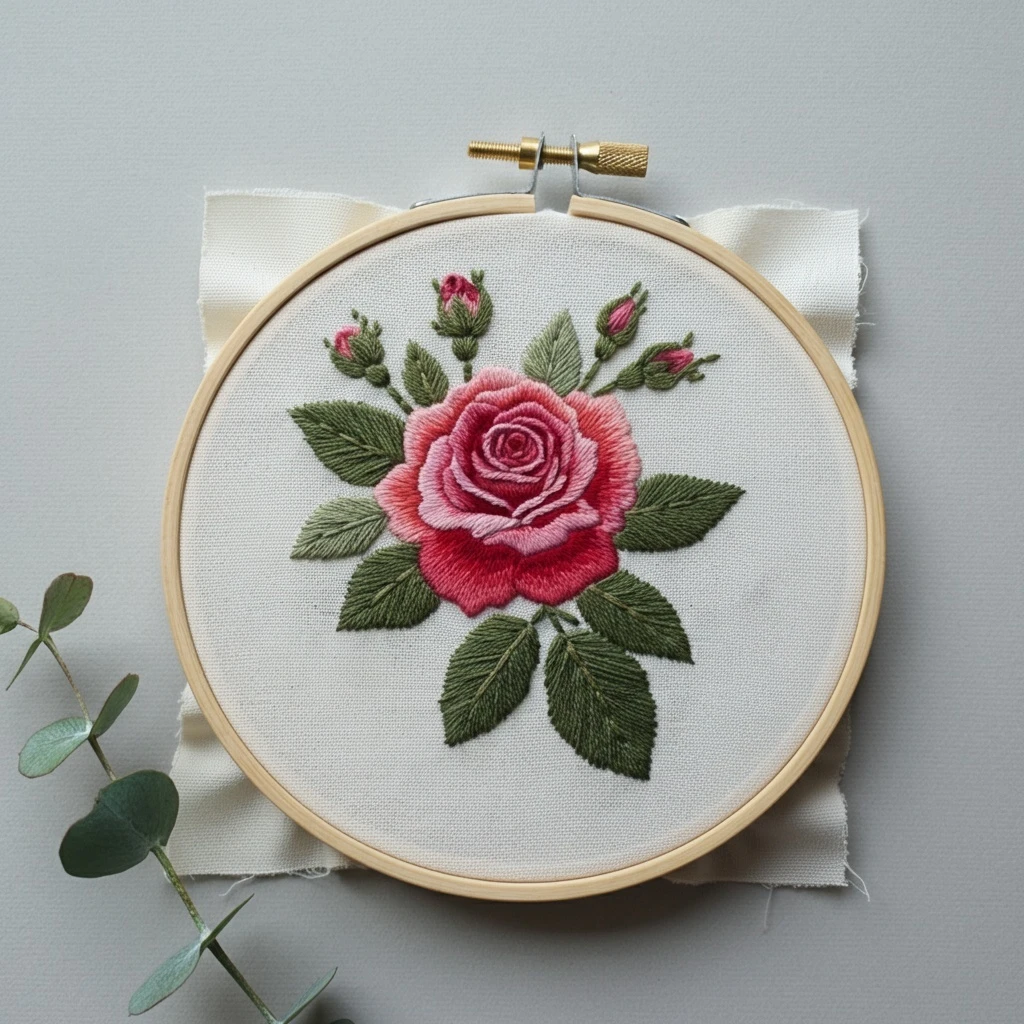
DMC palette & embroidery notes
Elegant Rose And Bud
A polished hand-embroidery guide for a romantic central rose with curled petals, small rosebuds, olive-green leaves, fine stems, and soft botanical shading.
Design read: the reference shows a full rose in layered pinks and raspberry reds, surrounded by unopened buds and deep textured leaves. The strongest visual effect comes from petal-to-petal value shifts, darker inner folds, pale outer highlights, and directional leaf stitches that imitate veins.
Best fabric impression: warm white, ivory, or oatmeal linen/cotton keeps the rose elegant while letting the reds and greens stay rich.
Skill level Confident beginner to intermediate
Main texture Long & short shading
Finish style Dimensional, painterly, refined
Suggested DMC Color Palette
The palette is organized by how the floss will be used: pale petal highlights, warm rose mid-tones, deep folds, bud accents, and natural olive foliage. Substitute nearby shades if your stash is limited, but keep the value steps: light, medium, dark, and deepest shadow.
| Swatch | DMC | Color name | Use notes |
|---|---|---|---|
| 151 | Dusty Rose - Very Light | Softest petal rims, pale turned edges, and tiny highlight strokes on the outer rose. | |
| 818 | Baby Pink | Gentle transition from the light rim into the body of large petals. | |
| 3713 | Salmon - Very Light | Warm blush on curled petals; blend with 3354 for a natural rose-pink gradient. | |
| 3354 | Dusty Rose - Light | Primary rose mid-tone for broad petals and the soft sides of buds. | |
| 3806 | Cyclamen Pink - Light | Bright saturated strokes in the lower petals and rosebud tips. | |
| 777 | Raspberry - Very Dark | Deep petal folds, underside of the lower rose, and concentrated inner spiral shadows. | |
| 815 | Garnet - Medium | Darkest inner rose lines and small anchor shadows where petals overlap. | |
| 3722 | Shell Pink - Medium | Muted rose bridge shade; useful where the flower should look elegant rather than neon. | |
| 3052 | Green Gray - Medium | Light leaf planes, bud sepals, and upper surfaces catching light. | |
| 3051 | Green Gray - Dark | Main leaf fill for the olive-green foliage around the rose. | |
| 3346 | Hunter Green | Leaf shadows beside veins and darker rosebud bases. | |
| 3363 | Pine Green - Medium | Deep leaf tips, stems, and the darkest shaded foliage behind the rose. | |
| 936 | Avocado Green - Very Dark | Fine outlines on leaf edges and small dark accents at bud collars. | |
| 3021 | Brown Gray - Very Dark | Optional muted stem shadow; use sparingly to keep the greenery natural. | |
| 3865 | Winter White | Tiny sparkle highlights only; especially effective on petal edges if the fabric is not white. |
Stitch Plan by Design Element
Central rose petals
Use long and short stitch in curved rows, following the direction each petal curls. Start with the darkest stitches tucked under overlapping petals, then feather medium pinks outward and finish with pale edge strokes.
Inner spiral
Work tiny split stitch or stem stitch curves in 815 and 777. Keep the stitches short and close so the center reads as a tightly rolled rose rather than a flat circle.
Rosebuds
Fill bud tips with satin stitch or long and short stitch using 3354, 3806, and a touch of 777. Wrap green sepals around each bud with detached fly stitch or small straight stitches.
Leaves
Create a central vein with stem stitch, then fill each half with fishbone stitch or angled long and short stitches. Change stitch angle on each leaf side for a realistic feathered texture.
Stems
Use 1-strand stem stitch for thin, graceful stems. For slightly thicker areas, place a second line of split stitch in a darker green on the shadow side.
Outlines
Use selective outlining only. A full dark outline can make the rose heavy; instead, add 815 to deep petal creases and 936 to leaf tips and undersides.
Thread Count, Blending & Shading Guidance
Thread-count guide
- Rose body: 1 strand for fine shading; 2 strands only on larger lower petals if you want faster coverage.
- Inner center and outlines: 1 strand for clean detail.
- Leaves: 1 strand for realistic veins; 2 strands for bold folk-style texture.
- Stems and sepals: 1 strand, with very short stitches around curves.
Blending combinations
- Soft highlight blend: one strand 151 + one strand 818.
- Warm petal blend: one strand 3713 + one strand 3354.
- Rich rose shadow: one strand 3806 + one strand 777.
- Natural leaf blend: one strand 3051 + one strand 3346.
Suggested value map
Use 815 and 777 in the rose center and lower petal folds, 3806 and 3354 through the saturated middle petals, 3713 and 818 on outward-facing petal planes, and 151 as the final highlight. On leaves, use 936 at the deepest tips, 3363 and 3346 for shaded edges, 3051 for the main body, and 3052 for lifted veins or light-facing leaf sections.
Beginner-Friendly Practical Tips
Before stitching
- Choose a tightly woven cotton or linen and keep the hoop drum-tight to prevent puckering.
- Transfer only the essential petal boundaries and leaf center veins; too many lines can distract from shading.
- Pre-sort floss into light, mid, dark, and deepest shadow groups before starting.
While stitching
- Work from the background leaves toward the front rose so overlapping areas stay tidy.
- Keep petal stitches slightly curved, not straight across, to follow the rose shape.
- Use shorter stitches near tight curves and longer strokes on broad outer petals.
Finishing details
- Add final accent stitches only after the full rose is filled; this helps you judge where contrast is really needed.
- For leaf texture, add a few single-strand 3052 or 3865 highlight stitches alongside the vein, not on every leaf.
- For a refined heirloom finish, avoid bulky knots: start with a waste knot or tiny anchoring stitches under filled areas.
Common fixes
- If the rose looks flat, deepen only the tucked-under folds with 777 or 815.
- If the leaves overpower the flower, reduce the darkest green outlining and add a few lighter 3052 strokes.
- If the buds disappear, outline their sepal bases with one strand of 936 and brighten the tips with 3806.