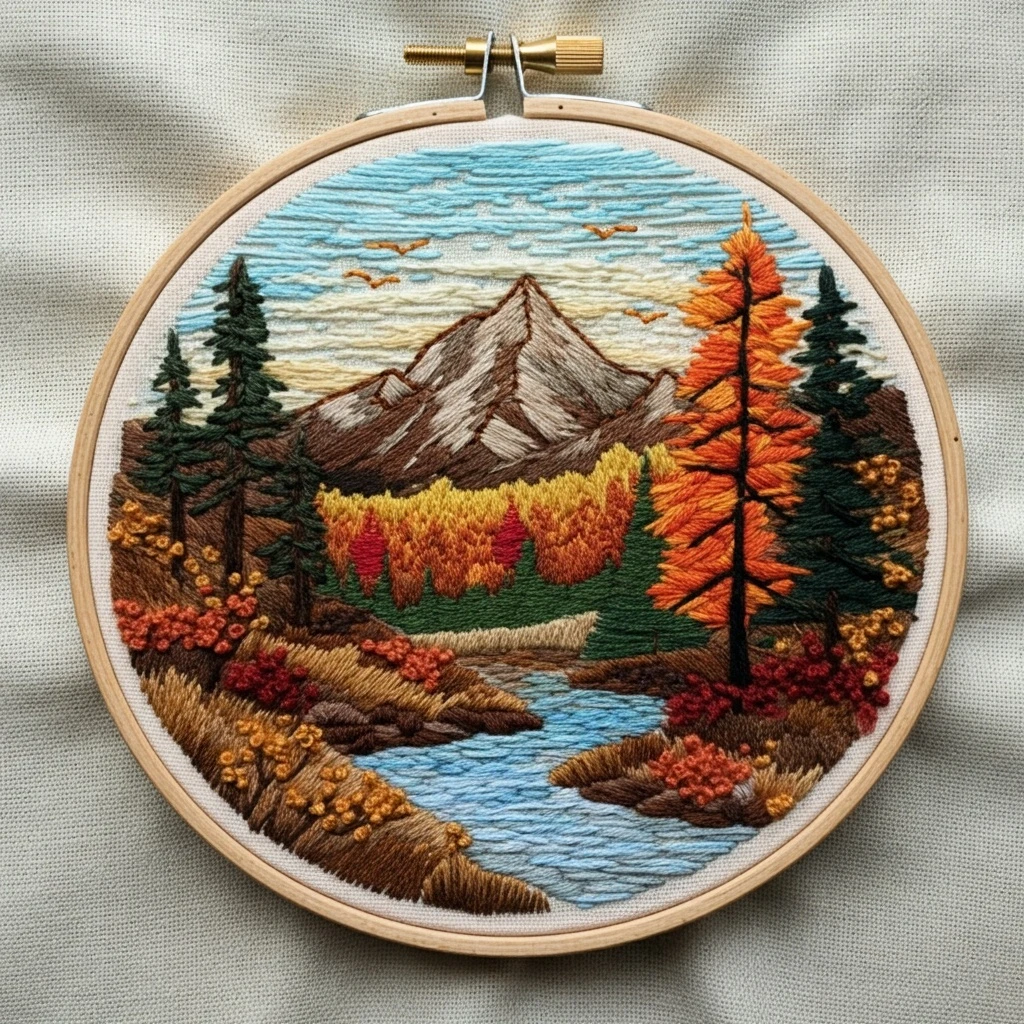
A warm scenic embroidery guide for a layered autumn mountain view: distant peaks, ochre ridges, russet and golden trees, dark evergreen accents, a winding path, cool blue water, and tiny sky details. The palette is designed to keep the landscape rich, dimensional, and beginner-friendly without requiring too many floss colors.
Layered mountain ridgesCopper, gold & red foliageCool water contrastRaised leaf texture
⌒⌒
Color story from the reference
The design reads as a cozy autumn panorama. Warm copper, rust, golden yellow, and garnet foliage dominate the foreground, while the mountain shapes are calmer: taupe-brown ridges, muted grey shadows, and small pale highlights on the highest peaks. Cool teal-blue water and deep blue-green evergreens give the scene contrast so the orange leaves feel brighter.
For the most elegant result, use the darkest browns and greens only for structure. Let the orange, gold, and red stitches sit on top as texture rather than filling every space solidly.
DMC B5200Snow White
Peak highlights, small glints on water, and the brightest edge of distant mountain snow. Use 1 strand for a crisp, clean accent.
DMC 415Pearl Grey
Cool shadow on snowy caps, pale rock facets, and distant haze. Blend with white for soft ridge transitions.
DMC 840Beige Brown, Medium
Mountain contour lines, tree trunks, pathway texture, and gentle outlines where black would feel too hard.
DMC 3371Black Brown
Tiny birds, deepest trunk shadows, rock cracks, and final definition. Keep this to 1 strand for refined linework.
DMC 918Red Copper, Dark
Shaded mountain slopes, burnt-orange shrubs, and the darker sides of autumn tree masses.
DMC 919Red Copper
Main rust-orange foliage and warm midtones along the foothills. Excellent for seed stitch and mixed knots.
DMC 321Christmas Red
Bright maple-leaf pops in the foreground. Scatter sparingly so the red becomes a lively accent.
DMC 902Garnet, Very Dark
Deep red shadows inside tree clusters and shaded valley pockets. Adds value contrast beneath orange and gold knots.
DMC 742Tangerine, Light
Golden foliage, sunlit leaf tips, and cheerful highlights along the path edge.
DMC 3821Straw
Soft yellow highlights in distant grasses, warm sky glow, and the lightest gold leaves.
DMC 500Blue Green, Very Dark
Evergreen silhouettes, shaded forest bases, and grounding foliage behind the brighter leaves.
DMC 501Blue Green, Dark
Mid-green shrubs, distant pine texture, and transition stitches between the dark forest and gold leaves.
DMC 3846Turquoise, Light
Primary stream or river color. Follow the curve of the water with smooth split stitch lines.
DMC 3843Electric Blue
Water highlights and small reflective ripples. Add near the end so the blue stays clean against the warm foliage.
DMC 3863Mocha Beige, Medium
Winding path, dry grasses, and warm neutral ground. Directional stitches help shape the road.
DMC 646Beaver Grey, Dark
Rock shadows, muted mountain creases, and cool neutral breaks between warm areas.
Stitch plan by design element
Distant peaksUse long-and-short stitch with 1 strand for smooth, soft slopes. Add B5200 and 415 only on the highest lit edges so the mountains remain airy.
Autumn ridgesWork angled satin, split, or long-and-short stitches in 918, 919, 840, and 646. Keep each ridge’s stitch angle consistent to show the land planes.
Golden tree massesBuild texture with French knots, colonial knots, and seed stitch. Layer 742 and 3821 over a few darker 918 or 902 stitches.
Red maple accentsUse 321 for scattered bright knots and short star-like straight stitches. Avoid large blocks of red; small sparks look more natural.
EvergreensUse fly stitch, fern stitch, and short straight stitches in 500 and 501. Stitch darker trees behind the bright foliage first.
River and pathUse curved split stitch for water and directional straight stitch for the path. Let their stitch direction lead the eye into the landscape.
Thread-count guidance
For a 5-6 inch hoop
Use 1 strand for birds, peak highlights, branch tips, mountain creases, and delicate water glints. Use 2 strands for most mountain fills, path lines, river edges, and tree trunks. Use 2 strands for French knots unless you want the closest foreground foliage to be extra raised.
For a 7-8 inch hoop
Use 2 strands for most filled shapes, 1 strand for fine outlines, and 3 strands for a few foreground knots. Larger hoops can support more knot texture, but keep distant mountains flatter and smoother.
Simple depth rule: thin and smooth in the distance, thicker and more textured in the foreground. This makes a small embroidered landscape feel spacious.
Blending and shading ideas
Start with the sky and far mountains. Lightly stitch any background glow first, then add the most distant ridge in muted grey-brown tones.
Shape the slopes with stitch direction. Angle stitches downward along each ridge instead of filling horizontally. This gives the mountains structure without heavy outlines.
Layer foliage from dark to light. Place 500, 501, 902, and 918 first, then add 919, 742, 3821, and 321 on top as leaf texture.
Blend knots randomly. Alternate red copper, tangerine, and straw in uneven clusters. Real autumn trees look varied, not striped.
Keep water clean. Stitch the river after nearby dark greens are complete. Add only a few pale blue and white highlights so the water remains fresh.
Outline selectively. Finish with 3371 or 840 on birds, key trunks, a few rock edges, and the strongest path curve. Too much outline will flatten the scenic look.
Beginner-friendly stitching tips
Work back to frontBackground glow, far peaks, nearer ridges, forest, river, path, trunks, then final leaf knots. This order keeps overlaps tidy.
Use fewer colors per areaChoose three main warm colors for each tree group: one dark, one midtone, one highlight. This prevents a confetti look.
Leave breathing spaceDo not cover every bit of fabric in the trees. Small gaps make knot clusters look lighter and more natural.
Anchor knots securelyAutumn foliage uses many knots, so keep the back tidy and avoid long thread carries that may show through light fabric.
Check contrast earlyAfter the first tree cluster, step back. Add more 902 or 3371 if the foreground is not reading clearly.
Press gentlyWhen finished, press from the back on a folded towel so raised knots and textured foliage are not crushed.
Suggested stitch menu
Long-and-short stitch: mountain slopes, distant hills, and soft shading. Stem stitch: trunks, riverbanks, path edges, and flowing contours. Split stitch: smooth water lines and delicate outlines. French knots: foreground leaf clusters and blossom-like autumn dots. Seed stitch: distant foliage, fallen leaves, and ground texture. Fly stitch or fern stitch: pine branches and evergreen silhouettes. Straight stitch: grasses, rocks, bark marks, and tiny sky birds.
For a polished hand-embroidery finish, use texture as the star: smooth mountains behind raised autumn leaves, with only a few crisp dark lines to define the composition.