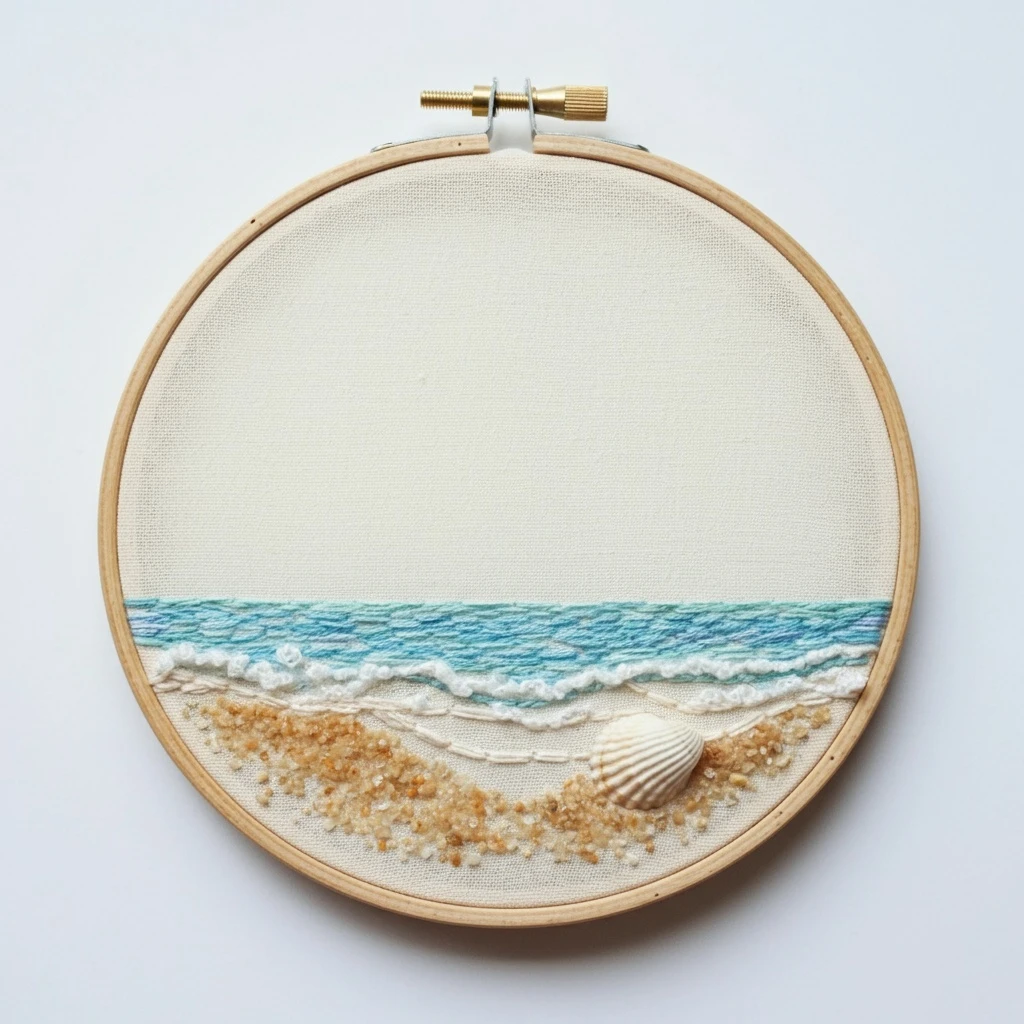
Embroidered Beach Scene with Seashell - DMC Palette & Stitching Tips
DMC palette & embroidery guide
Embroidered Beach Scene with Seashell
A soft coastal embroidery guide for a seaside vignette: scalloped seashell, warm sand, pale surf, aqua water, sky glow, small grasses, and tiny beach textures. The palette keeps the scene airy and sun-washed while giving the shell enough ribbed detail to become the focal point.
The design reads as a calm beach scene built around a decorative seashell. Expect creamy sand, pale foam, turquoise-blue water, soft sky tones, blush shell ridges, peachy coral shadows, and a few muted greens for dune grass or small coastal sprigs. The palette should feel gentle rather than saturated, with darker values used only for shell grooves, horizon definition, and tiny textural accents.
The shell is the focus. Keep the ocean and sand stitched lightly so the ribbing, blush highlights, and warm outline of the seashell remain clear.
DMC B5200Snow White
Bright foam crests, tiny shell shine, and crisp accents at the waterline. Use sparingly so highlights sparkle.
DMC 3865Winter White
Soft shell highlights, dry sand glints, and gentler foam where pure white would look too stark.
DMC 738Tan, Very Light
Main sand fill, beach base, and warm background stitches around the shell.
DMC 437Tan, Light
Sand shadows, shell cast shadow, small pebbles, and grounding stitches under the seashell.
DMC 839Beige Brown, Dark
Fine shell outline, deepest sand marks, and small detail lines when black would be too harsh.
DMC 948Peach, Very Light
Lightest shell planes and soft blush transitions along the scalloped ridges.
DMC 758Terra Cotta, Very Light
Primary shell color, warm ribbing, and peach shading on the lower shell fan.
DMC 356Terra Cotta, Medium
Shell groove shadows, base curve, and deeper scallop separations. Blend with 758 for natural depth.
DMC 3708Melon, Light
Coral warmth on the shell and optional tiny beach flowers or blush accents.
DMC 964Sea Green, Light
Pale sky, shallow water, and soft washed areas near the horizon.
DMC 597Turquoise
Main ocean bands, gentle wave shapes, and midtone water fill behind the shell.
DMC 3809Turquoise, Very Dark
Darker waterline, underside of waves, and small horizon accents for depth.
DMC 3756Baby Blue, Ultra Very Light
Sky wash, airy reflections, and barely-there transition stitches between foam and water.
DMC 3011Khaki Green, Dark
Dune grass, tiny seaweed details, and muted botanical sprigs around the sand.
Stitch plan by design element
Scalloped seashellUse long-and-short stitch in 948, 758, and 356. Follow each rib from the hinge outward so the fan shape stays dimensional.
Shell groovesWork split stitch or stem stitch in 356 and 839 between the ribs. Keep the lines tapered and slightly curved.
Surf and foamUse whipped running stitch, stem stitch, or couching in B5200 and 3865 for clean curling wave lines.
Ocean bandsFill with horizontal satin, split, or long straight stitches in 964, 597, and 3809. Keep the stitch direction level for calm water.
Sand textureUse seed stitch, tiny straight stitch, and French knots in 738, 437, and 3865. Leave open fabric for a light beach feel.
Dune grass accentsUse fly stitch and detached chain in 3011, with 437 at the base for dry coastal stems.
Thread-count guidance
For a 5-6 inch hoop
Use 1 strand for shell groove lines, foam highlights, tiny pebbles, and grass tips. Use 2 strands for the shell fill, ocean bands, and the main sand texture. Use French knots with 1-2 strands and one wrap for small grains of sand.
For a 7-8 inch hoop
Use 2 strands for most fill areas, 1 strand for fine outlines, and 3 strands only for a few raised foam lines or shell-base accents. Larger hoops benefit from more gradual shading between 948, 758, and 356.
Best beginner shortcut: stitch the shell first, then add sand around it. This prevents the background texture from crowding the shell’s clean scalloped edge.
Blending and shading ideas
Outline the shell lightly. Use 1 strand of 839 or a pale removable guide. Avoid a heavy dark outline until the fill is complete.
Shade each rib separately. Start each rib with 3865 or 948 at the top, move into 758 through the center, and use 356 near the lower groove or base.
Blend peach tones with mixed strands. Thread one strand of 948 with one strand of 758 for soft middle areas; use one strand of 758 with one strand of 356 for deeper rib shadows.
Keep water simple. Horizontal stitches in 964 and 597 will read as calm sea. Add only a few 3809 lines so the background does not overpower the shell.
Use foam as a highlight, not a fill. Place short B5200 accents along the wave crests and shoreline, then soften nearby with 3865.
Build sand last. Scatter seed stitches unevenly around the shell, using 738 first, 437 for shadow, and tiny 3865 stitches for sparkle.
Beginner-friendly practical tips
Use a hoop with firm tensionSand texture and shell ribs look much cleaner when the fabric is drum-tight before every session.
Keep stitches shortShort shell stitches are easier to angle and less likely to snag than long satin stitches across a wide rib.
Work from light to darkFill the shell with pale peach first, then add deeper groove shadows. It is easier to darken than to lighten.
Do not overfill the sandOpen fabric between seed stitches gives the beach a soft, natural look and saves time.
Use gentle outlinesChoose 839 for most edges and reserve the darkest water or brown only for tiny points of emphasis.
Press from the backAfter stitching, press face down on a towel so French knots, foam ridges, and shell texture stay raised.
Suggested stitch menu
Long-and-short stitch: seashell rib shading and soft shell curves. Split stitch: fine shell grooves, horizon line, and controlled outlines. Stem stitch: wave curves, shell base, and dune grass stems. Whipped running stitch: clean foam lines and pale surf edges. Seed stitch: sand texture and small beach speckles. French knots: raised grains, pebbles, and optional tiny shell bumps. Fly stitch: dune grass, seaweed, and small coastal sprigs.
For a polished finish, keep the seashell richly shaded, the ocean smooth and horizontal, and the sand lightly textured rather than densely filled.