
DMC palette & stitching guide
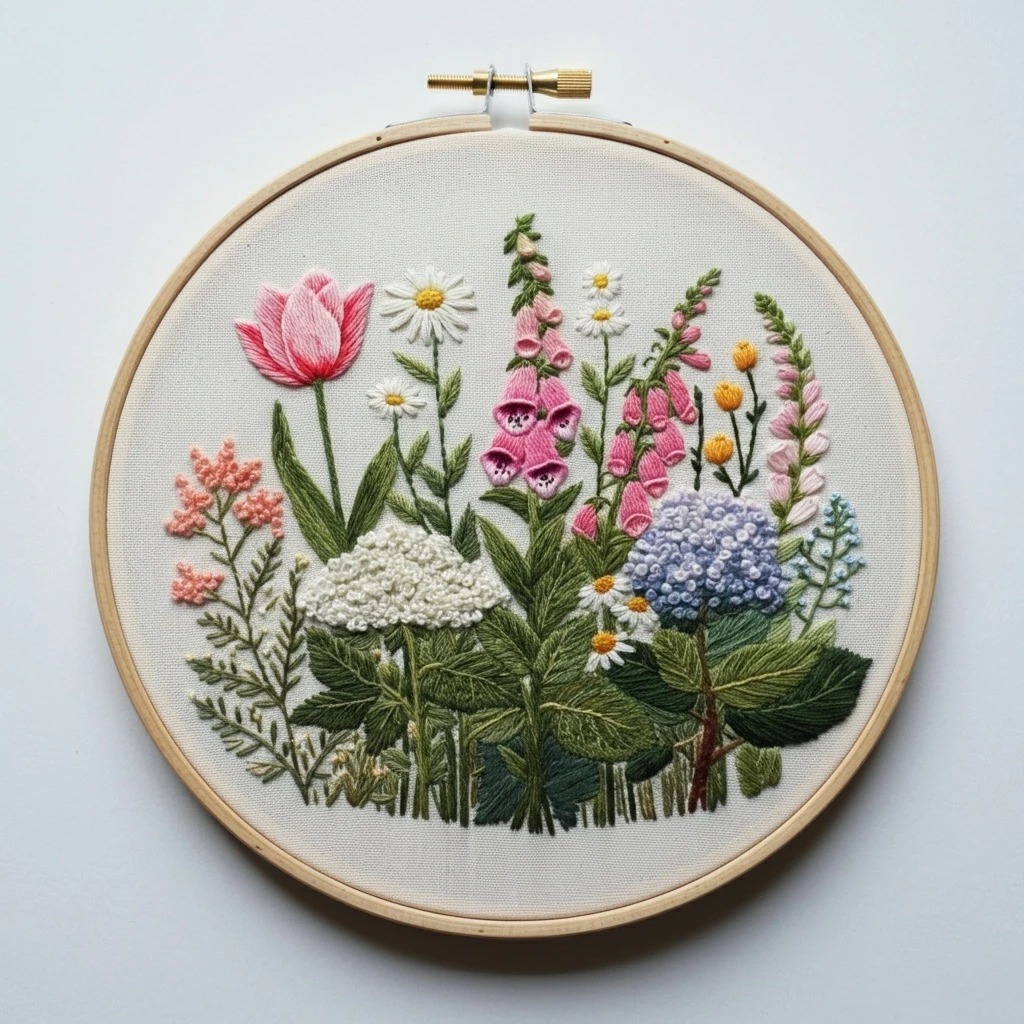
Embroidered Garden Floral Hoop
A lush round-hoop garden design with a pink tulip, foxglove bells, white daisies, coral filler blossoms, rounded hydrangea clusters, and dense layered greenery. The palette below is estimated from the visible embroidery preview and translated into practical DMC stranded-cotton choices for a soft botanical finish.
Likely DMC Color Palette
Coverage is a visual estimate rather than exact thread usage. The design relies on quiet green layering, rosy-pink petal shading, white daisy contrast, and small raised knots for the hydrangea and filler blossoms.
Stitching Suggestions
Keep the big flower shapes smooth, then contrast them with knotty flower heads and fine airy stems. Most of the charm comes from alternating dense leaves with tiny open negative spaces.
| Element | Best stitch | How to work it |
|---|---|---|
| Tulip and large pink bloom | Long-and-short stitch with split-stitch outline | Use 2 strands for the fill. Angle each stitch from petal base to tip, changing from 3687/3688 at the base to 3689 or 899 at the lip. |
| Foxglove-style bell flowers | Padded satin, detached chain, and tiny backstitch | Make each bell as a curved satin-fill pouch; add one dark pink stitch inside the throat so the flowers look hollow. |
| Daisies | Lazy daisy or straight stitch petals with French-knot centers | Work petals in 1-2 strands of 3865. Place 3078 first for the center, then dot a few 782 knots over it for warmth. |
| White hydrangea mound | French knots, colonial knots, or seed stitch | Cluster 1-wrap knots in 3865 and add a few pale green shadow stitches underneath so the white mass does not look flat. |
| Blue-lavender hydrangea | French knots with mixed blue-violets | Blend 156 and 340 in scattered knots; keep lighter knots near the upper-left and deeper knots near the lower-right. |
| Large leaves | Fishbone stitch and long-and-short stitch | Use 2 strands. Work the central vein first, then stitch diagonally toward the edge so the leaves read as folded and ribbed. |
| Fine ferny sprays | Stem stitch with single straight leaves | Use 1 strand of 3052 or 3011 for airy side foliage; avoid overfilling so the delicate stems remain botanical. |
| Coral side blossoms | French knots and tiny straight stitches | Use 353 for raised buds, then anchor each cluster with muted green branching in 1 strand. |
| Grounding stems at base | Straight stitch, split stitch, and couching | Stitch the vertical stems last around the leaf base; vary greens so the lower edge stays natural instead of one solid band. |
Thread Count, Blending & Shading
Strand guidance
- Use 2 strands for most petals, large leaves, and satin-filled bell flowers.
- Use 1 strand for fine stems, leaf veins, petal outlines, and small internal flower marks.
- Use 2-3 strands only for French knots that need a plump hydrangea or berry-like texture.
Blending ideas
- For pink flowers, thread one strand of 3688 with one strand of 3689 for soft mid petals.
- For darker petal cups, blend 3687 with 3688 and keep the darker strand closest to the flower center.
- For sage greenery, alternate 3363 and 3052 instead of blending every stitch; it gives a more natural garden rhythm.
Outlining details
- Outline the tulip with split stitch before filling so the petal edge remains crisp.
- Use dark green sparingly around leaf overlaps; too much outline can make the garden look heavy.
- Backstitch tiny foxglove throats with 3687 or one touch of brown-purple for a shadowed opening.
Texture notes
- Work the hydrangea clusters with varied knot sizes so they read as rounded blooms.
- Use straight stitches of different lengths for the grass-like base; avoid a perfectly even lower edge.
- Add daisy centers after the petals so the knots sit proudly on top.
Beginner-Friendly Working Order
Lightly stitch the main stems and central veins first so every flower has a clear anchor.
Stitch the tulip, large leaves, and foxglove bells before adding tiny details.
Build the white and blue hydrangeas with knots, placing lighter knots on top and darker ones below.
Add daisies, coral knots, leaf veins, and final outlining as the last pass.
Finishing Notes
This garden hoop looks best when the greenery feels layered rather than flat. Let the darkest greens form the shadowed base, reserve winter white for crisp daisy petals and hydrangea highlights, and keep pink shading directional so each bloom has a natural cup, fold, or bell shape.