
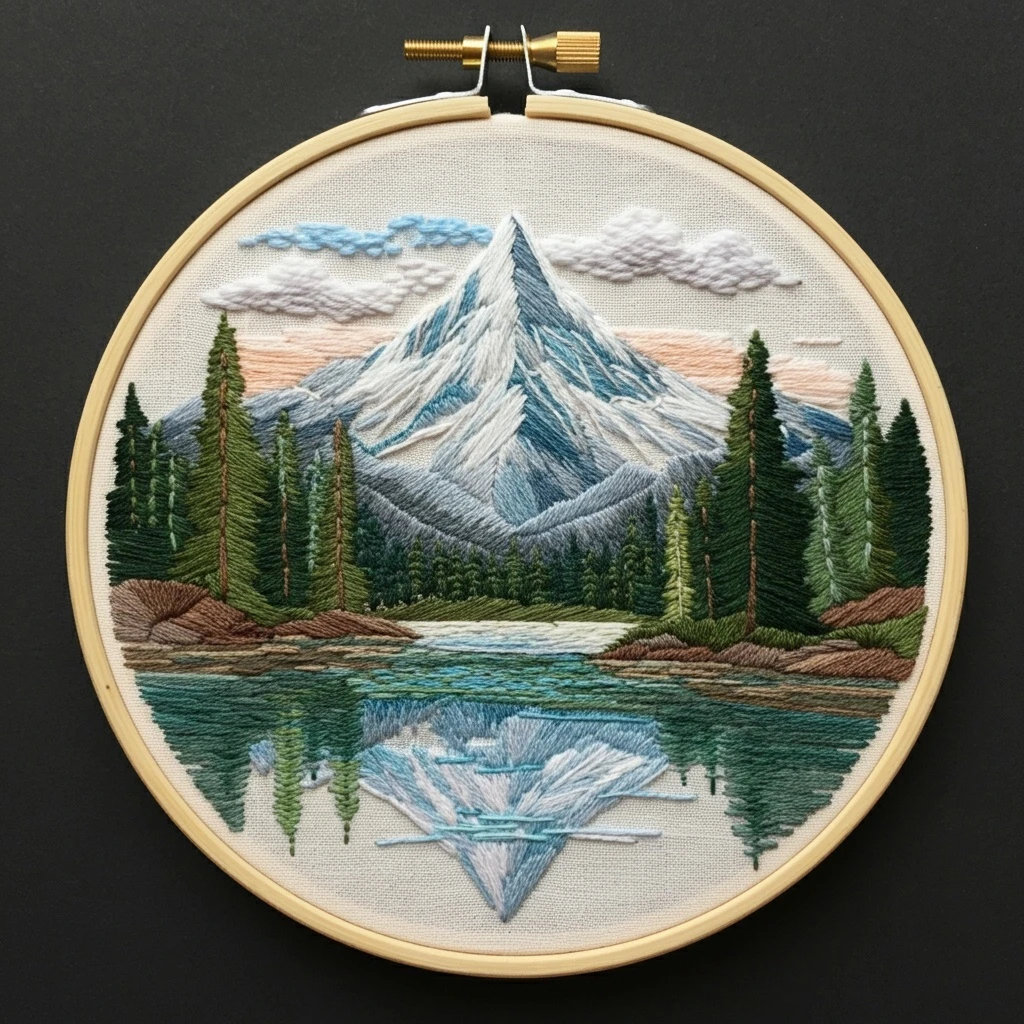
Embroidered Mountain Landscape With Reflection
A polished stitching guide for a hoop scene with snow-capped peaks, layered pine forest, calm teal lake water, mirrored mountain reflections, soft clouds, rocky shoreline, and a warm dawn glow.
Design color story
The reference design is built around crisp snowy whites, cool blue-gray mountain shadows, deep pine greens, teal lake water, earthy brown banks, and a quiet peach horizon. Keep the center mountain high-contrast, then soften the lower reflection with lighter thread counts and slightly broken lines.
Brightest snow caps, cloud highlights, and tiny glints on the lake surface. Use sparingly so it remains the brightest accent.
Soft snow shadows, misty cloud underside, and pale reflected mountain planes.
Cool mountain mid-tones, distant slope haze, and pale water ripples.
Blue-green creases on the peak and darker mirrored facets in the lake.
Deep mountain ravines, lake depth near the shoreline, and contrast behind snow ridges.
Primary lake band, dark evergreen masses, and shadowed forest base.
Tall pine silhouettes, deepest tree cores, and crisp edge accents around the waterline.
Mid green pine branches, far forest texture, and mossy ground planes.
Sunlit tree tips and reflected lighter foliage in the water.
Rock outlines, bank shadows, tree trunks, and grounding lines under the forest.
Warm rocks, exposed shoreline, and softened land reflections.
Subtle sunrise band behind the mountain. Stitch with 1 strand so it stays atmospheric.
Stitch map by design element
Snow-capped mountain
Use long and short stitch following the slope direction. Work from the ridge line outward: B5200 for crisp snow, 762 for soft breaks, 927/926 for blue-gray shadow gullies, and 924 only in the deepest creases.
Pine forest
Build trees with stacked fly stitches, fishbone stitch, or short diagonal straight stitches. Use 890 for silhouette centers, 501 for lower shadow, and 3051/3052 on branch tips facing the open sky.
Lake & reflection
Use horizontal satin, split, or stem lines. Reflections should be looser and more broken than the real mountain: alternate 927, 926, 501, and B5200 in uneven short strokes.
Clouds and sky
Keep clouds fluffy with French knots, seed stitch, or loose chain clusters. Add peach horizon lines with 1 strand of 948 and a few pale blue stitches for cool sky balance.
Rocky shore
Outline rocks in 839, fill with angled satin or split stitch in 3862, and add a few dark underside stitches where banks meet water.
Hoop composition
Preserve open fabric at the lower reflection and sky edges. The unstitched linen acts as mist, helping the dense central scene stay readable.
Thread-count guidance
Recommended strand counts
- 1 strand: peach sky lines, distant ridges, reflection details, delicate cloud shadows.
- 2 strands: most mountain shading, lake ripples, medium tree details, rocks.
- 3 strands: foreground pines, darkest forest bases, bold waterline accents.
- 4 strands: optional only for chunky cloud knots or very bold foreground texture.
Needle & fabric
- Use a size 7-9 embroidery needle for 1-2 strands and a size 5-6 for thicker pine areas.
- Natural beige linen, cotton-linen, or tightly woven calico enhances the outdoor scene.
- Keep the hoop drum-tight; landscape satin stitches look cleaner when tension is even.
Blending and shading ideas
For a painterly landscape, blend nearby DMC shades inside one needle rather than making hard color blocks.
Reflection rule
Repeat the mountain colors below the waterline, but reduce each area by one strand and stitch horizontally. This makes the reflection feel watery instead of like a second solid mountain.
Beginner-friendly stitching order
Transfer the main shapes lightly
Mark the mountain ridge, tree line, shoreline, and reflection boundary. Avoid heavy transfer marks in the sky and water.
Stitch the background first
Add clouds, peach horizon, and distant blue-gray ridges before the foreground trees cover any joins.
Build the mountain in directional layers
Follow the natural slopes with long and short stitch, alternating snow and shadow colors in slim wedges.
Add forest mass and trunks
Place dark pine silhouettes first, then add lighter branch strokes on top. Use brown trunks only where they improve definition.
Finish water and reflection last
Use calm horizontal stitches and leave small gaps of fabric between ripple lines for sparkle.
Outlining, texture & finishing tips
Outlining details
Use split stitch with 1 strand of 924 or 839 only where the image needs clarity: mountain ridge, tree bases, rock edges, and narrow shoreline. Avoid outlining every snow patch.
Texture choices
Combine smooth satin for water, long and short stitch for mountain planes, fly stitch for pines, seed stitch for distant forest, and French knots for soft cloud clumps.
Practical finishing
Press from the back on a towel, trim loose dark threads behind pale sky areas, and lace the fabric neatly so the circular landscape sits centered in the hoop.