
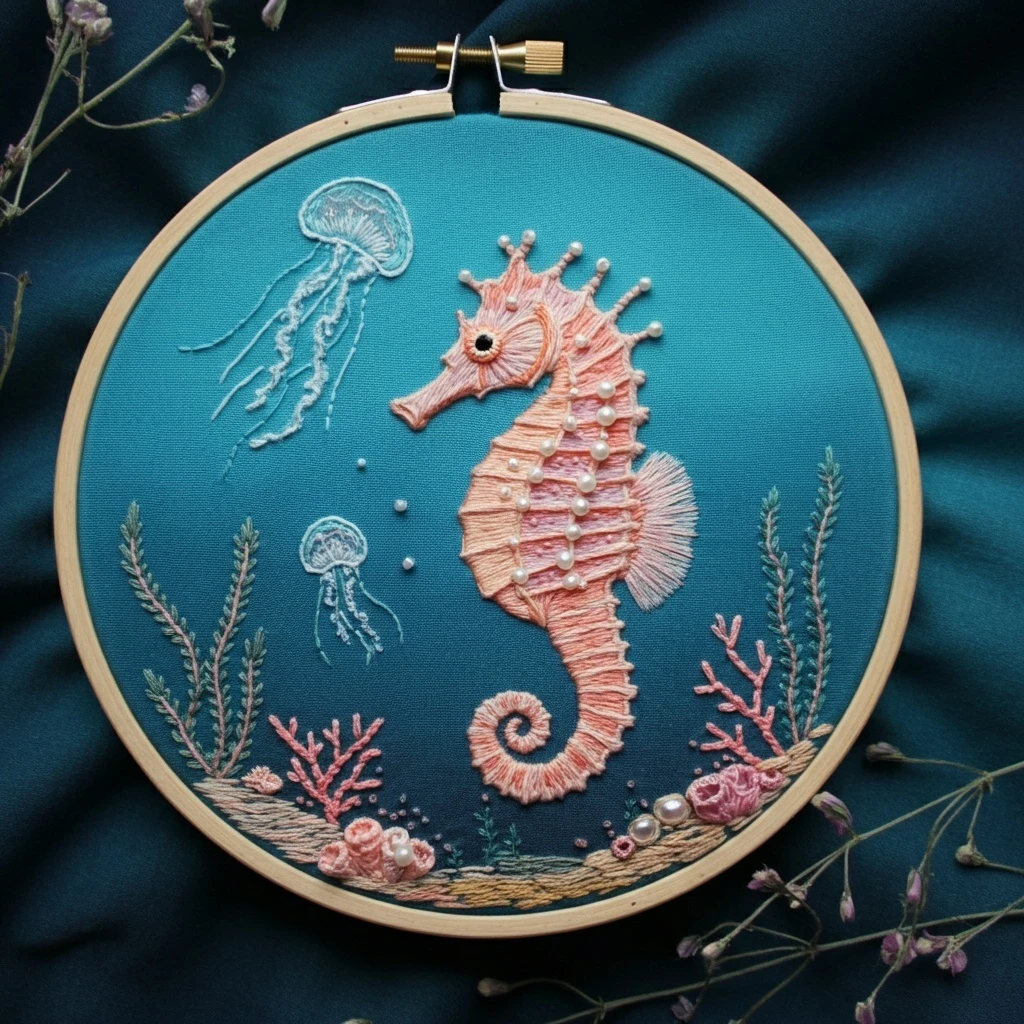
Embroidered Seahorse & Jellyfish Underwater Fantasy
A soft ocean-hoop palette built around coral-pink seahorse ridges, airy translucent jellyfish, teal sea cloth, pearl bubbles, branching coral, seaweed sprigs, shells, and sandy reef texture.
Polished DMC Color Palette
Use these shades as a practical working palette. The design benefits from warm coral values against a cool teal ground, with pale aqua highlights to keep the jellyfish light and translucent.
Stitch Plan by Design Element
Build the embroidery from background details forward: sea plants and jellyfish first, sandy reef next, then the seahorse body, finishing with pearls, bubbles, and final outlining.
| Area | Recommended stitches | Thread guidance |
|---|---|---|
| Seahorse body | Long and short stitch for the body fill, satin stitch for raised belly plates, split stitch for rib outlines, and whipped back stitch along the snout. | Use 2 strands for fill, 1 strand for delicate facial lines, and 3 strands only on the strongest belly ridges. |
| Dorsal fin | Straight stitches radiating from the body edge, with a fine back stitch arc at the base. | Blend 1 strand 353 + 1 strand 3766 for a translucent peach-blue fin effect. |
| Jellyfish bells | Split stitch outline, light satin arcs, and tiny straight stitches radiating inside the bell. | Keep to 1 strand for transparency; add a few 3865 highlights last. |
| Jellyfish tentacles | Loose stem stitch, couching for long floating strands, and tiny French knots for frilly oral arms. | Use 1 strand so the tentacles look airy rather than rope-like. |
| Seaweed | Stem stitch for stalks, fly stitch and detached chain for side leaves. | Use 2 strands for main stems and 1 strand for tip leaves. |
| Branching coral | Whipped back stitch or raised stem stitch with small straight-stitch branches. | 2 strands of 352; add 351 only underneath or at branch forks. |
| Sandy reef | Layered running stitch, seed stitch, couching, and short horizontal straight stitches. | Mix 842 and 3828; vary strand count between 1 and 3 for natural texture. |
| Pearls and bubbles | French knots, colonial knots, seed beads, or small pearl beads secured with a cross stitch. | Use 3865 or 762 for stitched bubbles; choose beads for dimensional pearls. |
Blending, Shading & Texture Suggestions
The reference has strong dimensional contrast: a plush coral seahorse, misty jellyfish, and textured reef floor. These combinations help recreate that layered underwater look.
Suggested blends
Shading sequence
- Map the seahorse ridges first with light split stitch, then fill between them using short long-and-short stitches.
- Place darkest coral only in the underside of the snout, under belly ridges, and inside the tail curl.
- Keep jellyfish softer than the seahorse: thin lines, open spaces, and small white highlights are enough.
- Add pearls and bubbles after all thread work so they sit cleanly on top of the stitched surface.
Thread Count & Practical Working Notes
These settings keep the design crisp on teal fabric while preserving the delicate fantasy feel of the jellyfish and underwater plants.
Outlining
Use 1 strand for the jellyfish and small plant details, 2 strands for the seahorse outline, and a whipped line on the snout if you want it to look slightly raised.
Filling
Use 2 strands for long-and-short shading on the seahorse. For satin belly plates, keep stitches short and slightly angled so the ribs follow the curve.
Texture
Scatter seed stitches at the reef base in 842, 3828, and 762. Keep them uneven: clustered near shells and sparse toward open water.
Beads
For pearl dots, use small pearl beads secured with two passes of 3865 or matching beading thread. Do not pull too tightly or the fabric will pucker.
Needle choice
A size 7 or 8 embroidery needle works for most stitching. Switch to a beading needle for pearls and a sharper needle for dense satin sections.
Hoop tension
Keep the teal fabric drum-tight before adding beads. Re-tighten after large filled areas because long-and-short stitch can relax the fabric slightly.
Beginner-Friendly Order of Work
Follow this order to reduce snagging and keep the most dimensional details neat.
- Transfer the pattern lightly; use a white or pale aqua transfer line on dark teal fabric.
- Stitch the jellyfish first with 1-strand pale aqua and white, leaving long tentacles loose-looking but securely anchored.
- Complete seaweed, coral branches, shells, and sandy base before the large seahorse so your hand does not crush raised stitches.
- Fill the seahorse body from light to dark, following the curve from head to tail with smooth directional stitches.
- Add rib outlines, fin rays, eye details, pearls, bubbles, and any final sparkle knots last.