
DMC Palette & Embroidery Notes
Embroidered Shiba Inu Portrait With Cherry Blossoms
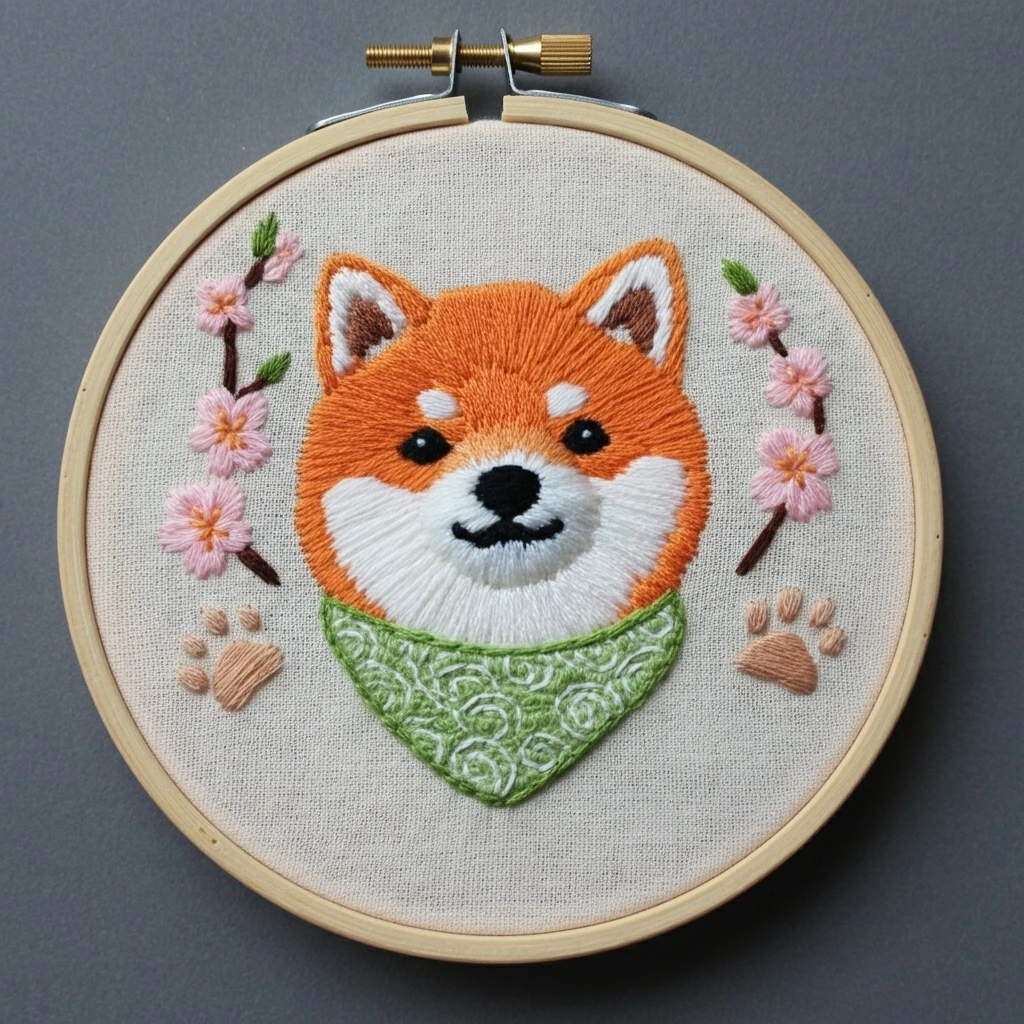
A warm, cheerful hoop design with a fox-red Shiba face, soft cream muzzle, glossy black features, spring cherry blossoms, leafy branches, little paw prints, and a patterned green bandana. The palette below is tuned for a natural pet-portrait look with clear beginner-friendly stitch planning.
Design Color Read
Fur & face
The Shiba’s head is built from copper orange, russet, golden brown, cream, white, and a few warm shadow tones. Keep the stitch direction radiating from the center forehead and cheeks so the portrait feels fluffy rather than flat.
Florals & branches
The cherry blossoms sit in airy pink clusters on dark brown stems with small green leaves. Use lighter pink at petal tips and stronger pink at the flower centers for definition.
Bandana & paws
The green bandana contrasts the orange face. A scrolling vine pattern works best with pale green or white details over a medium leaf-green fill. Peachy paw prints echo the portrait’s warmth.
Suggested DMC Floss Palette
Choose these as close practical matches for the pictured design. Adjust one step lighter or darker if your fabric is brighter, darker, or strongly textured.
DMC 921 — Copper
Main Shiba coat, ear edges, outer cheek areas, warm forehead strokes.
DMC 922 — Light Copper
Mid-tone fur transitions and blended highlights over the orange coat.
DMC 920 — Medium Copper
Darker fur shadows around ears, face outline, and lower cheek edges.
DMC 898 — Very Dark Coffee Brown
Inner ear depth, branch shadows, and tiny dark accents around flower stems.
DMC B5200 — Snow White
Bright muzzle, inner ear highlights, brow patches, and eye sparkle dots.
DMC 3865 — Winter White
Soft cream-white fur under B5200 to reduce harsh contrast in the muzzle.
DMC 644 — Medium Beige Gray
Subtle muzzle shadows, lower face curve, and definition between white fur strokes.
DMC 310 — Black
Eyes, nose, smile line, and crisp final outlines where needed.
DMC 818 — Baby Pink
Light cherry blossom petals and soft petal tips.
DMC 151 — Very Light Dusty Rose
Petal shadows, overlapping flower folds, and blossom centers.
DMC 3854 — Light Autumn Gold
Tiny blossom centers and a few warm accents in the flower cluster.
DMC 704 — Bright Chartreuse
Fresh leaves and light green bandana highlights.
DMC 702 — Kelly Green
Main bandana fill, leaf bases, and stronger green outlines.
DMC 772 — Very Light Yellow Green
Swirled bandana pattern and soft leaf highlights.
DMC 407 — Desert Sand
Peach paw pads and optional soft shading at the edge of the muzzle.
DMC 938 — Ultra Dark Coffee Brown
Cherry branch structure and deepest ear/outline accents when black is too strong.
Stitch Plan by Design Area
| Area | Best stitches | Practical notes |
|---|---|---|
| Orange Shiba coat | Long-and-short stitch, split stitch guide lines | Use 1 strand for realistic fur. Change direction at the forehead, cheeks, and ears so the face keeps its rounded shape. |
| White muzzle and cheeks | Long-and-short stitch, satin stitch for small patches | Blend B5200 with 3865 and a few 644 shadow stitches near the mouth curve. Keep strokes slightly curved and downward. |
| Eyes, nose, mouth | Satin stitch, padded satin, tiny French knot or straight stitch highlight | Use 2 strands of black for a glossy nose. Add one tiny white highlight only after the black area is complete. |
| Cherry blossoms | Lazy daisy, straight stitch petals, French knots | Work petals with 2 strands. Add dusty rose near the petal bases and autumn gold knots in the center. |
| Branches and leaves | Stem stitch, backstitch, fishbone stitch | Branches look more organic when stitched in dark brown with slight bends. Leaves can be fishbone or simple satin shapes. |
| Green bandana | Satin stitch, split stitch outline, couching or backstitch scrolls | Fill with green first, then add pale scroll lines over the top. Keep pattern stitches loose enough that the fabric does not pucker. |
| Paw prints | Satin stitch, padded satin stitch | Use 2 strands of desert sand. Pad the main paw pad with one base layer if you want a raised, plush look. |
Thread Counts, Blending & Shading
Thread-count guide
- 1 strand: fur shading, muzzle texture, tiny facial corrections, and fine bandana scrolls.
- 2 strands: blossom petals, leaves, branch lines, paw pads, and the clean green bandana edge.
- 3 strands: only for bold outer accents or if the finished hoop will be viewed from a distance.
Blending ideas
- Blend one strand DMC 921 with one strand DMC 922 for a lively copper midtone.
- Blend one strand DMC 3865 with one strand DMC 644 for soft muzzle shadow without making the face gray.
- Blend one strand DMC 818 with one strand DMC 151 for cherry petals that feel dimensional but delicate.
- For the bandana, mix DMC 702 and 704 in alternating rows before adding DMC 772 scrollwork.
Texture & Finishing Suggestions
Soft fur texture
Use staggered long-and-short rows rather than blocks of satin stitch. Let a few copper stitches overlap into the cream areas to create a natural transition around the cheeks.
Clean outlines
Outline the face with split stitch in a darker copper, not black, so the portrait stays warm. Reserve black for the eyes, nose, and mouth.
Dimensional flowers
Stitch petals from outer tip toward center. Add French knots last, after the branch and petal stitches are secure, to keep the blossoms crisp.
Practical hoop advice
- Use a medium-weight linen or cotton-linen blend so the dense Shiba face has enough support.
- Keep the fabric drum tight; fur fill areas can pull the cloth if the hoop loosens.
- Start with the face outline, then stitch large fur zones, then flowers, bandana details, facial features, and final highlights.
- Step back every few rows to check symmetry in the eyes and muzzle before adding the darkest details.
- Press only from the back on a folded towel so raised satin stitches, French knots, and padded paw pads are not flattened.