
DMC color palette & stitching notes
Embroidered Sunset and Wildflowers
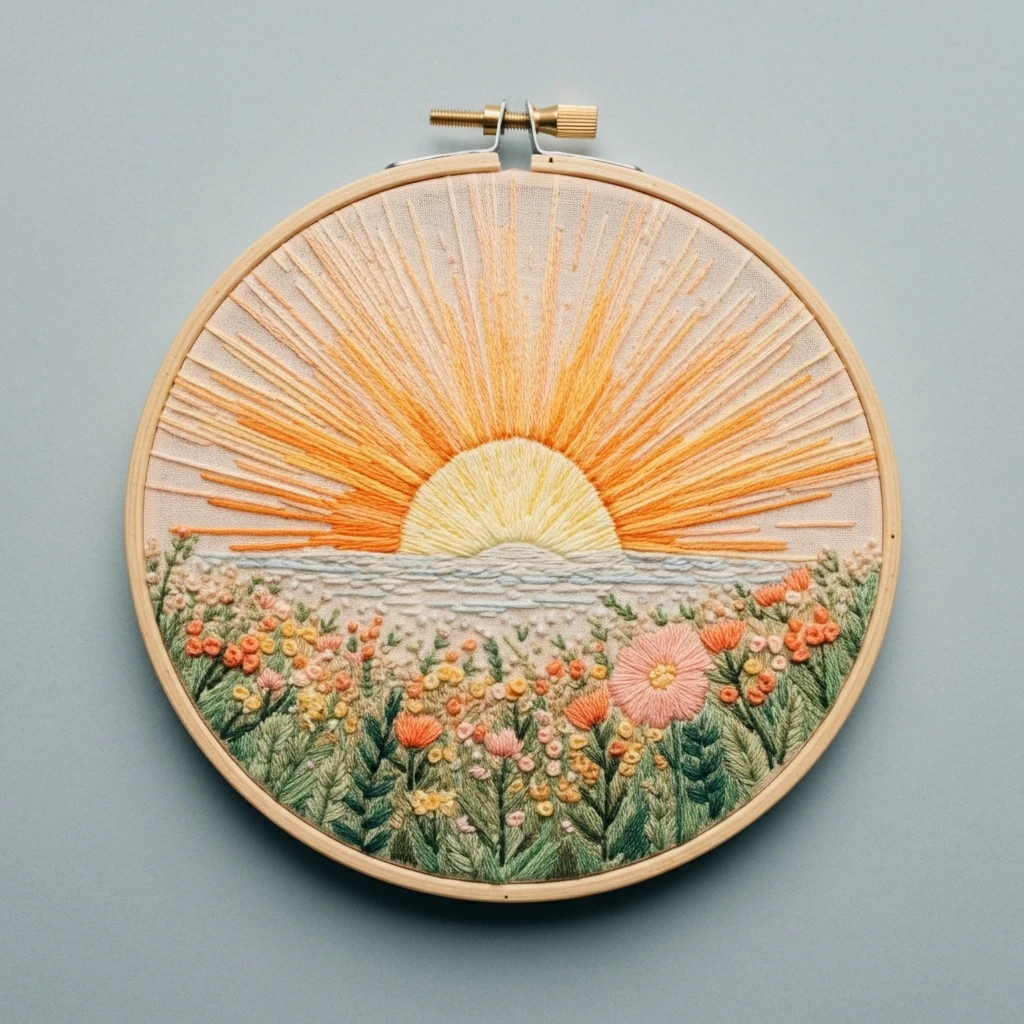
A warm hoop-art landscape with a low glowing sun, long radiating sunset rays, a soft horizon line, and a dense foreground meadow of yellow, coral, peach, pink, sage, and deep green wildflowers.
Recommended DMC palette
These colors are selected to echo the reference: pale linen sky, golden sun, orange rays, misty blue waterline, cream seed flowers, coral blossoms, pink daisy petals, and layered greens in the meadow.
Stitch map and thread-count guidance
Sun and rays
Use long straight stitch from the sun outward, changing length so the rays feel hand-drawn rather than perfectly even. Work with 2 strands for the main rays and 1 strand for pale filler rays. Blend DMC 3823 + 746 at the sun top, then shift to 742, 741, and 740 nearer the lower rays.
Horizon and waterline
Use relaxed stem stitch or split back stitch in DMC 926 with tiny broken running stitches in 746. Keep the horizon slightly uneven; the reference reads as soft ripples, not a hard border.
Wildflower meadow
Layer from back to front: 1-strand random straight stitches in 3013, then 2-strand stems in 3052 and 3363. Add French knots, lazy daisies, detached chain petals, and small satin-stitch flower heads in 742, 741, 761, 352, and 746.
Foreground leaves
Use fishbone stitch for larger leaves, fly stitch for ferny sprigs, and couching for tall curved stems. Reserve DMC 3362 for the lowest shadows so the meadow keeps depth without becoming muddy.
Practical stitch suggestions
| Design area | Best stitches | How to handle it |
|---|---|---|
| Sun disk | Long and short stitch, satin stitch, split stitch outline | Outline the semicircle first with 1 strand of 742, then fill vertically with 2 strands. Mix 3823 and 746 near the top for a creamy glow. |
| Radiating sky | Long straight stitch, couching, seed stitch | Start each ray close to the sun, but leave a few gaps so the fabric color becomes part of the sky. Add the palest rays last with 1 strand. |
| Water/horizon | Stem stitch, whipped running stitch, tiny back stitch | Use short horizontal strokes. Keep thread tension loose to avoid puckering across the hoop width. |
| Small flower clusters | French knots, colonial knots, seed stitch | Work clusters in odd numbers. Combine 742, 741, 352, and 746 for a natural field effect. |
| Large daisy/poppy blooms | Detached chain, satin stitch, straight stitch spokes | Use 2 strands for petals, 1 strand for petal veins, and a small knot cluster in 742 or 3823 for centers. |
| Grasses and stems | Straight stitch, fly stitch, fishbone stitch, back stitch | Vary green values by layer: pale grasses first, mid greens for leaves, dark pine only at the bottom and behind flowers. |
Blending, shading, and texture tips
- Sun glow: blend one strand DMC 3823 with one strand DMC 746 for the softest highlight, then switch to two strands of 742 for warmth.
- Orange rays: use 741 for the general rays and add selective 740 only near the sun base and horizon, where the reference is most saturated.
- Petal dimension: place 761 on the petal tips and 352 at the base; one or two tiny straight stitches in 746 make the flower feel sunlit.
- Meadow depth: stitch distant grasses with 1 strand and foreground grasses with 2 strands. This simple thread-count change creates perspective.
- Outlining: keep outlines soft. Use split stitch rather than heavy back stitch around the sun, and avoid outlining every flower so the foreground remains airy.
- Texture control: use a mix of French knots and small straight stitches instead of filling every blossom with satin stitch; this keeps the meadow lively and beginner friendly.
Beginner-friendly order of work
- Transfer the sun, horizon, main flower stems, and a few large blossoms only. Leave tiny filler flowers freehand.
- Stitch the sun disk first, then the longest rays, rotating the hoop often so each ray is comfortable to stitch.
- Add the horizon and water ripples before the meadow; this prevents green stitches from crowding the clean line.
- Build the meadow in layers: pale background grasses, mid green leaves, dark foreground stems, then flowers last.
- Finish with scattered knots and tiny highlights. Stop before the meadow looks completely filled; open fabric spaces help the design breathe.