
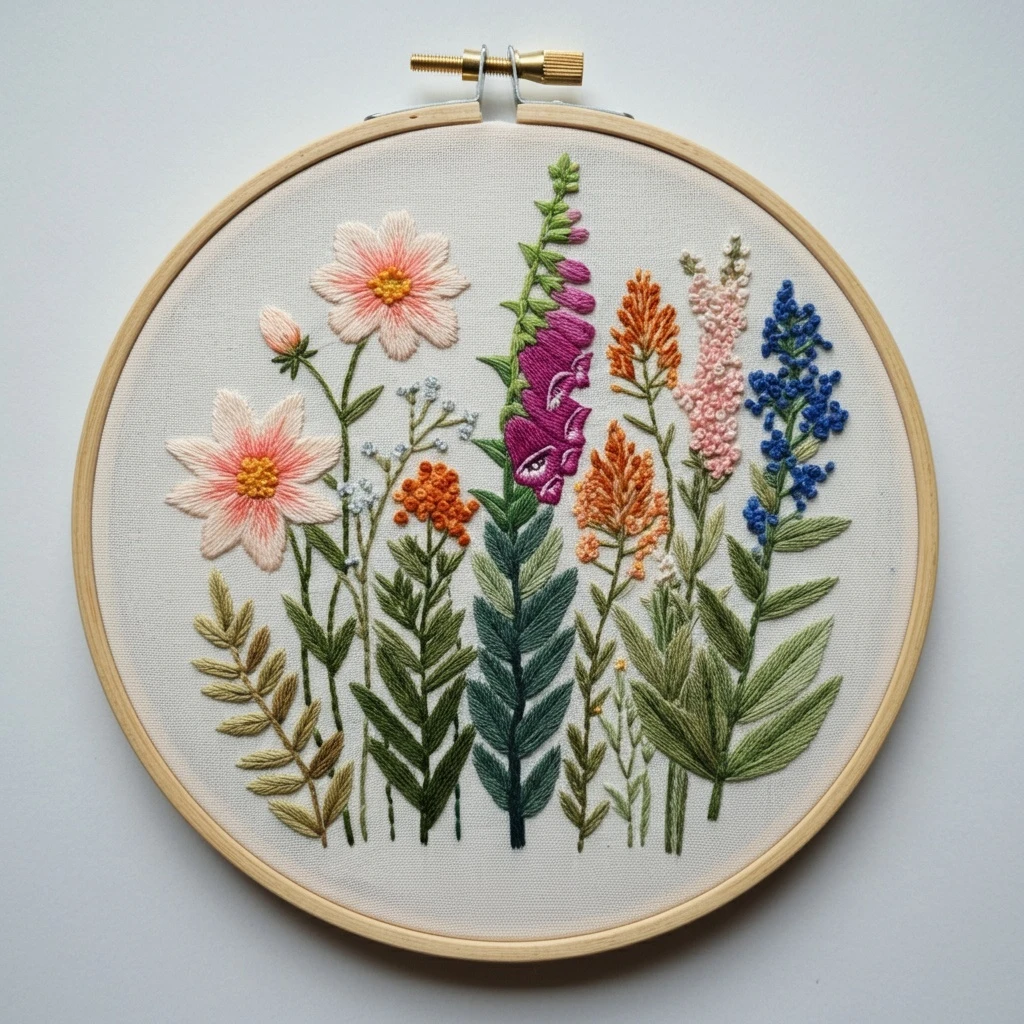
Embroidered Wildflower Meadow In Hoop
A soft meadow arrangement with pale blush daisies, coral-pink shading, magenta foxglove bells, orange seed heads, blue berry-like blossoms, pale pink flower spikes, silvery baby’s breath, and layered green foliage on warm neutral fabric.
Likely DMC Color Palette
The design needs a wide meadow palette: creamy petal highlights, peach-coral centers, bright yellows, saturated magenta, warm orange, blue-violet accents, silvery gray-blue sprigs, and several greens for believable stems and leaves.
Main highlight for the pale daisy petals; place on petal tips and outer edges for clean, luminous flower shapes.
Soft pink underlayer for daisy petals and the tall pale flower spike; blend lightly into cream for a delicate meadow look.
Coral shading at daisy throats; use short stitches radiating outward so the color fades naturally into pale petals.
Bright yellow French knots for daisy centers and tiny scattered yellow buds.
Deeper gold for shadow knots in flower centers and warm specks inside orange clusters.
Main tone for orange plume flowers and round berry clusters; works well as padded satin, straight stitch, or French knots.
Highlight on orange flower tips and the forward-facing berry knots so the clusters do not look flat.
Primary color for the tall foxglove-like bloom; concentrate in the bell openings and lower petal shadows.
Highlight strokes on magenta bells and small buds near the upper stem; blend with darker plum for rounded petals.
Pale pink clustered flower spike; use as the main knot color with a few cream highlights.
Deep blue bead-like blossoms on the right; ideal for French knots or colonial knots.
Small highlights on blue knots and cooler accent stitches within the blue flower spray.
Tiny pale baby’s-breath flowers and cool highlights on small gray-blue sprigs.
Muted stems and small airy flower branches where the design needs a soft background note.
Core stem color for the central meadow stems and darker leaf veins.
Fresh mid-green leaves, especially the upright sprigs and right-side blade leaves.
Olive transitions in fern-like foliage; balances the bright green without overpowering flowers.
Muted yellow-green for the dry fern on the left and sun-touched leaf tips.
Darkest accents in the central fern and lower stems; use sparingly to create depth.
Optional hoop-colored accent if adding a stitched rim, label, or warm neutral border detail.
Stitching Suggestions
This pattern will look best when the major flowers are smooth and directional, while the clustered blooms are raised and dotted. Keep the meadow stems narrow so the composition stays light.
| Design Element | Recommended Stitch | Thread Count & Practical Notes |
|---|---|---|
| Large pale daisies | Long and short stitch, satin stitch, or split stitch shading | Use 2 strands for petals. Work from the petal edge toward the center with DMC 3865 and 818, then add short coral DMC 353 strokes near the throat. Keep each petal direction separate so the flower looks softly ribbed. |
| Daisy centers | French knots or colonial knots | Use 2 strands, one or two wraps. Mix DMC 725 and 783, placing darker knots closer to the center shadow and brighter knots around the top edge. |
| Magenta foxglove bells | Padded satin stitch, long and short stitch, split stitch outlines | Use 2 strands of DMC 915 for the shadow base and DMC 3607 for lifted edges. Add tiny cream or pale pink curved stitches inside the bells to mimic the light markings visible in the preview. |
| Orange plumes and berry heads | Straight stitch, detached chain, French knots | Use DMC 921 as the main color and DMC 741 for highlights. For plume flowers, angle short straight stitches upward along the stem. For berries, cluster knots tightly but vary height and spacing. |
| Pale pink flower spike | French knots, seed stitch, tiny lazy daisy | Use 1–2 strands of DMC 761 with a few DMC 818 and 3865 accents. Build the spike in small uneven clusters, leaving slivers of fabric between knots for a natural, airy texture. |
| Blue meadow blooms | French knots, colonial knots, tiny straight stitches | Use 2 strands of DMC 798 for most knots, then touch the front-facing knots with DMC 809. Keep the green stem visible so the blue does not become a solid mass. |
| Baby’s breath and pale sprigs | Single-wrap French knots, seed stitch, backstitch | Use 1 strand for thin branches in DMC 927 or 3363 and 1 strand for tiny DMC 762 blossoms. These details should sit behind the larger flowers. |
| Central fern and layered leaves | Fishbone stitch, fly stitch, straight stitch | Use 2 strands for broad leaves and 1 strand for narrow stems. Blend DMC 500, 3363, 3346, and 3052. Place darker green at the center vein and lighter green along the outer leaf edges. |
| Fine meadow stems | Stem stitch, split backstitch, couching for very long stems | Use 1 strand for most stems. Switch between olive and pine greens so adjacent stems are distinct. Keep stems slightly uneven rather than perfectly parallel. |
| Dry left-side fern | Fishbone stitch or paired straight stitches | Use 1–2 strands of DMC 3013 with touches of 3052. Angle each leaflet from the central stem and leave tiny gaps at the tips for a dry botanical feel. |
Thread Count, Blending & Shading Plan
Use 2 strands for the large daisies. Blend DMC 3865 + 818 in adjacent stitches rather than twisting them together, then add coral DMC 353 only near the centers.
Use 1 strand for thin stems and 2 strands only for the strongest central stems. This keeps the meadow from looking heavy at the base.
Use 2 strands for raised knots. Make a few knots with one wrap and a few with two wraps so the orange, pink, and blue clusters have natural texture.
Start leaves with dark DMC 500 or 3363 on the center vein, fill with DMC 3346, and add DMC 3052 or 3013 on sunlit tips.
Use split stitch outlines only where needed: daisy petal separations, foxglove edges, and a few main leaf veins. Too much outlining will flatten the soft meadow effect.
Let some background fabric show between stems and flower clusters. The reference design has a breathable bouquet shape rather than a fully filled garden bed.
Where to Start
Work from the structural greens outward, then add the most dimensional knots last so they stay clean and raised.
Beginner-Friendly Practical Tips
- Use a sharp embroidery needle for split stitch and a slightly larger needle for French knots so the knots pass through fabric cleanly.
- Keep the fabric drum-tight in the hoop; loose fabric makes long petal stitches and leaf stitches pucker.
- For the daisy petals, stitch one petal at a time instead of circling the whole flower. This preserves each petal’s direction.
- When a stem sits behind a flower, stitch the stem first and let the flower cover the join.
- Do not pull French knots too tight. A raised, rounded knot gives the meadow flowers their charm.
- If a color feels too bright, add one strand of a softer neighboring shade in nearby stitches rather than removing the bright thread completely.
- Save the darkest greens and magentas for the last shading pass; a few small shadows are more effective than heavy dark fills.
Encouraging Finish
This wildflower meadow is all about contrast: soft shaded daisies, tall textured spikes, bead-like blue and orange knots, and many greens stitched in different directions. Build the bouquet slowly from stems to leaves to flowers, and let the small irregularities make it feel freshly gathered from a meadow.