
Embroidered Winter Mountain Lake Landscape
A polished DMC floss palette and practical stitch plan for a snowy hoop scene with layered mountains, evergreen forests, soft clouds, reflective lake water, and warm bark accents.
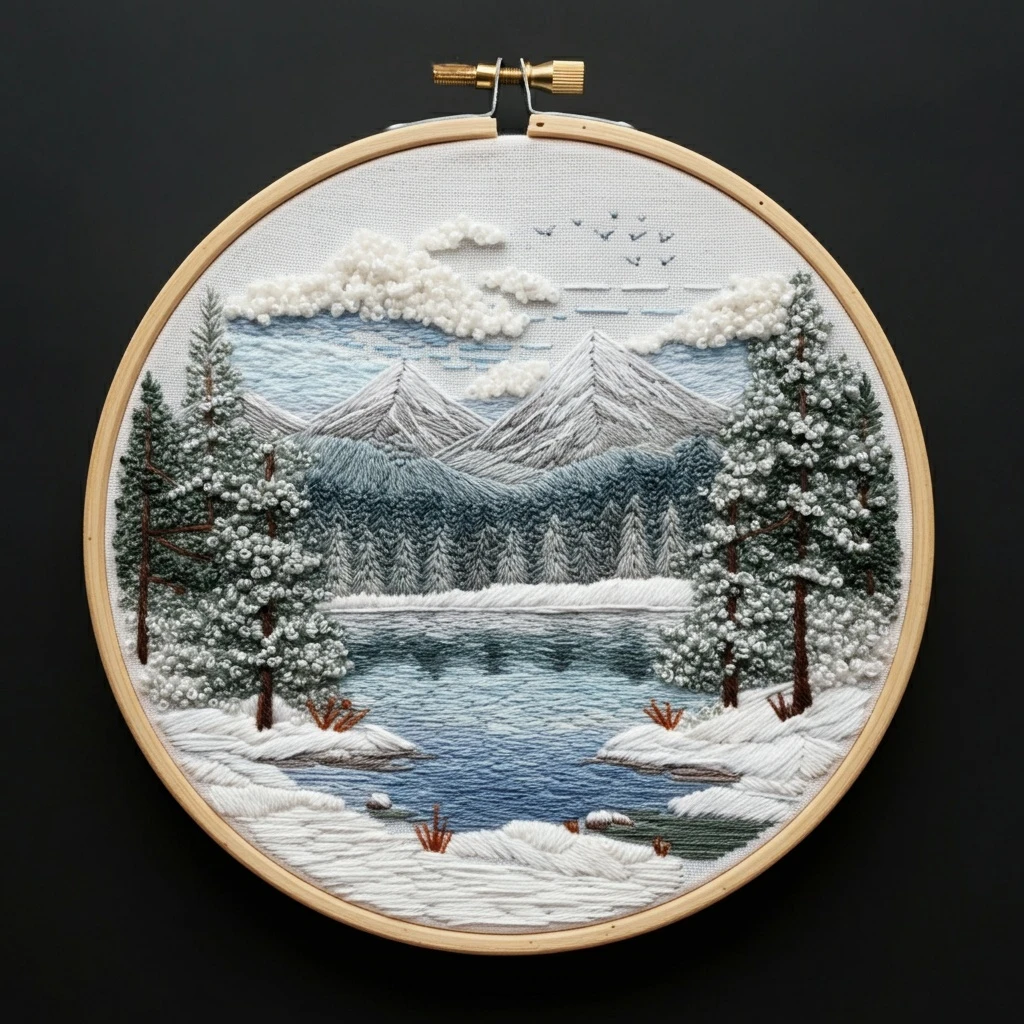
Preview image from the linked design reference. Colors are estimated from the visible stitched sample and matched to close DMC embroidery floss shades.
Design Color Read
This landscape is built from cool winter neutrals: ivory snow, pale gray mountain ridges, blue-gray sky, dark teal pines, slate lake reflections, and touches of warm brown for trunks and reeds. The main visual effect comes from directional stitch texture rather than saturated color.
Likely DMC Color Palette
Coverage percentages are visual estimates from the preview, not exact thread usage. Keep the palette cool and slightly muted so the white snow and dark trees remain the focus.
Stitching Suggestions
| Element | Stitch Type | Practical Notes |
|---|---|---|
| Snowbanks | Long satin stitch, long-and-short stitch | Follow the slope of each bank. Use 3865 for the base, B5200 on raised ridges, and 762 sparingly where snow folds turn away from the light. |
| Mountains | Straight stitch, split stitch, long-and-short stitch | Work from peak downward with angled strokes. Alternate 762, 415, and 168 to create rocky planes; keep a few crisp B5200 lines on the highest ridges. |
| Distant sky | Fine horizontal straight stitch | Use 1 strand of 927 and 932 with short broken lines. Leave tiny gaps of fabric showing so the sky stays airy and does not compete with the mountains. |
| Clouds | French knots, colonial knots, padded satin | Build the soft cloud masses with loose B5200 and 3865 knots. Add 762 underneath only where the cloud needs a shadowed base. |
| Evergreen forest | Fishbone stitch, straight stitch, fly stitch | Start with dark 500 in the tree centers, then layer 501 and 924 outward. Add white knots or tiny straight stitches last for snow sitting on branch tips. |
| Large foreground pines | Stem stitch trunk, fly stitch branches, French-knot snow | Use 898 for trunks and main branches. Stitch branches downward at a slight angle, then add snow in small uneven clusters instead of perfectly spaced dots. |
| Lake water | Horizontal straight stitch, split stitch, seed stitch | Keep stitches mostly horizontal. Blend 932, 3768, and 924, saving 3865/B5200 for narrow highlights near the shore and reflected snow. |
| Reflections | Short broken straight stitch | Mirror the dark tree shapes with soft, uneven horizontal dashes. Avoid outlining every reflection; broken marks look more like moving water. |
| Birds and fine horizon marks | Single-strand backstitch or tiny V stitches | Use 415 or 924 with one strand. Keep birds very small so they read as distant details rather than foreground motifs. |
| Reeds and exposed twigs | Straight stitch, stem stitch | Use 975 over 898 for warm tips. Add these accents after the snowbanks so the reeds sit visibly on top. |
Thread Count, Blending & Shading Guidance
Recommended strand counts
- 1 strand: birds, sky lines, mountain ridge outlines, fine needles, delicate lake ripples.
- 2 strands: most mountain filling, forest texture, shoreline shading, water midtones.
- 3 strands: padded snowbanks, bold foreground tree branches, heavier lake shadows.
- Full or 4+ strands: only for fluffy knot clusters if you want extra raised cloud and snow texture.
Useful blends
- 3865 + 762: quiet snow shadows without making the snow look dirty.
- 762 + 415: crisp mountain planes and distant ridge definition.
- 927 + 932: pale sky and soft reflected blue in the lake.
- 3768 + 924: layered lake depth and evergreen reflections.
- 500 + 501: dark pine centers with slightly lighter branch tips.
Beginner-Friendly Working Order
- Mark the horizon and mountain peaks first. These lines control the whole composition, so keep them clean and lightly stitched.
- Fill the sky and distant mountains. Work pale areas before dark trees so darker floss does not fuzz into the white snow.
- Add forest layers from back to front. Use lighter, thinner stitches on distant trees and darker, heavier stitches on foreground pines.
- Stitch the lake horizontally. Use short, uneven strokes; the water should look layered, not filled like a solid block.
- Finish with snow texture and accents. Add French-knot clouds, snow on branches, twig details, and tiny birds last.
Outlining, Texture & Finishing Tips
- Use very little hard outlining. This design looks most natural when boundaries are created by value changes and stitch direction.
- For snowy tree branches, do not cover every green stitch. Place irregular white knots on the outer branch shelves so the pines stay dimensional.
- Keep mountain stitches long and angled, but keep lake stitches short and horizontal. That contrast helps separate land from water.
- When shading snow, use pale gray in thin broken stitches rather than heavy solid patches. Winter whites should still dominate.
- Rotate the hoop while stitching the mountains and snowbanks. Pulling each stitch in the natural slope direction gives cleaner texture.
- Press from the back over a folded towel after finishing so raised knots and padded snow are not flattened.