
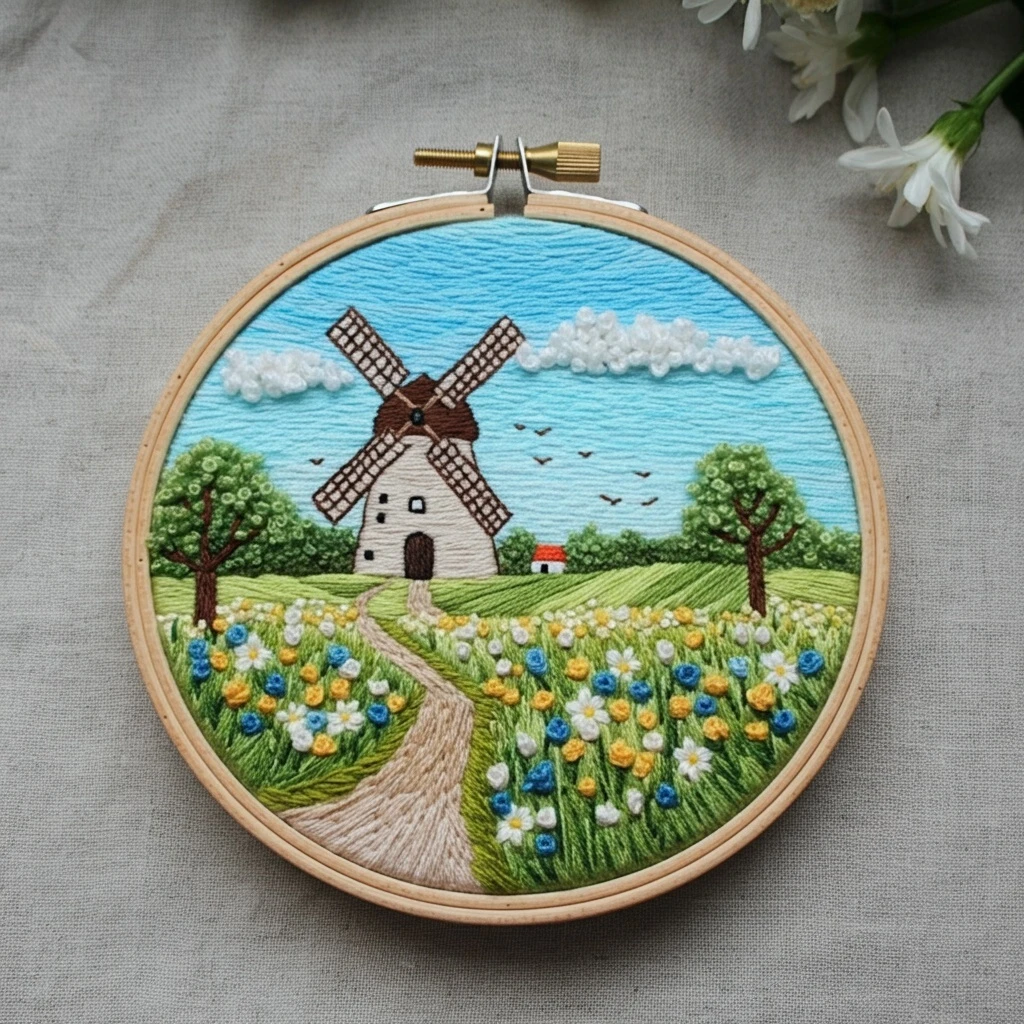
Design #816 · Landscape & Meadow
Enchanted Forest Clearing
A bright, storybook meadow scene with a pale windmill, curved pathway, rolling green field, fluffy clouds, dotted wildflowers, leafy trees, and a clear turquoise sky. The design relies on layered greens, crisp dark outlines, raised floral knots, and soft directional stitches to create depth inside the hoop.
Likely DMC Color Palette
The strongest color families are turquoise sky, light and deep grass greens, dark cocoa outlines, creamy windmill whites, tan path tones, white cloud texture, yellow daisy centers, and blue meadow blossoms. Coverage percentages are visual estimates, not exact thread usage.
DMC 3846 · Bright Turquoise Light
Use for the clear blue sky. Work long horizontal satin or split stitches so the sky reads smooth behind the clouds and windmill.
18% visual coverageDMC 747 · Sky Blue Very Light
Blend into the lower sky and around cloud edges to soften transitions without losing the bright spring atmosphere.
8% visual coverageDMC 3345 · Hunter Green Dark
Use sparingly for darker meadow blades, distant hedgerow shadows, and the undersides of leafy tree clusters.
12% visual coverageDMC 3347 · Yellow Green Medium
This is the principal grass shade. Stitch in curved rows that follow the hill slope and the path perspective.
15% visual coverageDMC 472 · Avocado Green Ultra Light
Add as short highlight strokes over the medium green, especially near the foreground flower stems and hill crests.
9% visual coverageDMC 3371 · Black Brown
Use one strand for crisp details: windmill blade grid, tiny birds, door shadow, and fine branch definition.
6% visual coverageDMC 898 · Coffee Brown Very Dark
Layer with black-brown for the windmill roof, tree trunks, and strong branch lines. Good for anchoring the composition.
7% visual coverageDMC 842 · Beige Brown Very Light
Use for the main path fill and subtle shaded strokes on the cream windmill walls.
8% visual coverageDMC 3865 · Winter White
Best for fluffy clouds, daisy petals, and the pale windmill. Combine smooth fills with raised knots for contrast.
9% visual coverageDMC 725 · Topaz Medium Light
Use for small meadow flowers and warm flower centers. One-wrap French knots keep the blooms tidy.
5% visual coverageDMC 3843 · Electric Blue
Creates the vivid cornflower-like dots in the foreground. Place slightly irregular clusters so the field feels natural.
5% visual coverageDMC 606 · Bright Orange-Red
Use as a small high-impact accent for the distant cottage roof. A single strand keeps it miniature and clean.
1% visual coverageStitching Suggestions
Work from background to foreground: sky first, then windmill and trees, then fields, path, flowers, and final outlines. This keeps raised knots and foreground grasses from being flattened while you stitch larger areas.
| Element | Stitch type | Practical notes |
|---|---|---|
| Blue sky | Long horizontal split stitch or satin stitch | Use 2 strands. Keep rows parallel and slightly staggered; blend DMC 3846 with 747 near the horizon and around cloud edges. |
| Fluffy clouds | French knots, colonial knots, or tight seed stitch | Use 2 strands of 3865. Vary one- and two-wrap knots for a soft puffed edge. Leave a few tiny gaps so the cloud stays airy. |
| Windmill body | Long and short stitch with split-stitch outline | Fill with winter white and beige shadows. Add the door and windows last with one strand of dark brown for clean shape definition. |
| Windmill blades | Backstitch grid over satin or straight stitches | Use 1 strand for the lattice. Stitch the blade arms first, then add short crossbars so the grid remains even. |
| Tree canopies | French knots, seed stitch, and tiny detached chains | Build from dark green underneath to lighter green on top. Cluster knots unevenly to suggest leaf masses rather than a solid circle. |
| Tree trunks and branches | Stem stitch and split stitch | Use 1-2 strands of 898 with 3371 only in the deepest forks. Taper branch ends by switching to one strand. |
| Rolling field | Directional long and short stitch | Follow the curve of the hills. Use 2 strands in the midground and 1 strand for fine foreground blades so the scene has scale. |
| Curving pathway | Split stitch fill with short straight-stitch texture | Use beige brown for the base, then add irregular darker tan strokes along the center curve to make the path recede. |
| Meadow flowers | French knots, lazy daisy, tiny straight stitches | Use 1-2 strands. Blue and yellow knots can be denser in the foreground; white lazy daisies should stay small and bright. |
| Distant birds | Single-strand fly stitch | Make each bird with one tiny shallow V. Keep spacing irregular and avoid oversized stitches in the sky. |
Thread Count, Blending & Shading Plan
Use 2 strands for main fills
Sky, meadow, path, windmill walls, and larger tree masses will cover neatly with two strands. Keep tension gentle so the surface stays smooth.
Switch to 1 strand for miniature detail
Birds, windows, windmill lattice, branch tips, roof accent, and fine grass blades need one strand so the design does not look heavy.
Blend greens directionally
Alternate 3347, 472, and 3345 in short rows. Angle the stitches toward the path or horizon to strengthen the landscape perspective.
Shade the windmill lightly
Use 3865 as the clean base, then place 842 only along the lower left wall, blade overlaps, and door edge. Too much tan will dull the focal point.
Keep flowers raised but controlled
Use one-wrap knots for most meadow dots and two-wrap knots only in the closest foreground. This creates depth without overcrowding the grass.
Outline after filling
Add the darkest browns after the windmill, trees, and path are filled. Late outlining sharpens the scene and hides tiny fill irregularities.
Texture & Dimension Notes
Make the clearing feel deep
- Use smoother, flatter stitches in the sky and distant hills.
- Increase stitch texture in the foreground with upright grass strokes and raised flower knots.
- Keep the distant cottage roof very small; the bright orange-red works best as a tiny accent.
- Place the path stitches in the direction of the curve to pull the viewer's eye toward the windmill.
Avoid common issues
- Do not overpack the sky; crowded horizontal stitches can buckle the fabric.
- Mark windmill blade angles lightly before stitching so the lattice stays symmetrical.
- Use shorter grass stitches near flower clusters to prevent knots from sinking into long thread lines.
- Save the white daisies and cloud knots for clean hands and a fresh needle to keep whites bright.
Finishing Advice
A landscape hoop like this looks most polished when the fabric stays taut and the details remain small. Re-tighten the hoop before the final pass, trim traveling threads behind white areas, and press from the back on a padded towel so raised clouds and flower knots keep their texture.