
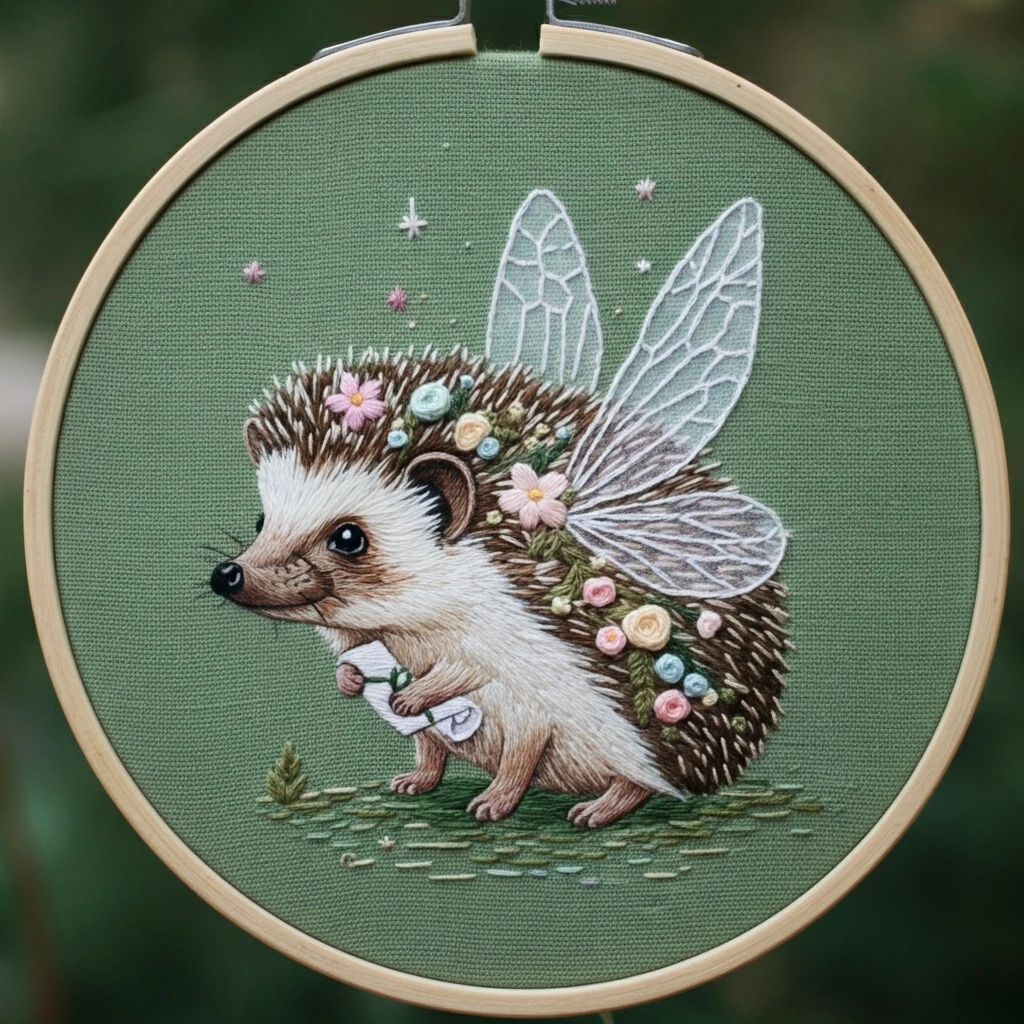
Enchanted Hedgehog Fairy
A woodland hedgehog with translucent fairy wings, cream belly fur, cocoa spines, tiny pastel garden flowers, and a soft sage-green linen background. The palette below keeps the piece gentle and storybook-like while preserving enough contrast for the eye, nose, wing veins, and individual quills to read clearly.
Polished DMC color palette
Use the darker shades sparingly as anchors, then build the hedgehog with many fine directional stitches. The image relies on soft value shifts more than bright color, so blends and single-strand detailing will make the design look refined rather than heavy.
Stitch map by design area
Thread-count and blending guidance
| Area | Strands | Recommended blend | How to use it |
|---|---|---|---|
| Fine fur | 1 strand | Ecru + 822 + occasional B5200 | Build the cream coat in thin layers. Put the brightest B5200 only on the ridge of the cheek, forehead, and belly edge. |
| Muzzle and legs | 1 strand, sometimes 2 | 632 + 3863 + 3031 | Shade under the eye, around the nose, under the chin, and at paw joints. Use split stitch for contour lines. |
| Spines | 1–2 strands | 3371 + 3031, then 632/Ecru tips | Start with dark base strokes, then add mid-brown quills and pale tips. Do not fill every gap; the fabric helps create depth. |
| Wings | 1 strand | 762 + 318 + B5200 or 746 | Use pale gray for structure, darker gray only near overlapping wing bases, and white for selective sparkle. |
| Flowers | 2–3 strands | 224/225 petals, 3823 centers, 3761 buds | Raise flowers slightly with more strands or small knots. Keep petals simple so they remain miniature and readable. |
| Leaves and ground | 1–2 strands | 3363 + 3345 + 3011 + 3047 | Use darker greens under flowers and the body, then add lighter single strokes for moss and small leaf tips. |
Practical stitching order
1. Stabilize and sketch lightly
Use a sage linen or cotton-linen ground close to the image background, then transfer only the main silhouette, wing veins, eye, flower centers, and foot placement. Avoid drawing every quill; stitched direction will create the texture.
2. Work from back to front
Stitch the far wings first, then the darker spine mass, then face and belly fur. Add flowers, wing highlights, whiskers, eye shine, and magical stars last so the delicate details remain crisp.
3. Keep the outline soft
Instead of a heavy black outline, use 3031 or 3371 on the shadow side and Ecru/B5200 on the lit fur edge. For the wings, whip a pale backstitch to make the veins smooth and fairy-like.
4. Use texture contrast
Make the face smooth with long-and-short stitch, the spines prickly with broken straight stitches, the wings airy with linework, and the flowers raised with knots and woven wheels. This gives the small design depth.
Shading, outlining, and texture suggestions
- Eye: fill with 310 satin stitch, rim lightly with 3799 or 3371 if available, and place one tiny B5200 straight stitch or French knot for shine.
- Nose: satin stitch 310, then add a small 318/B5200 highlight at the upper left to keep it glossy.
- Ear: outline in 3371, fill with 632 and 3863, and add a soft inner curve with 822.
- Face transition: feather 632 into Ecru with irregular stitches; avoid a hard stripe between muzzle and white fur.
- Spine crown: use scattered vertical and diagonal straight stitches. Let a few Ecru quill tips overlap the head for a natural hedgehog silhouette.
- Wing overlap: make the rear wing slightly darker with 318 and the front wing brighter with 762/B5200 so the layers separate.
- Flowers: stitch leaves first in 3363, add 3345 highlights, then place pink and blue blossoms over the greenery.
- Ground: use broken horizontal stitches in 3011, 522, and 3047. Keep most stitches short and uneven for a mossy fairy clearing.
Beginner-friendly finishing tips
Control bulk
For a small hoop, use 1 strand for outlines, fur, face details, and wing veins. Reserve 2–3 strands for flower petals, French knots, and a few foreground leaves only.
Test the pale threads
On sage fabric, B5200 can look bright. Test Ecru, 746, and B5200 side by side; use B5200 only where you want sparkle, not across the whole belly.
Rotate the hoop
Turn the hoop as you stitch fur and quills so your hand naturally follows the direction of growth. Directional stitches are more important than perfect stitch length.
Finish with magic
Add the tiny surrounding stars, dew dots, and wing glints at the very end using one strand. This keeps the final effect delicate, airy, and enchanted.