
DMC color palette & hand embroidery notes
Exotic Bird Floral Mandala
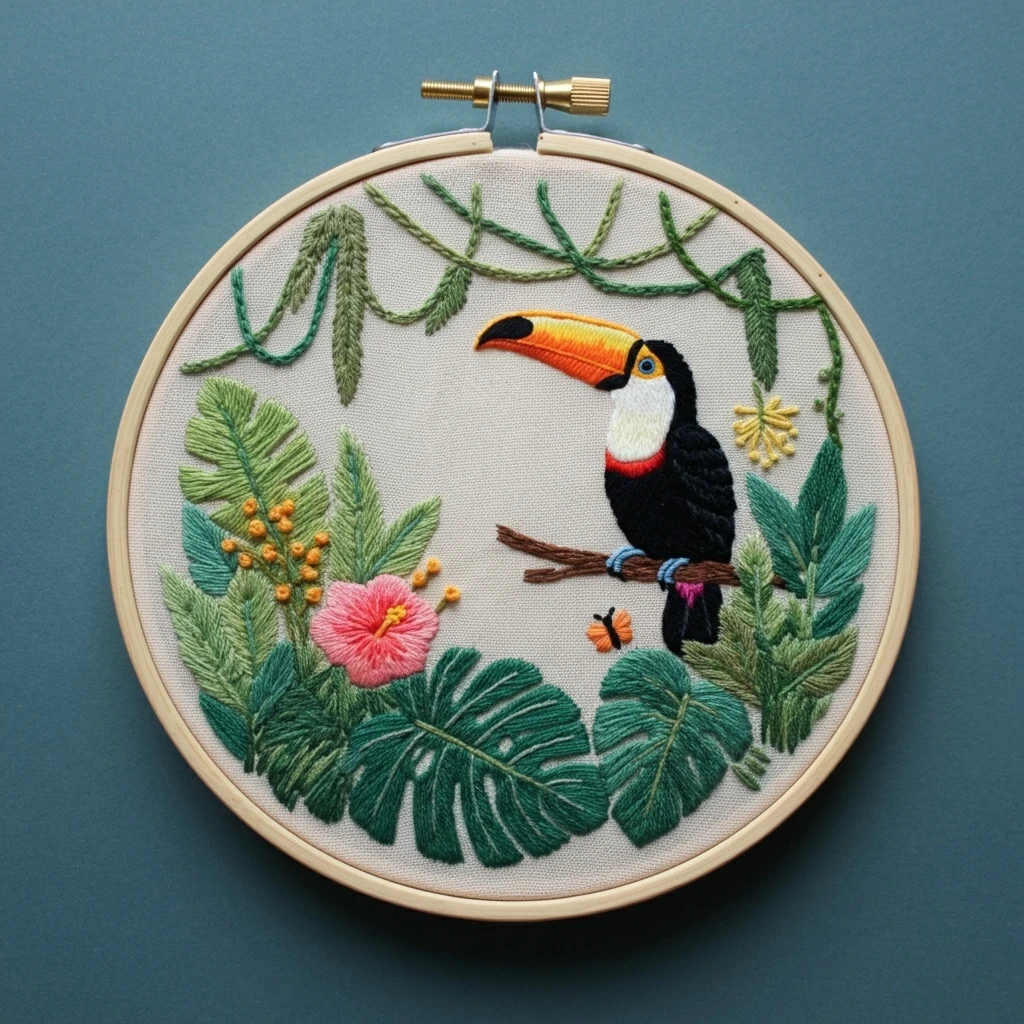
A tropical hoop design centered on a toucan-like bird, deep jungle foliage, a coral hibiscus bloom, golden berry clusters, trailing vines, and small butterfly accents. The palette balances glossy black plumage, warm citrus beak tones, cool teal leaves, and soft linen neutrals.
Design read
The artwork has a circular garden composition: large monstera leaves anchor the lower curve, feathery palm fronds fill the sides, vines drape across the top, and the bird perches slightly right of center. Keep the bird crisp and high contrast; let the foliage vary in strand count and direction so the greenery feels layered rather than flat.
Warm ivory or natural linen, medium weave
Tropical botanical, dimensional, bright focal bird
Confident beginner to intermediate
Long-and-short leaves, satin beak, whipped vines
Thread-count snapshot
- 1 strand: fine vein lines, bird eye ring, tiny berry stems, butterfly antennae.
- 2 strands: most outlines, beak shading, flower veins, small leaves, branch details.
- 3 strands: bold vine stems, large leaf filling, black bird body texture, berry padding.
- 4–6 strands: optional raised berries or wrapped vine accents only; avoid bulky satin areas.
Suggested DMC palette
Palette tip: For a compact kit, the most essential colors are 310, 746, 972, 740, 900, 321, 3806, 500, 3812, 469, 471, and 938. Add 3846 only if you want the tiny blue eye and foot bands to pop.
Stitch plan by design area
| Area | Suggested stitches | Practical notes |
|---|---|---|
| Bird body | Long-and-short stitch, split stitch outline, tiny satin details | Build black plumage with 2 strands of 310, then add directional scallops with 1 strand so the wing stays dimensional. |
| Beak | Satin stitch, long-and-short shading, back stitch | Work from yellow at the crown into orange and burnt orange underneath. Use short parallel stitches to keep the curve smooth. |
| Large leaves | Fishbone stitch, long-and-short stitch, stem stitch veins | Change stitch direction on each lobe of the monstera leaves; leave slim fabric breaks for cut lines if the pattern shows them. |
| Vines | Stem stitch, whipped back stitch, couching | Use 2–3 strands for vine curves. Whip with a lighter green to create a twisted tropical tendril. |
| Hibiscus | Long-and-short petals, satin center, French knots | Shade petal tips with pink and deepen the throat with cranberry; stitch the yellow stamen last. |
| Berries & small flower | French knots, colonial knots, lazy daisy | Use 2 wraps for small berries and 3 wraps for raised gold clusters. Keep spacing irregular and botanical. |
| Butterfly | Satin stitch, straight stitch, back stitch | Use one strand for antennae and body so it does not compete with the bird. |
Blending & shading guidance
Beak gradient
Start the upper ridge with DMC 972, move into 740 across the main body, and tuck DMC 900 along the lower edge. Where colors meet, alternate single long-and-short stitches rather than creating a hard stripe.
Leaf depth
Use DMC 500 in the underside of leaves and near overlaps, DMC 3812 for broad midtones, and DMC 469 or 471 on leaf tips. One-strand vein highlights make the dense green areas readable.
White chest
Use DMC 746 with small touches of ecru or a single gray-beige thread if available. Keep stitches short and slightly curved to mimic downy feathers.
Flower glow
Blend DMC 3806 with DMC 600 near the center. Add a few straight stitches in 972 for pollen so the hibiscus connects visually to the beak and berries.
Outlining details
- Use split stitch around the bird silhouette before filling; it creates a clean edge against the pale fabric.
- Back stitch the beak division with one strand of 900 or 310, depending on how bold you want the cartoon-like edge.
- Outline large leaves only on shadowed sides; full outlines can make the foliage look stiff.
Texture suggestions
- For feathery palms, stitch each leaflet as a separate straight stitch angled away from the center vein.
- Use padded satin or clustered French knots for the golden berry sprays.
- Try whipped stem stitch on the top garland to distinguish it from flat leaf veins.
Beginner-friendly tips
- Work from background vines to large leaves, then flower, branch, bird, and final knots.
- Use shorter satin stitches on the beak; long loose stitches snag easily on curved shapes.
- Do not pull dense leaf stitches too tightly or the hoop fabric may pucker.
Recommended stitching order
Because this design has many overlapping greens, stitch the deepest background elements first and reserve the brightest accents for the end. This keeps the toucan, flower, and gold berries crisp while the foliage forms a soft mandala frame.
Finishing notes
Press from the back on a padded towel so knots and raised berries are not flattened. If framing in the hoop, wrap the inner hoop with cotton tape before mounting; it helps grip the linen and suits the natural tropical look. Trim carried threads behind the white chest and pale fabric areas so dark greens and black do not shadow through.