
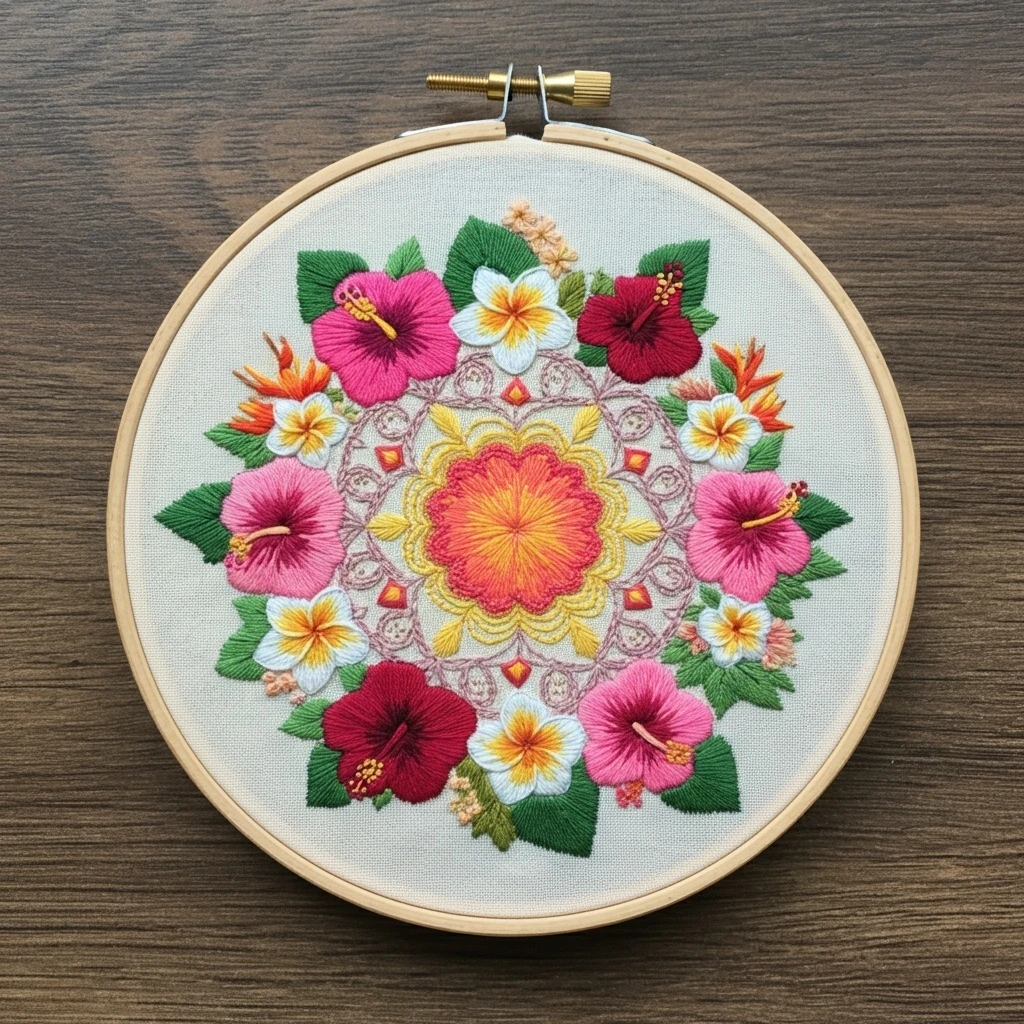
Exotic Bloom Mandala
A radiant tropical floral mandala with hibiscus pinks, ruby petals, plumeria whites, marigold centers, leafy greens, and soft mauve ornamental linework. This guide keeps the embroidery lively and dimensional while staying friendly for beginners.
Suggested DMC Color Palette
The artwork reads as saturated tropical florals against a neutral hoop background: hot pink and raspberry flowers, deep crimson accents, golden-yellow centers, crisp white plumeria petals, forest leaves, and dusty mauve mandala scrollwork.
Stitch Map by Design Element
Work from the center outward so the mandala stays balanced. Keep mirrored elements consistent by stitching the same feature on opposite sides before changing colors.
Long & short stitch
Use 1 strand for smooth shading. Start with DMC 742 in the center, blend into 720, then rim with 600 or 602 for the scalloped petals.
Directional satin stitch
Follow each petal's natural fan shape. Add dark straight stitches from the throat outward to create the dramatic tropical veining.
Satin + split outline
Fill petals with 3865, shade the throat with 745 and 742, then use a fine split stitch outline to keep the white petals readable.
Fishbone stitch
Use 699 at the base and vein, then 702 and 3347 toward the edges. Angle each stitch toward the center vein for a raised leaf texture.
Back stitch or stem stitch
Use 316 for the main mauve ornamental lines and 3727 for lighter curls. Keep stitches short around tight curves.
French knots
Use 742 or 745 for pollen and 815 for red flower throats. Wrap once for tiny dots, twice for raised pollen beads.
Thread-count guidance
- 1 strand: fine outlines, mandala scrollwork, inner petal veins, delicate plumeria shading.
- 2 strands: most satin stitch petals, leaves, center flower fill, and small decorative diamonds.
- 3 strands: raised stamens, bold outer leaf tips, or areas where you want a fuller handmade texture.
- Use a smaller needle for 1-strand lines and a slightly larger crewel needle for dense satin sections.
Blending ideas
- Blend one strand DMC 600 with one strand DMC 602 for rich hibiscus shadows.
- Pair DMC 720 and 742 for warm orange-yellow glow in the center and plumeria throats.
- Combine DMC 699 and 702 in leaves to avoid flat green blocks.
- Use DMC 316 sparingly with 3727 so the lace ring looks airy, not heavy.
For the smoothest color shift, stagger stitch lengths rather than ending each color in a hard row. Let darker stitches reach unevenly into the next shade.
Outlining, Shading & Texture Notes
Outlining details
- Outline major petals with split stitch in a slightly darker shade, then fill over the inner edge for a clean border.
- Use short back stitches for the mauve circular ornaments so curves stay graceful.
- For the small red-orange diamond accents, outline in DMC 815 and fill with DMC 720 or 742.
- Keep white petals outlined only where needed; too much dark outline can make them look heavy.
Shading guidance
- Place deepest pinks and reds at flower throats, under overlaps, and along inner folds.
- Keep yellow highlights concentrated near flower centers for a glowing tropical look.
- Shade leaves from dark center vein to bright outer edge to create lift.
- Use peach stitches around small blossoms to soften the transition between pink and orange areas.
Beginner-Friendly Working Order
Practical Tips for a Polished Finish
Hoop and tension
- Keep fabric drum-tight, especially for satin and long-and-short stitch areas.
- Rotate the hoop so your needle follows each petal direction naturally.
- Avoid carrying dark thread behind white petals; it may show through pale fabric.
Clean stitching habits
- Use thread lengths around 14 to 18 inches to reduce fraying in dense petal fills.
- Separate all six floss strands first, then recombine the number you need for smoother stitches.
- Press finished embroidery face-down on a towel so raised knots and satin stitches are protected.