
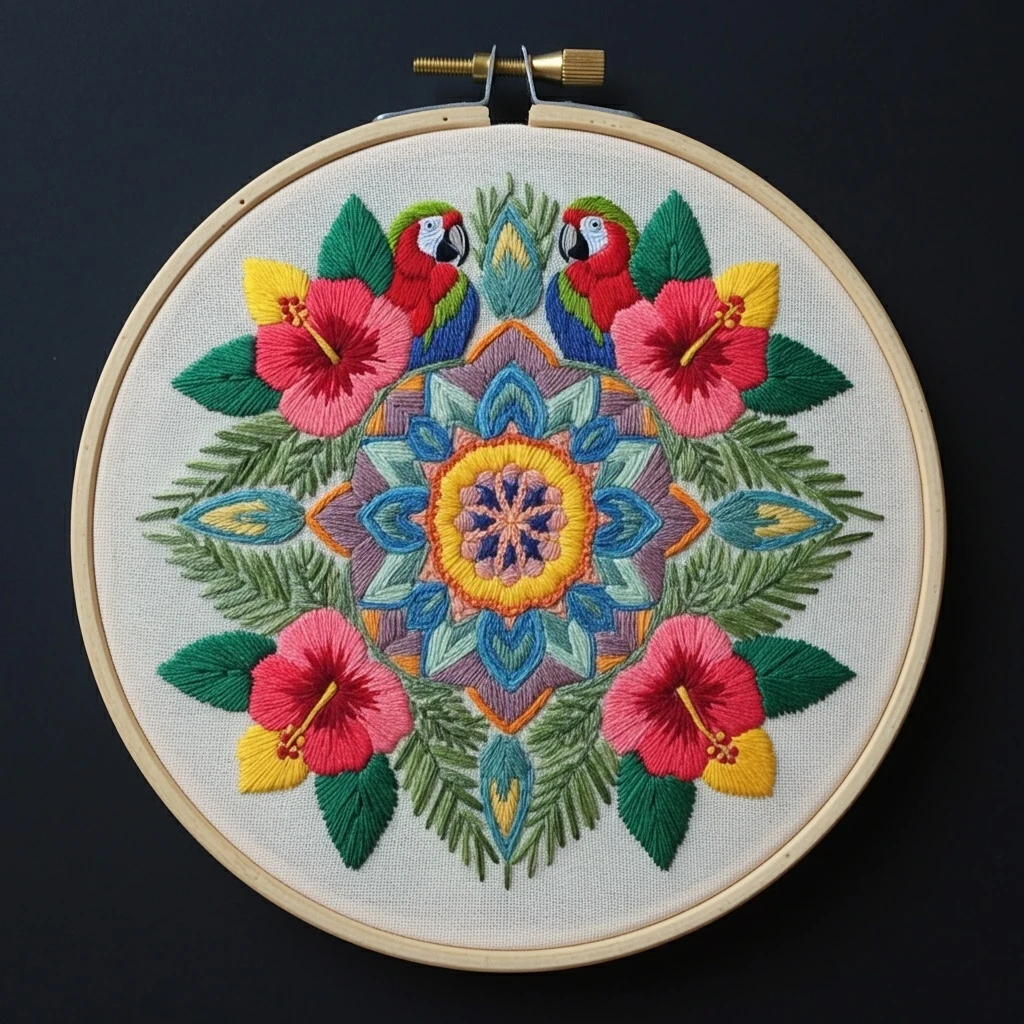
Exotic Parrots Hibiscus Mandala
A vivid tropical hoop design with mirrored red parrots, hibiscus blossoms, yellow petal accents, deep emerald leaves, ferny greenery, and a blue-teal mandala center. This guide keeps the parrots crisp, the flowers dimensional, and the radial symmetry easy to manage.
Suggested DMC Color Palette
The image is dominated by scarlet parrots and hibiscus, sunny yellow outer petals, emerald tropical leaves, muted olive fern fronds, peacock-blue mandala petals, orange outlines, and soft mauve-lavender geometric fills. Use the deepest colors for the parrot masks and flower throats, then reserve the lightest shades for highlights and visual sparkle.
Stitch Map by Design Element
Work in mirrored pairs so both parrots and opposite hibiscus flowers remain balanced. Complete the same color area on the left and right before switching threads.
Long & short stitch
Use 1 strand for feather shading: DMC 816 in shadow, 666 for the main body, and tiny 3716 or 3865 highlights near the face and shoulder edges.
Satin + French knot
Fill the beaks with short satin stitches in 310, leaving a small 3865 separation line. Add a single-wrap French knot or tiny straight stitch for each eye.
Directional satin stitch
Fan stitches from the throat to the petal tips. Use 816 at the center, 666 and 602 for the body, then 3716 at the outer illuminated edges.
Fishbone stitch
Build the leaf vein first, then angle stitches outward. Use 909 at the center and base, 702 in the middle, and 3347 for lifted edge highlights.
Fly stitch
Use rows of fly stitch or open straight stitches in 3052 and 3347. Keep these airy so the parrots and flowers remain the strongest shapes.
Split stitch outlines
Outline blue and teal petals with 798 or 3809, then fill with satin or brick stitch. Add 741/742 on the center ring for the warm focal glow.
Thread-count guidance
- 1 strand: parrot facial detail, feather direction lines, eye dots, beak separation, and fine mandala outlines.
- 2 strands: most hibiscus petals, parrot body fill, satin leaves, blue mandala petals, and orange accent shapes.
- 3 strands: raised yellow stamens, bold center ring, large outer leaf veins, or textured fern stems.
- Use shorter thread lengths for red and blue sections because saturated floss can fuzz when dragged through dense satin stitches.
Blending ideas
- Blend one strand DMC 816 with one strand DMC 666 for parrot shadows that are rich but not blackened.
- Blend DMC 666 with DMC 602 through the hibiscus mid-petals, then finish tips with DMC 3716.
- Pair DMC 3843 with DMC 3809 for the teal-blue mandala petals and parrot wings.
- Mix DMC 3052 with DMC 3347 in fern fronds for a natural, feathery green variation.
For smooth tropical shading, stagger the stitch lengths where two colors meet. Avoid a straight boundary between dark throats and light petal tips unless the artwork specifically shows a sharp fold.
Outlining, Shading & Texture Notes
Outlining details
- Use split stitch in DMC 816 around red parrot forms and hibiscus throats for clean definition without a heavy cartoon edge.
- Use DMC 798 or 3809 for blue mandala outlines; keep stitches very short around pointed teardrop shapes.
- Outline the yellow petal accents with DMC 741 when they touch pale fabric, then fill with 742 for brightness.
- Reserve DMC 310 for beaks, pupils, and the deepest tiny shadows. Too much black will flatten the tropical palette.
Shading guidance
- Place the darkest reds under parrot wings, along lower bellies, and at flower centers.
- Keep the parrot face patches bright with DMC 3865 and add only a few gray-blue or black detail stitches.
- Shade leaves from dark central vein to lighter edge so each leaf appears folded and glossy.
- Use the mauve background fills lightly; they should give the mandala depth while letting the parrots, hibiscus, and blue petals shine.
Beginner-Friendly Working Order
Practical Tips for a Polished Finish
Hoop and tension
- Keep the fabric drum-tight so satin leaves and petal fills do not pucker.
- Rotate the hoop often; the neatest stitches follow the feather, petal, or leaf direction rather than your hand position.
- Avoid carrying dark red, blue, or black threads behind white parrot faces because they may shadow through pale fabric.
Clean stitching habits
- Separate all six floss strands first, then recombine the number needed for smoother coverage.
- Use 14 to 18 inch thread lengths for dense satin areas to reduce fuzzing and tangles.
- Press the finished piece face-down on a thick towel so French knots, satin stitches, and feather texture stay raised.