
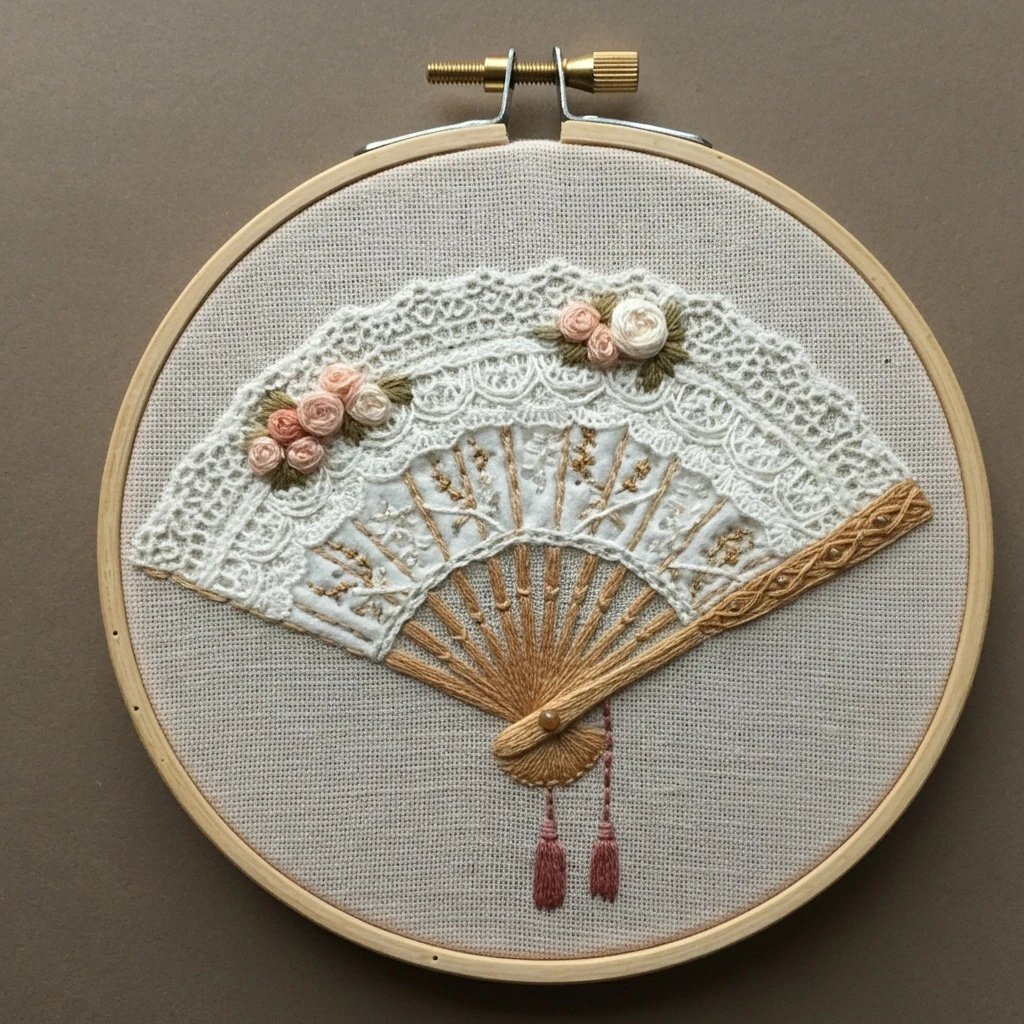
Exquisite Lace Hand Fan
A refined ivory lace fan with carved golden ribs, tiny blush roses, olive leaves, champagne accents, and rose tassels. This guide focuses on raised lace texture, delicate fan spokes, soft floral shading, and beginner-friendly stitch order.
Design Color Read
The artwork is built around a soft neutral ground, an ivory crocheted-looking lace canopy, warm honey-gold wooden fan ribs, muted champagne vine details, clusters of dusty pink roses, olive-brown leaves, and deeper rose tassels. The strongest contrast is not dark blackwork, but the shift from creamy white raised lace to tan fan bones and mauve-pink floral accents.
For the most elegant finish, keep the lace area slightly raised and matte, then make the wooden ribs smoother and more directional. Use tiny accents of metallic or golden floss only where the pattern suggests glints, not across every spoke.
| Area | Visual goal |
|---|---|
| Lace canopy | Milky ivory, dimensional knots, airy scallops and loops |
| Fan ribs | Warm carved wood, even satin/stem stitch direction |
| Roses | Dusty peach-pink to pale shell highlights |
| Tassels | Muted mauve rose with deeper shadow at the tips |
Suggested DMC Palette
Stitch Map
Buttonhole, detached chain & French knots
Work the scalloped top edge in 2 strands of Ecru, then add B5200 French knots in uneven clusters to imitate a crocheted lace rim.
Stem stitch, back stitch & lazy daisy
Outline curved lace panels with 1 strand of 822 or Ecru. Add small lazy-daisy arches and back-stitched curves inside each panel.
Satin stitch and split stitch
Use long, smooth satin stitches from pivot to fan edge. Split-stitch a darker line beside selected ribs for carved depth.
Woven wheel roses
Build roses with 5 spoke foundations and wrap with 754, 761, and 3712. Keep the center slightly tighter and the outer wrap looser.
Thread Count & Blending
- Fine outlines: use 1 strand for lace panel divisions, curved inner arches, and delicate gold vine stems.
- Main lace texture: use 2 strands for buttonhole scallops, detached chains, and raised knots.
- Fan ribs and handle: use 2 strands for satin stitch; switch to 1 strand of 420 for narrow groove shadows.
- Rose shading: blend 1 strand 754 + 1 strand 761 for soft petals; add 3722 only on the underside of fuller roses.
- Tassels: use 3 strands for the body if you want a plush fringe; couch a darker strand down the center for shadow.
- Optional sparkle: substitute a single strand of DMC Light Effects gold for selected 680 seed dots, but keep it minimal.
Shading, Texture & Order of Work
1. Start with structure
Stitch the fan ribs first so the geometry stays clean. Work from the central pivot outward and keep the tension even so the fan does not pucker.
2. Build the lace in layers
Outline the lace panels, then add inner loops, mesh-like knots, and raised scallops. Let small spaces of fabric show through to keep the fan airy.
3. Add florals last
Roses and leaves should sit on top of the lace. This gives the arrangement a dimensional corsage effect and hides any meeting points neatly.
A white-on-neutral design succeeds through texture more than color. Vary stitch height: flat satin for ribs, medium stem stitch for outlines, and raised knots/woven wheels for lace and flowers.
Beginner-Friendly Practical Tips
- Use a tightly hooped linen or cotton-linen fabric; loose fabric makes the long fan ribs wobble.
- Mark only the essential fan ribs and scalloped edge with a removable pen. Too many guidelines can show through pale lace stitches.
- Keep lace stitches short and consistent. If a curved line looks uneven, add a few tiny French knots to disguise the join.
- For the handle braid, stitch the base in 437, then cross small diagonal 167/420 stitches over the top to suggest woven carving.
- Comb tassel strands gently with a needle after stitching, then trim the bottoms level for a miniature fringe finish.
- Press from the back on a thick towel so raised roses, knots, and lace texture remain dimensional.