
DMC palette & hand embroidery guide
Fawn In A Wildflower Meadow
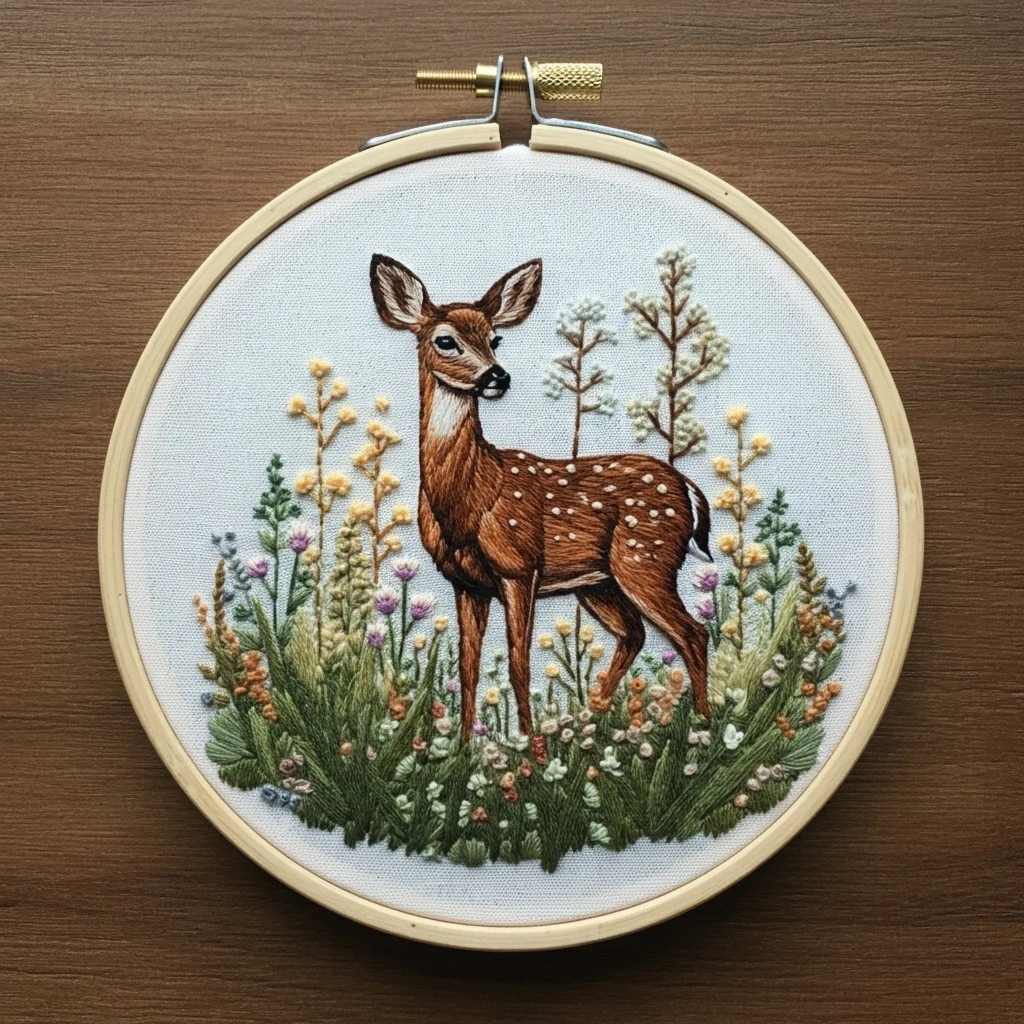
A detailed needle-painted fawn stands among airy meadow grasses, cream seed heads, soft purple blossoms, coral wildflowers, and fine twiggy stems. The design depends on warm brown fur shading, crisp dark facial details, tiny white spots, and layered green texture at the base.
Color story from the reference image
Fawn body
Use a smooth range from golden chestnut to deep umber. The neck, belly shadow, legs, ear rims, nose, and eye accents need the strongest contrast.
Meadow base
The foreground is a dense mix of olive, pine, sage, and blue-green. Vary strand count and direction so the grasses look natural rather than flat.
Wildflowers
Soft cream bobbles, dusty lavender petals, peach-coral clusters, and tiny ivory flowers add the meadow sparkle around the fawn.
Recommended DMC floss palette
Use these as practical matches for the visible colors. Keep the darkest browns and black-browns for only the smallest accents so the fawn remains soft and lifelike.
Stitch plan by design area
Thread-count, blending, and shading guidance
| Area | Strands | Best approach |
|---|---|---|
| Needle-painted face | 1 strand | Use very short stitches and blend 938 / 898 / 975 / 977 gradually. One strand prevents bulky features. |
| Body and neck | 1-2 strands | Block the main chestnut shapes with 976, then feather in 975 shadows and 977 or 3826 highlights. |
| Legs and hooves | 1 strand | Keep the legs narrow with split stitch outlines and long vertical shading. Finish hooves with 938 or 3371. |
| Dense foreground grass | 2 strands base, 1 strand top | Lay dark stitches first, then add lighter single-strand blades over the top for depth and movement. |
| Tiny flowers | 1-2 strands | Use 1 strand for petals and 2 wraps for French knots. Make seed heads slightly raised for texture. |
Outlining and texture suggestions
Outlines that stay soft
- Use dark brown rather than pure black for most fawn outlines.
- Switch to DMC 3371 only for the eye, nose point, mouth crease, and deepest hoof marks.
- Break the outline at highlighted edges so the coat appears illuminated rather than cartoon-like.
Meadow texture
- Angle grass stitches in different directions, especially around the legs.
- Place taller stems behind the fawn first, then add foreground grasses last.
- Use French knots in varied wraps: one wrap for tiny dots, two wraps for fuller blossoms.
Needle-painting depth
- Map the darkest shapes before filling: under neck, belly line, inner ears, rear leg, and tail edge.
- Overlap stitches like fur, not rows. Irregular stitch lengths create a more realistic coat.
- Keep highlights narrow and directional; too much light thread will flatten the fawn.
Finishing balance
- After flowers are stitched, add a few dark grass blades over them to integrate the base.
- Use tiny white stitches for the fawn spots only after all brown shading is complete.
- Steam-block lightly from the back so raised knots remain dimensional.
Beginner-friendly practical tips
Start simple
Begin with the tall stems and meadow greens to warm up. Save the fawn face for when your stitch tension feels steady.
Use short lengths
Needle painting looks cleaner with 12-15 inch thread lengths. Long lengths fuzz quickly, especially in dark browns.
Check from a distance
Every few colors, step back from the hoop. The fur should read as smooth shading, while the meadow should read as loose texture.