
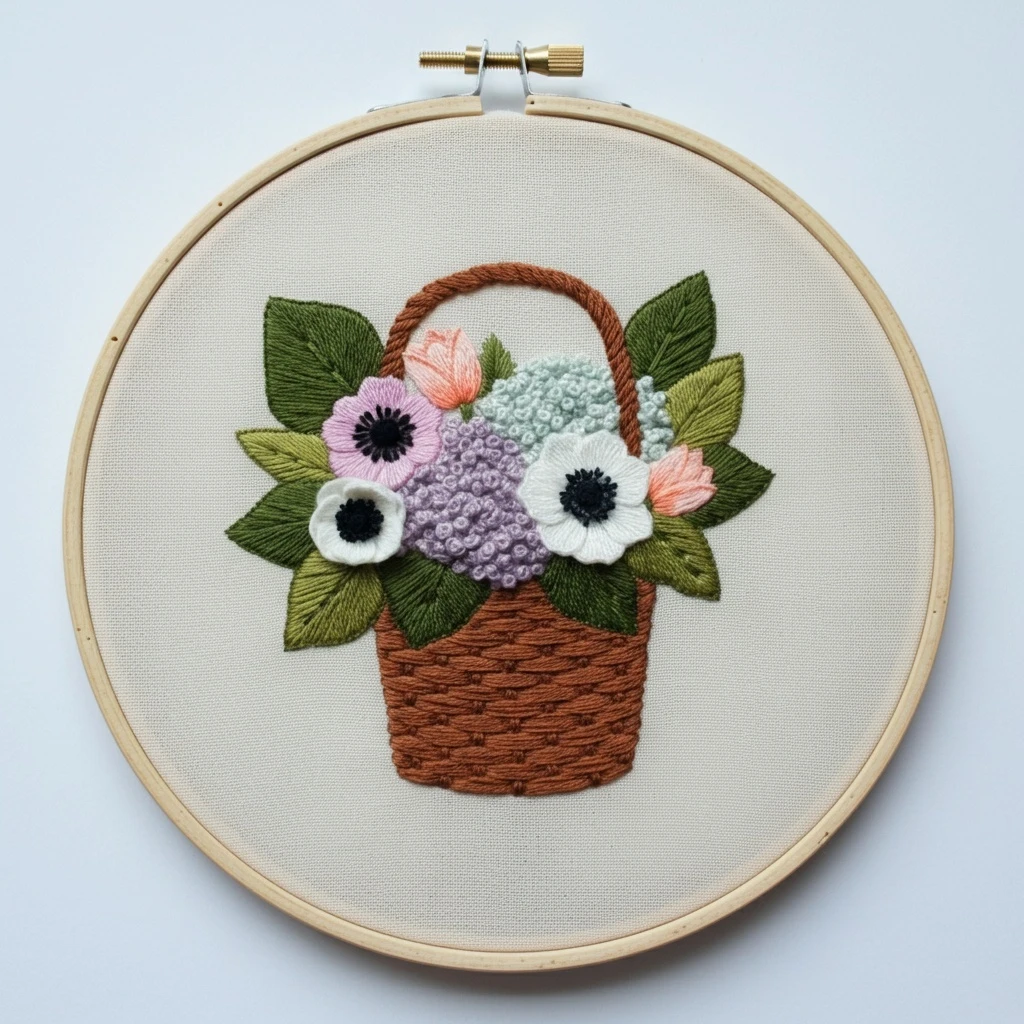
Design #918 · Basket Bouquet Palette
Floral Basket Arrangement
A polished DMC palette and practical stitching guide for the hoop design with a warm woven basket, arched handle, deep green leaves, white anemone-style flowers, coral-pink buds, lavender clusters, and misty blue-green hydrangea texture.
Preview
Palette matches are estimated from the visible hoop preview. Thread colors can shift with fabric tone, lighting, screen settings, and strand count, so treat these as close DMC working matches.
Color Story
This design balances a structured rust-brown basket with a soft, rounded bouquet. The strongest contrast comes from black flower centers against creamy white petals, while the mint hydrangea cluster and lavender knot cluster add cool pastel volume. Deep olive leaves frame the flowers and make the coral-pink buds feel brighter.
The basket should look dense and woven, while the flowers should sit visibly above it. Stitch the handle and basket first, add the large leaves and main blossoms second, then finish with knots, small buds, and vein details so the surface texture remains crisp.
Likely DMC Color Palette
A balanced palette of browns, greens, creamy whites, coral pinks, misty blue-greens, and lavender-violets for the visible design elements.
DMC 3371 · Black Brown
Use one strand for fine groove lines between basket rows and two strands in the darkest side edges. A few short stitches below the basket rim help the basket look tucked behind the flowers.
DMC 898 · Coffee Brown Very Dark
This is the primary dark wicker shade. Use stem stitch or couching for the arched handle and alternating horizontal rows for the basket body.
DMC 801 · Coffee Brown Dark
Work most basket bands with this shade, then layer 898 underneath and 433 on top. It gives the basket its warm, handmade wicker tone.
DMC 433 · Brown Medium
Add short highlight strokes along upper ridges and the front curve of the basket. Use sparingly so the woven texture stays dimensional.
DMC 310 · Black
Use tightly packed French knots for the black flower centers and single straight stitches for small radiating stamens. Keep black confined so it stays crisp and graphic.
DMC B5200 · Snow White
Use for the clean upper sections of the white anemone-style petals. Satin stitch with two strands gives a smooth raised petal surface.
DMC 3865 · Winter White
Blend with B5200 near petal bases and use for off-white filler flowers. This keeps the white blossoms visible on natural linen.
DMC 761 · Salmon Light
Use long-and-short stitch or satin stitch for the peach-pink buds. Keep the outer petal tips lighter to preserve the delicate folded look.
DMC 352 · Coral Light
Place at the base of each pink bud and in inner petal folds. A few strokes beside 761 create a natural coral gradient.
DMC 3813 · Blue Green Light
Use for the large airy blue-green flower cluster. French knots, colonial knots, or tiny detached chain stitches create the rounded hydrangea texture.
DMC 747 · Sky Blue Very Light
Add on the upper-left or top-facing knots of the mint cluster. It gives the hydrangea a fresh, lifted highlight without turning it icy white.
DMC 964 · Sea Green Light
Use under the mint cluster and around the right-side filler buds to suggest depth. Mix with 3813 when you want a softer transition.
DMC 3042 · Antique Violet Light
Use as the main lavender knot color. Work clustered knots close together, varying knot size to avoid a polka-dot effect.
DMC 3041 · Antique Violet Medium
Place in the lower-left and center of the lavender cluster. This shade makes the pale violet knots look rounded and layered.
DMC 895 · Hunter Green Very Dark
Use for the darkest leaves tucked behind the basket and flowers. Fishbone stitch or long-and-short stitch gives strong directional leaf grain.
DMC 936 · Avocado Green Very Dark
A reliable mid-dark foliage color for the large leaves. Use two strands for filled leaves and one strand for veins over lighter greens.
DMC 732 · Olive Green
Use on outward-facing leaves and along one side of fishbone leaves. It softens the foliage and connects the dark greens to the light highlights.
DMC 3012 · Khaki Green Medium
Add to leaf tips, center veins, and the lighter right-side foliage. It keeps the bouquet from feeling too heavy around the dark greens.
Stitch Plan by Area
| Design Area | Recommended Stitches | Thread Count & Notes |
|---|---|---|
| Basket body | Stem stitch, back stitch, woven couching, short horizontal straight stitches | Use 3 strands for body rows if you want strong wicker texture, 2 strands for smaller hoops. Alternate 801 and 898, then add 433 highlights and 3371 shadow notches. |
| Arched handle | Twisted stem stitch, whipped back stitch, or couched rope line | Use 4 strands or two parallel 2-strand lines. Whip with 801 over an 898 base to create the raised rope effect seen in the sample. |
| Large leaves | Fishbone stitch, long-and-short stitch, split stitch veins | Use 2 strands for the fill and 1 strand for veins. Vary 895, 936, 732, and 3012 so leaves do not merge into one flat green mass. |
| White anemone flowers | Padded satin stitch, long-and-short stitch, French knots, straight stitch stamens | Pad big petals with one layer of split stitch before satin stitching. Use B5200 on petal tips, 3865 at bases, and 310 for the dark center. |
| Pink buds | Satin stitch, fishbone petal stitch, tiny split stitch outlines | Use 2 strands for fills. Blend 761 and 352 with short alternating strokes to create folded coral petals; outline with one strand of 352 only where definition is needed. |
| Mint and lavender clusters | French knots, colonial knots, seed stitch, detached chain | Use 2 strands for most knots and 1 strand for the smallest top dots. Vary knot direction and size for a natural hydrangea-like surface. |
| Tiny filler buds | Lazy daisy, seed stitch, tiny satin stitch | Use 1 strand for delicate buds around the bouquet edge. Keep these light so they do not compete with the larger flowers. |
Blending & Shading Ideas
Beginner-Friendly Practical Tips
Order of stitching
- Transfer the basket, handle, main flowers, and large leaves first.
- Stitch basket body and handle before the bouquet overlaps them.
- Add large leaves next so flowers can sit on top visually.
- Finish with anemones, pink buds, knot clusters, and tiny filler details.
Thread-count guidance
- 1 strand: veins, outlines, stamens, tiny filler buds.
- 2 strands: most petals, leaves, knots, and shaded fills.
- 3 strands: basket rows or chunky decorative texture.
- 4 strands: raised handle, only if the hoop size allows it.
Outlining details
- Outline only the shadow side of petals to keep flowers soft.
- Use split stitch for neat petal edges and back stitch for crisp basket edges.
- Use dark green veins on dark leaves and khaki-green veins on pale leaves.
Texture control
- Keep knot clusters close but not perfectly gridded.
- Use a laying tool or needle tip to smooth satin petals.
- Rotate the hoop as you stitch leaves so the grain follows the leaf shape.
Finishing Notes
For a polished hoop, press the fabric from the back before adding the final black centers and raised knots. Keep the fabric drum-tight while stitching the basket so horizontal bands stay straight. After stitching, gently remove transfer marks, allow the fabric to dry flat, then re-hoop with the basket centered slightly below the visual midpoint so the arched handle and bouquet have room to breathe.