
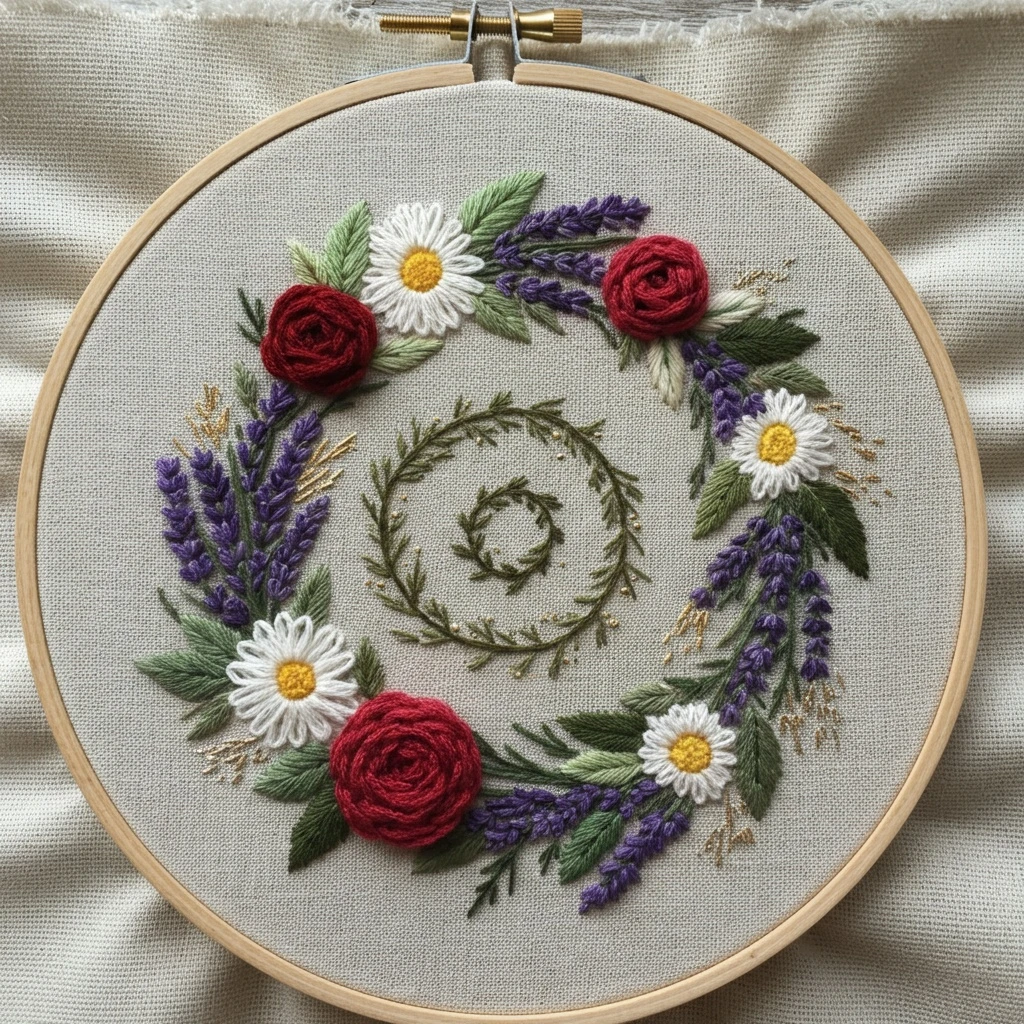
Floral Wreath Harmony
A balanced botanical hoop with crimson roses, white daisies, lavender-purple sprigs, layered sage and pine foliage, golden seed accents, and a delicate spiral wreath at the center. The palette below keeps the outer flowers plush and dimensional while preserving the airy, hand-sketched movement of the inner vine.
Suggested DMC floss palette
| Color | DMC | Name | Best use in this design |
|---|---|---|---|
| 815 | Garnet Medium | Main rose coils and the most visible red petal bands; gives the roses their rich cranberry tone. | |
| 814 | Garnet Dark | Inner rose shadows, tucked petal bases, and the darkest twists inside each woven rose. | |
| 816 | Garnet | Petal highlights on rose outer edges; blend with 815 to keep the red flowers lively. | |
| 3865 | Winter White | Daisy petals and small pale leaf highlights; works better than stark white on natural linen. | |
| 726 | Topaz Light | Daisy centers, golden pollen dots, and bright specks around the wreath. | |
| 680 | Old Gold Dark | Shadows in daisy centers and muted twig-like gold accent strokes. | |
| 333 | Blue Violet Very Dark | Lavender buds, purple sprig shadows, and the deepest knot clusters. | |
| 340 | Blue Violet Medium | Lavender highlights and front-facing knots so purple sprays do not look flat. | |
| 890 | Pistachio Green Ultra Dark | Dark pine leaves beneath roses and outer edge contrast near the right and lower wreath. | |
| 3345 | Hunter Green Dark | Main leaf veins, lavender stems, and darker portions of the central spiral vine. | |
| 3052 | Green Gray Medium | Soft sage leaves and transition stitches between dark greenery and linen background. | |
| 3053 | Green Gray | Light leaf tips, daisy-adjacent foliage, and highlights on feathered leaves. | |
| 3011 | Khaki Green Dark | Fine central spiral, rosemary-like sprigs, and understated vine outlines. |
Stitch map
Thread-count guidance
1 strand
Central spiral vine, fine rosemary needles, tiny gold flecks, and subtle outlines around daisy petals.
2 strands
Default for stems, fishbone leaves, lavender knots, daisy petals, and most outer wreath elements.
3 strands
Woven roses, large purple buds, and raised daisy centers when you want a more tactile hoop-art finish.
Blending, shading, and texture ideas
Dimensional roses
- Start each rose with five or seven spokes in 814, then weave 815 over and under until the circle is nearly filled.
- Add 816 only on the last round or two to suggest light catching the petal edges.
- Do not pull the wraps too tight; a relaxed woven wheel gives the plush rose texture seen in the reference.
Daisy brightness
- Use 3865 rather than pure white so petals stay soft on linen.
- Place petals with consistent outward direction; slightly overlap a few for a natural flower head.
- Mix 726 and 680 knots in the center so the yellow disks look rounded.
Lavender depth
- Work the lavender stems first in 3345 so every knot has a clean guide.
- Put 333 knots at the base of each cluster and 340 toward the tips for a sunlit purple variation.
- Use colonial knots for oval buds or detached chain for flatter, quicker sprigs.
Leaf layering
- Use 890 sparingly under the red roses and along the lower right to create depth.
- Alternate 3052 and 3053 on adjacent leaves instead of fully blending every leaf.
- For feathered greenery, stitch short straight stitches at a 35–45 degree angle from the stem.
Beginner-friendly order of stitching
- Transfer the wreath lightly: Mark the outer flower positions, central spiral, and main leaf directions. Avoid heavy marks under the daisy petals.
- Stitch the central spiral first: Use one strand of 3011 so you can keep the curl delicate and symmetrical before bulky flowers are added.
- Add stems and hidden greenery: Work lavender stems, rose stems, and the darkest under-leaves in 3345 and 890.
- Build the large flowers: Stitch woven roses next, then daisy petals, then yellow centers.
- Fill purple sprays and leaves: Add lavender knots and fishbone leaves, checking that the wreath still feels balanced around the circle.
- Finish with accents: Add gold knots and small seed stitches last so they sit cleanly on top of the foliage.
Outlining and finishing details
Outlining
Outline only where needed: the central spiral, lavender stems, and a few hidden leaf veins. The roses and daisies should be defined by texture rather than dark outlines.
Fabric and needle
Natural linen or cotton-linen in a neutral oatmeal tone suits the palette. Use a size 7 or 8 embroidery needle for 2–3 strands and a size 9 for one-strand details.