
DMC Palette & Hand Embroidery Notes
Forest Bear And Enchanted Trees
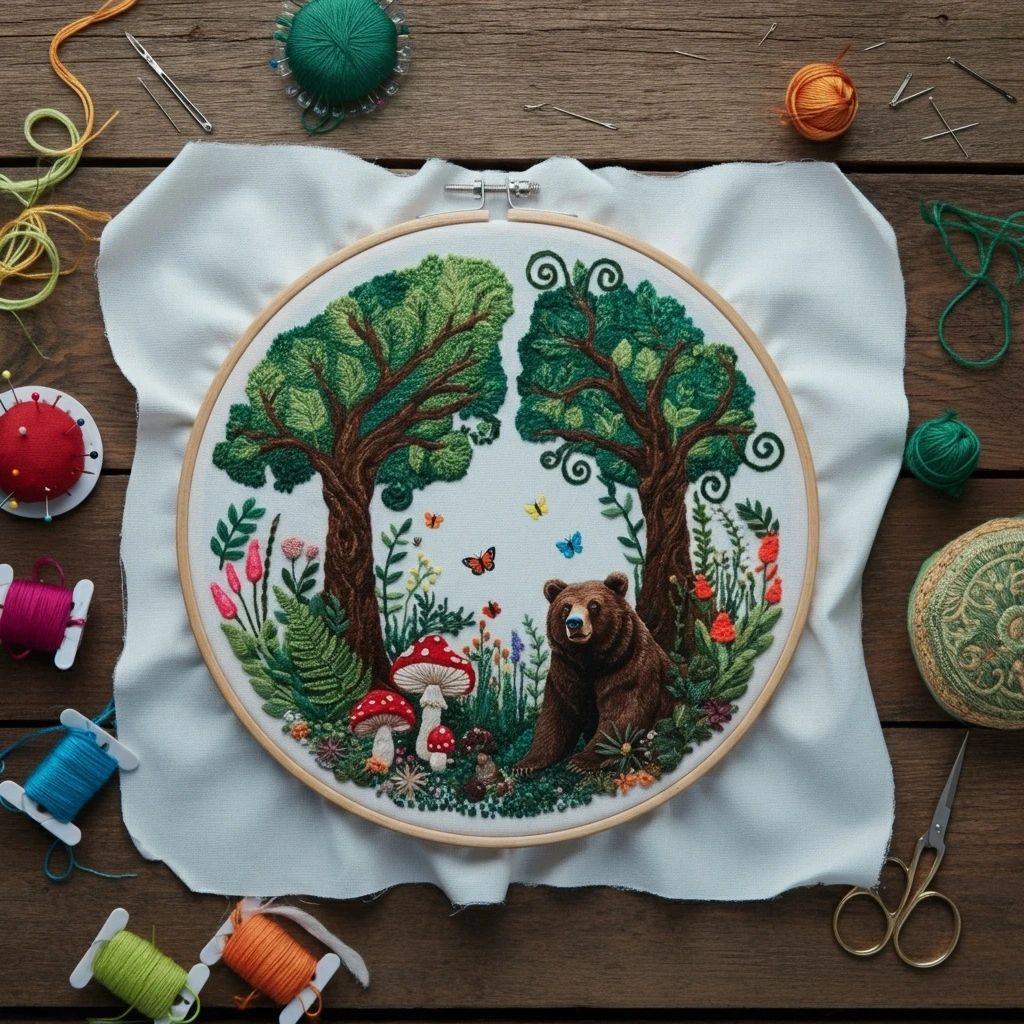
A woodland hoop filled with deep green tree canopies, twisting brown trunks, ferny undergrowth, red-capped mushrooms, tiny wildflowers, butterflies, and a softly shaded brown bear. The palette below keeps the scene earthy and magical while giving enough contrast for fur, bark, foliage, and miniature details.
Suggested DMC Color Palette
The image reads as an enchanted forest: blue-green shadows, mossy canopy highlights, warm bark, russet mushrooms, cream mushroom stems, small orange and yellow flowers, and soft sky-blue accents in the butterflies.
Bright dots on mushrooms, tiny flower centers, and sharp highlights in the bear's eyes.
Mushroom stems, soft ground highlights, and gentle breaks between darker forest areas.
Fern shadows, inner leaf veins, and lower-ground foliage under the bear.
Canopy highlights, new fern tips, and sunny patches on the left tree.
Dense evergreen clumps, curled vine shadows, and the deepest leafy outlines.
Main foliage body color for tree crowns, shrubs, and layered background leaves.
Bear shadow side, tree trunk grooves, branch undersides, and dark outlining.
Primary bark and bear midtone; blend with 938 for natural depth.
Warm highlights on the bear muzzle, shoulder, paws, and raised bark ridges.
Toadstool caps and bright woodland berries; use sparingly for strong focal points.
Orange flowers and butterfly wings; excellent for tiny satin stitches and French knots.
Yellow butterfly, flower centers, and small sparkle-like accents in the meadow.
Blue butterfly and tiny cool highlights that keep the scene lively.
Small pink blossoms near the forest floor and soft floral clusters.
Purple shadow flowers, deep berry dots, and a few cool accents near the base.
Minimal use only: bear nose, eye pupils, butterfly bodies, and the finest final outlines.
Color Placement & Use Notes
| Area | Core colors | Stitch approach | Practical note |
|---|---|---|---|
| Bear fur | 938, 801, 433, 822, 310 | Long-and-short, split stitch, single-strand directional strokes | Keep stitches following the body curve: downward on chest, rounded around muzzle, slightly diagonal along the shoulder. |
| Tree canopies | 3818, 909, 730, 734 | Seed stitch, fishbone leaves, scattered short straight stitches | Work dark greens first, then add broken light stitches on top to avoid flat blobs of foliage. |
| Trunks & branches | 938, 801, 433 | Stem stitch, split stitch, whipped backstitch | Alternate warm and dark browns in irregular lanes so bark looks twisted rather than striped. |
| Mushrooms | 321, B5200, 822, 938 | Satin stitch caps, French knot spots, split-stitch stems | Use white knots after the red caps are finished so the spots sit cleanly on top. |
| Ferns & meadow | 730, 734, 909, 3354, 741, 743, 154 | Fly stitch, detached chain, straight stitch, French knots | Vary stem heights and flower sizes to keep the foreground organic. |
| Butterflies | 741, 743, 3845, 310 | Tiny satin stitches with backstitched bodies | Use one strand for outlines; two strands can overpower the small shapes. |
Recommended Stitch Types
This design benefits from layered texture rather than perfectly filled flat areas. Choose stitches that suggest fur, bark, leaves, and tiny woodland details.
Thread Count Guidance
For a 6-inch hoop
- Bear fur: 1 strand for face and muzzle detail; 2 strands for body fill.
- Tree trunks: 2 strands for main stem stitch lines; 1 strand for dark bark grooves.
- Canopy texture: 2 strands for leafy masses, then 1 strand for highlight seed stitches.
- Flowers and butterflies: 1 strand for outlines, 2 strands for brighter petals or wings.
Blending Ideas
Outlining, Shading & Texture Plan
Bear face and body
Begin with the darkest fur masses in 938, fill mid areas with 801, then feather 433 into the muzzle and shoulder. Use 310 only for the nose, pupils, and very small defining lines so the portrait stays soft.
Enchanted trees
Outline trunk curves with stem stitch in 801, tuck 938 into the inner bends, and add 433 on raised ridges. For the curled branches and spirals, use one-strand whipped backstitch for a delicate fairy-tale line.
Forest floor
Layer ferns first, then flowers, then knots. A few 154 and 3354 knots at the base add depth among the greens; orange and yellow knots create sparkle without crowding the bear.
Beginner-Friendly Working Order
Stitch sequence
- Transfer main outlines lightly; mark only major leaf and fur directions, not every tiny stitch.
- Work tree trunks and large stems first so the composition has structure.
- Add background foliage in dark-to-light layers.
- Stitch the bear before the smallest flowers so foreground details do not snag.
- Finish with mushrooms, butterflies, French knots, and crisp one-strand outlines.
Practical tips
- Use shorter thread lengths, about 14–16 inches, to keep browns and greens from fuzzing.
- Rotate the hoop while stitching fur and bark; your needle should follow the curve rather than fight it.
- Do not overfill the canopy. Small fabric gaps can read as light peeking through leaves.
- Test red mushroom caps on scrap fabric; dense satin stitch may need gentle padding underneath.
- Press from the back on a towel to protect French knots and raised texture.