
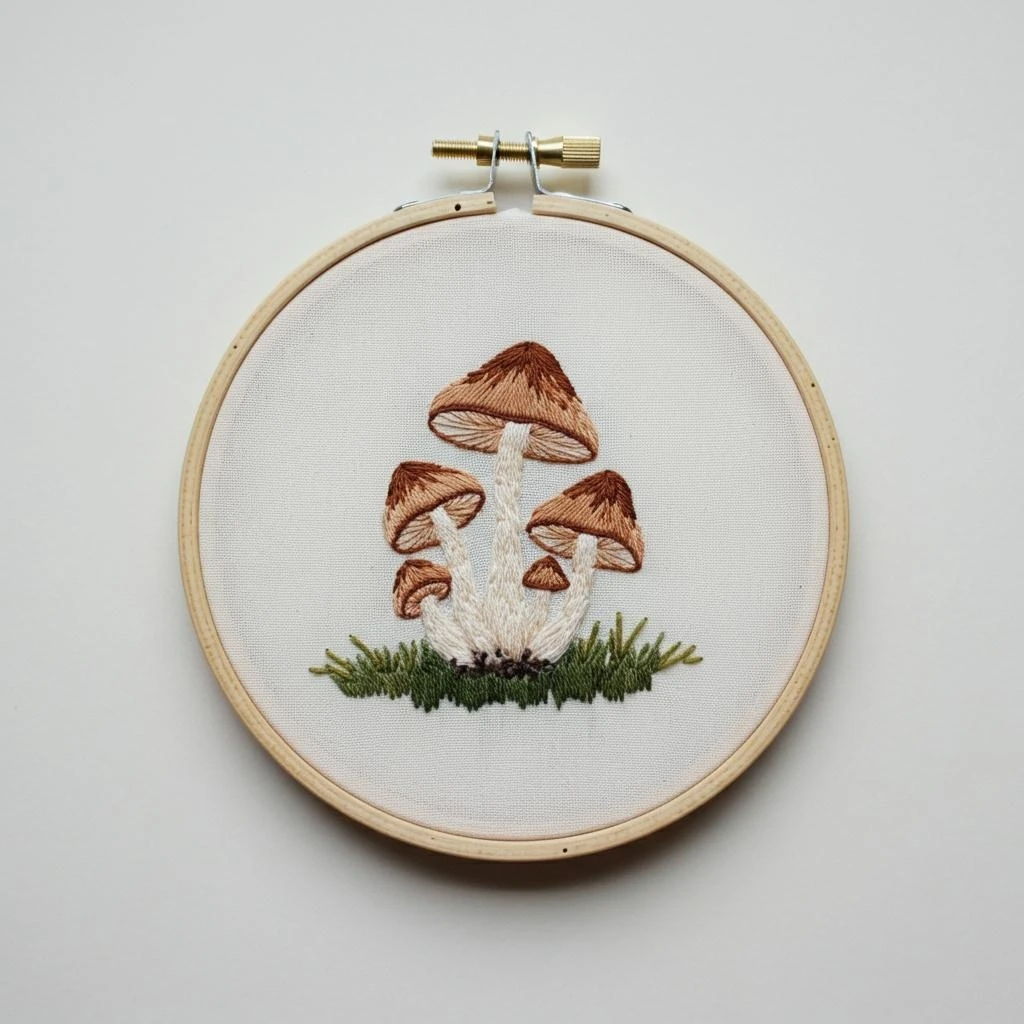
DMC palette & hand embroidery guide
Forest Fungi
A warm woodland palette for stitched mushroom caps, creamy stems, feathery gills, and tufted moss. The reference design is simple and charming, but it gets its depth from directional stitching, dark outlines, and tiny changes between rust, tan, cream, olive, and near-black thread.
Polished DMC Color Palette
Use this as a balanced working palette rather than a strict rule. The strongest match comes from layering two or three neighboring browns in the mushroom caps and mixing olive greens at the base.
Stitch Plan
Long & short stitch
Work from the cap center outward, following the mushroom’s curved slope. Let DMC 400 and 920 dominate, then feather in 922 and 977 at the rim.
Fine straight stitch
Use 1 strand in 3033, 3864, and occasional 938. Radiate lines from the stem outward so the underside feels structured but delicate.
Split stitch fill
Use 2 strands of 3033 with 3865 highlights. Add narrow 3864 shadows along one side and at stem bends.
Seed + straight stitch
Build the base with irregular vertical stitches. Add tiny seed stitches in 934 and 3371 for dark, crumbly soil texture.
Backstitch
Use 1 strand of 938 for cap rim emphasis and 3371 only where the image needs firm separation. Avoid outlining every stem edge.
Detached accents
Place a few short, angled strokes on the cap tops to mimic the reference’s darker flecks and shaggy surface.
Thread Count Guidance
For a 5–6 inch hoop
- 1 strand: gill lines, dark cap cracks, tiny soil knots, and final outline corrections.
- 2 strands: most cap filling, stems, lower cap rims, and controlled grass blades.
- 3 strands: only for the deepest moss tufts if you want a raised, plush base.
- Needles: use a size 7–9 embroidery needle; choose the smaller needle when working 1 strand detail.
Blending & Shading Recipes
The reference design has a handmade, slightly painterly effect. These blends keep the mushrooms warm without making the small design muddy.
| Area | Recommended blend | How to use it |
|---|---|---|
| Mushroom cap shadows | 1 strand DMC 938 + 1 strand DMC 400 | Use sparingly at cap centers, darkest rim folds, and the lower edge of the largest cap. |
| Main rust cap fill | 2 strands DMC 920, with scattered DMC 400 | Stagger the stitch lengths so the darker thread breaks into the copper rather than forming stripes. |
| Cap highlights | 1 strand DMC 922 + 1 strand DMC 977 | Add to the cap lip and high points; keep highlight strokes short and angled. |
| Creamy stems | 1 strand DMC 3865 + 1 strand DMC 3033 | Fill most of the stem with vertical split stitches, then add a few pure 3865 strokes on the lit side. |
| Soft stem shadows | 2 strands DMC 3864 or 3033 | Place shadows under caps, between overlapping stems, and near the ground line. |
| Moss and grass | Mix DMC 934, 935, and 3011 | Keep the center darkest, then use 3011 as thin outward grass spikes for a natural silhouette. |
Outlining Details
- Use 1 strand of DMC 938 around the cap rims and the deepest underside curves.
- Switch to DMC 400 for softer cap-top linework, especially on small mushrooms where black-brown would look heavy.
- For the stems, outline only the shadow side with DMC 3864 or a very light touch of 3033; this keeps the stems soft and organic.
- Use tiny, broken backstitches rather than one continuous heavy line. The design will look more hand-drawn and less cartoonish.
Texture Suggestions
- Scatter tiny cap flecks with short straight stitches in DMC 938 and DMC 400.
- Use irregular stitch direction on caps: downward strokes at the center, diagonal strokes at the shoulders, and nearly horizontal stitches along the rim.
- Add one or two French knots in DMC 3371 at the base for soil crumbs, but keep them very small.
- For moss, alternate vertical grass spikes with seed stitches so the base looks dense without becoming a solid green block.
Beginner-Friendly Practical Tips
Order of stitching
Start with the stems in pale thread, then stitch the gills, cap fills, cap texture, moss, and finally the tiny dark outlines. Working light-to-dark prevents rust and green floss from tinting the cream stems.
Keep the fabric clean
Rust browns and avocado greens can shed visible lint on pale fabric. Wash hands before stitching, trim fuzzy thread ends, and avoid dragging dark floss across the back behind the stems.
Make small mushrooms readable
On the smallest caps, skip complex blending. Use 920 for the fill, 400 for the underside edge, and one 922 highlight stroke.
Fix uneven fill
If a stem looks patchy, add a few 1-strand split stitches over the gaps rather than reworking the whole section. The slight irregularity suits fungi texture.