
DMC palette & embroidery guide
Forest Path
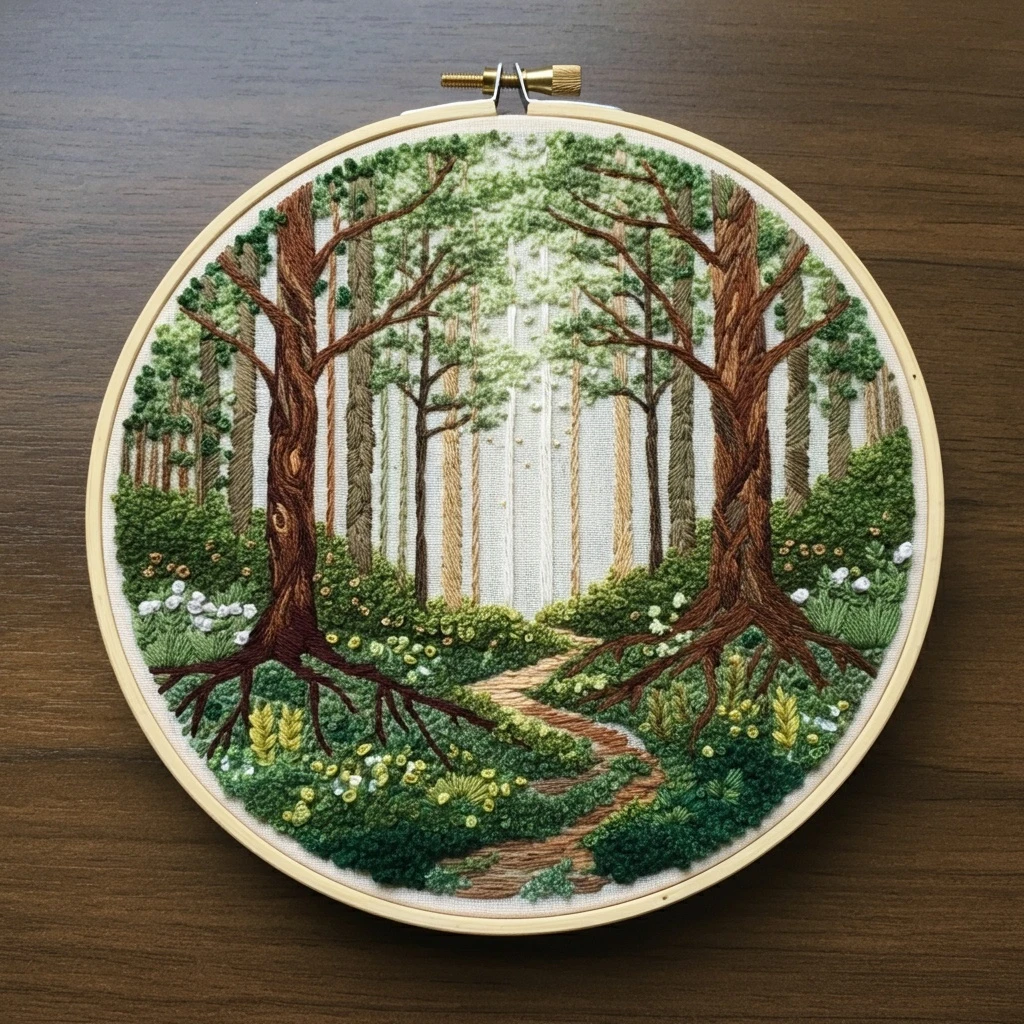
A layered woodland hoop with tall trunks, mossy groundcover, ferny undergrowth, tiny wildflowers, and a warm winding path leading into a pale misty clearing. The stitching approach should feel textured and organic: dense foreground greens, feathery canopy marks, strong bark lines, and gentle atmospheric shading in the distance.
1 Color story from the artwork
Dominant colors
Deep evergreen shrubs and dark moss form the bottom frame, while medium olive and pine greens make the tree canopy. The trunks range from reddish bark to dark umber, with muted grey-green distant trunks in the background.
Accent colors
The winding path is sandy tan with cinnamon shadows. Tiny white, cream, and soft yellow flowers brighten the foreground. A pale grey-green mist keeps the center airy instead of overcrowded.
2 Stitch plan by design area
Foreground trees & roots
Work long and short stitch in vertical bark bands with 2 strands. Add split stitch or stem stitch ridges in DMC 3371, 938, 433, and 434. Keep roots slightly darker than trunks so they anchor the composition.
Winding path
Use rows of stem stitch or staggered straight stitches following the curve. Blend DMC 437 with 434 for the side shadows and 739 through the center where the path catches light.
Dense shrubs & moss
Use French knots, colonial knots, seed stitch, and tiny detached chain stitches. Start with DMC 500/890 in shadow pockets, then scatter 935, 3011, and 3012 over the top.
Ferny plants
Make each frond with fly stitch or fishbone stitch. Use one strand for fine stems and two strands for foreground leaves. Add 3013 only at the tips for a fresh woodland glow.
Canopy texture
Stipple the treetops with loose seed stitches and small knots. Vary spacing: heavier at the rim, lighter near the misty center. Avoid fully filling the background so the fabric breathes.
Flowers & small highlights
Use one-wrap French knots for yellow centers and lazy daisy or tiny straight stitches for white petals. Keep flowers irregular in size so they look natural rather than dotted in rows.
3 Strand count, blending & shading
Thread-count guidance
| Area | Strands | Why |
|---|---|---|
| Foreground trunks | 2–3 | Bold texture and visible bark grooves. |
| Distant trunks | 1 | Soft recession without heavy lines. |
| Shrubs/moss | 2 | Good knot coverage and dimensional lift. |
| Fine branches | 1 | Clean delicate silhouettes. |
| Path | 2 | Smooth coverage with readable direction. |
Blending ideas
- For bark, thread one strand DMC 938 with one strand DMC 433 to make a natural mid-brown transition.
- For moss, blend DMC 890 + 935 in shadow areas and DMC 3011 + 3012 on raised clumps.
- For the misty center, use single-strand DMC 647 and 822 with broken vertical stitches rather than a solid fill.
- For the path, place 739 down the centerline, 437 beside it, and 434 along the outer curve.
4 Outlining, texture & beginner tips
Outlining details
- Outline major trunks with split stitch in DMC 3371 only on shadow sides; do not black-line every edge.
- Use stem stitch for branches so curves remain smooth and slightly raised.
- Break the path outline into short stitches instead of one continuous border; this keeps it earthy.
- Backstitch a few distant trunks with single-strand DMC 645, then soften with sparse 647 highlights.
Texture suggestions
- Mix knots and seed stitches in shrubs so the woodland floor looks uneven and alive.
- Use directional stitches on tree bark: mostly vertical, with diagonal accents around knots and root bends.
- Reserve the densest stitches for foreground greens; use open spacing in the center to suggest fog and depth.
- Add final white flower knots last so they stay clean and sit visually on top of the foliage.