
DMC palette & embroidery guide
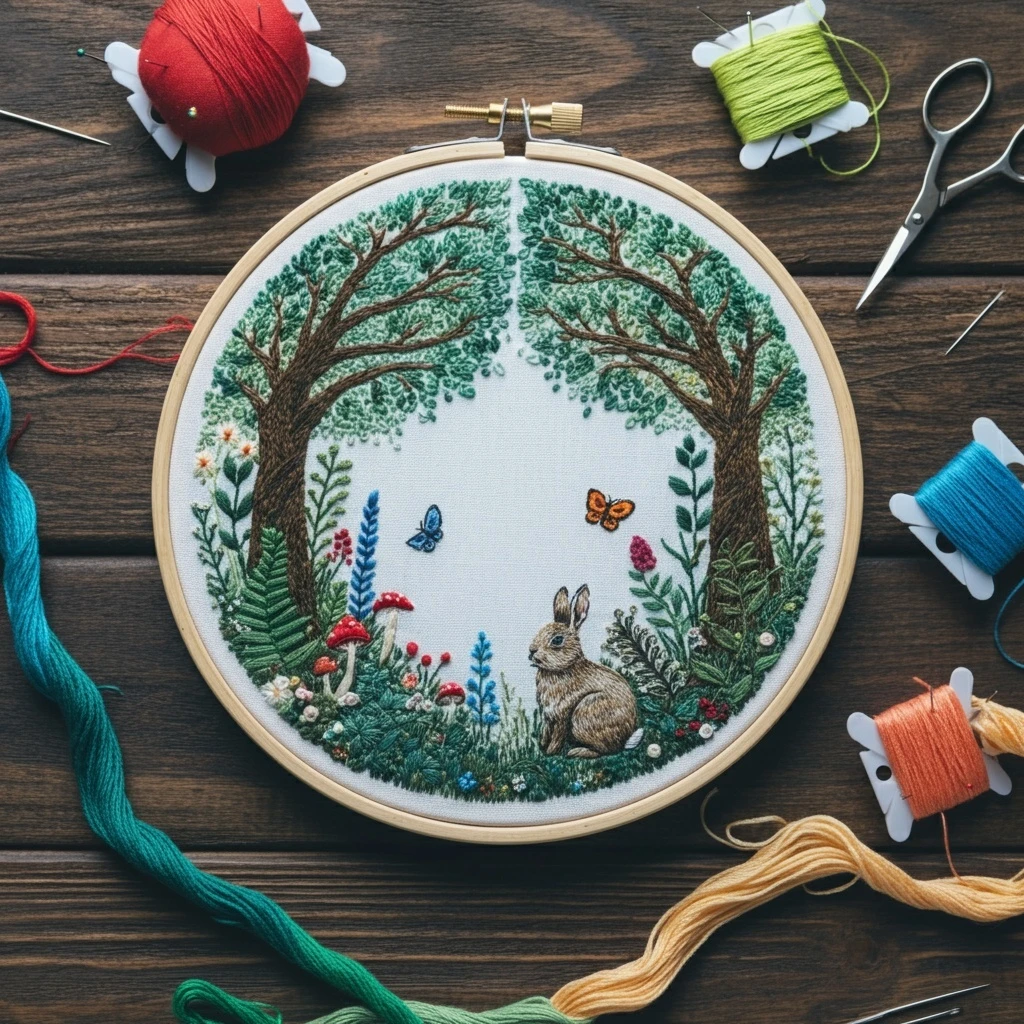
Forest Rabbit
A storybook woodland hoop with a soft brown rabbit nestled in the lower right, tall arching trees, dense ferny groundcover, red-capped mushrooms, tiny wildflowers, and bright butterfly accents. The embroidery should feel lush around the border but airy in the center, using textured greens to frame the rabbit and fine directional stitches to make the fur look gentle and dimensional.
1 Color story from the artwork
Dominant colors
The design is built from pine, teal-green, and moss tones in the trees and forest floor. Warm umber branches create the hoop’s arch, while the rabbit uses sandy taupe, beige, and grey-brown shading to stand apart from the greenery.
Accent colors
Red mushroom caps, blue flower spikes, white daisies, coral berries, and blue/orange butterflies add tiny saturated details. Use these accents sparingly so they sparkle without competing with the rabbit.
2 Stitch plan by design area
Rabbit fur
Use long and short stitch in the direction the fur grows: short strokes on the face, longer curved strokes on the back and haunch. Blend DMC 642, 3782, 433, and tiny touches of 3371 for the eye and deepest separations.
Trees & arching branches
Work stem stitch for branches and split stitch for trunk ridges. Layer 938 and 433 over a 3371 shadow edge, then add a few lighter bark streaks where the branches face the open center.
Ferny forest floor
Use fly stitch, fishbone stitch, and detached chain leaves. Stitch darker greens first, then place 367, 368, and 3013 on top so the foliage frames the rabbit without flattening it.
Canopy texture
Make the tree canopy with loose seed stitch and small French knots. Keep the top edge dense and rounded, then reduce stitch spacing toward the central opening to preserve the airy woodland clearing.
Mushrooms & berries
Use satin stitch or padded satin for red mushroom caps, Blanc or 739 French knots for spots, and stem stitch for slender stalks. Berries can be single French knots in 321 or 351.
Butterflies & flowers
Use lazy daisy stitches for butterfly wings and tiny straight stitches for antennae. White flowers work best with five small straight stitches around a 3822 knot center.
3 Strand count, blending & shading
Thread-count guidance
| Area | Strands | Why |
|---|---|---|
| Rabbit body | 1–2 | Fine fur strokes stay soft and directional. |
| Rabbit eye/nose | 1 | Crisp detail without bulky dark spots. |
| Tree trunks | 2–3 | Raised bark texture and strong framing. |
| Ferns & stems | 1–2 | Fine stems with fuller foreground leaves. |
| Knots and flowers | 2 | Visible dots and durable dimensional accents. |
Blending ideas
- For rabbit mid-fur, combine one strand DMC 642 with one strand DMC 3782; switch to 433 + 642 for the shaded back.
- For bark, blend DMC 938 + 433 and add single-strand 3371 only in the deepest cracks.
- For dense moss, mix DMC 500 + 501 at the base and DMC 502 + 367 on the upper leaf clusters.
- For the blue butterfly, shade with DMC 798 at the body and DMC 3843 near the wing tips.
4 Outlining, texture & beginner tips
Outlining details
- Outline the rabbit sparingly with single-strand DMC 938 or 3371 only under the belly, at the ear fold, and near the back foot.
- Use split stitch for the rabbit’s eye ring, then add one tiny Blanc stitch as a catchlight if the scale allows.
- Backstitch mushroom stems in a pale neutral before filling caps, so the red sits cleanly on top.
- Keep branch outlines uneven: broken stem stitches look more natural than a continuous heavy border.
Texture suggestions
- Alternate French knots and seed stitches in the lower foliage to create a plush woodland-floor texture.
- Make fern leaves with the stitch angle changing along the frond; this prevents the greenery from looking flat.
- Use short satin stitches for mushroom caps and place the white dots after the red thread is complete.
- Float a few single-strand leaf stitches around the central opening for depth, but leave enough fabric visible for light.