
DMC Palette & Stitching Notes
Forest Wildlife
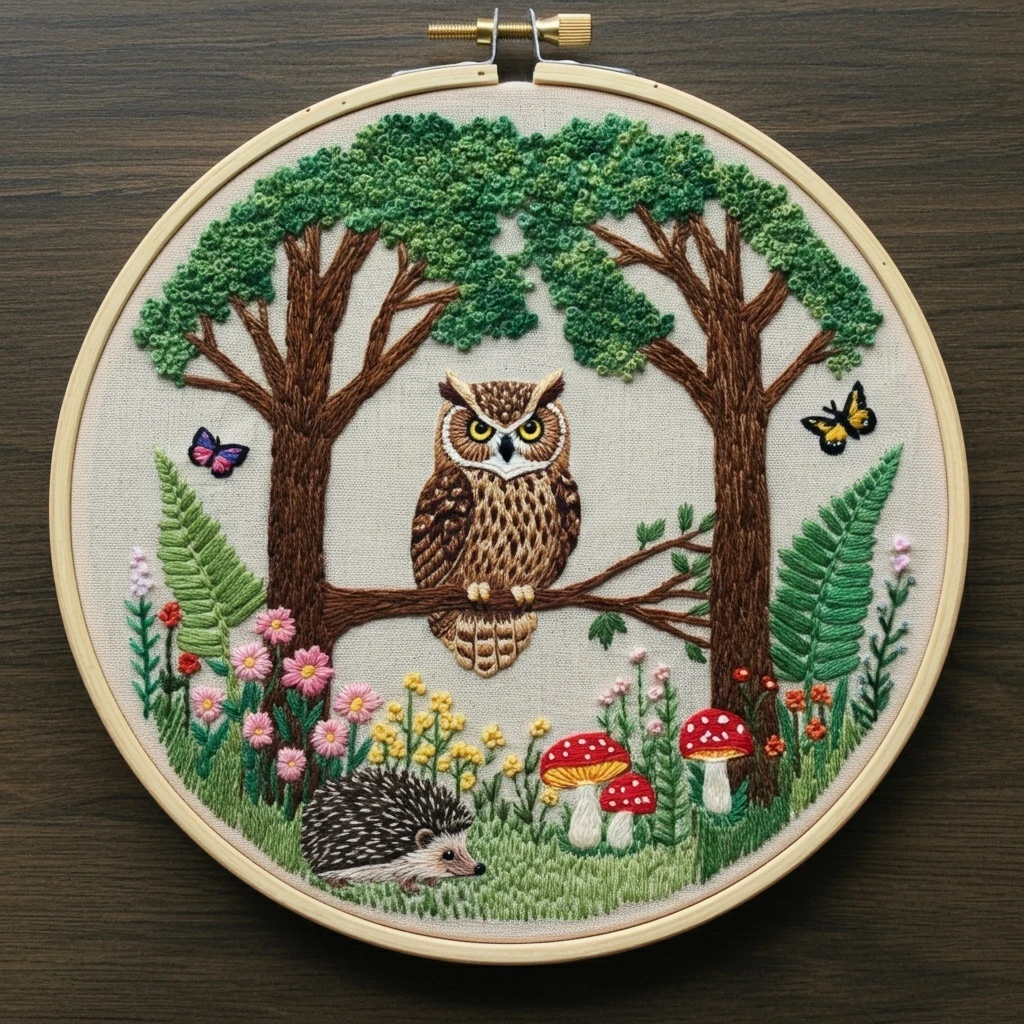
A cozy woodland hoop featuring a watchful owl on a branch, a small hedgehog in the grass, red-capped mushrooms, ferns, flowers, butterflies, and textured tree canopies. The palette balances deep evergreen foliage, warm bark browns, tawny owl feathers, cheerful wildflower accents, and crisp mushroom reds.
Core DMC Palette
Use these colors as a practical matched set. The design benefits from close-value greens and browns so leaves, bark, fur, and feathers do not look flat.
Stitch Map by Design Area
Work from background to foreground: trunks first, broad foliage next, animals, then flowers, mushrooms, and final outline accents.
| Area | Stitches & thread count | Practical notes |
|---|---|---|
| Tree canopies | French knots or colonial knots, 3 strands; mix 895, 699, 3347, 3348. | Cluster knots irregularly rather than in rows. Put darker knots under branches and inside canopy gaps; add light green last on the top edge. |
| Tree trunks & branches | Stem stitch and split stitch, 3–4 strands; long-and-short fill with 801, 976, 3371. | Follow the branch direction. Alternate warm medium brown with dark brown to create ridges; do not overblend or the bark will lose character. |
| Owl body | Long-and-short stitch, fishbone stitch, detached chain feather marks, 1–2 strands for detail. | Build the owl in small feather rows. Use 3371 at the outer edge, 801 for shadow feathers, 976 and 436 for center highlights. |
| Owl face & eyes | Satin stitch for eyes, split stitch face rings, tiny straight stitches for beak. | Keep the eyes crisp with 1 strand of 3371 outline. Use 744 for the iris and add a tiny 3865 catchlight only after all surrounding stitches are complete. |
| Hedgehog | Straight stitch quills with 1–2 strands; satin or split stitch for face. | Stagger quills in short strokes, mixing 3371 and 3865 for the spiky back. Use 436 softly on the snout and one black-brown stitch for the nose. |
| Ferns & grasses | Fishbone stitch for fern fronds, straight stitch for grass, 2 strands. | Use a central vein first, then angle leaves outward. Vary greens so the lower meadow feels layered and natural. |
| Mushrooms | Satin stitch caps, split stitch stems, French knots for white spots. | Shade red caps with 321 at the top and a touch of 801 or 976 at the lower curve. Keep white spots raised and uneven. |
| Flowers & butterflies | Lazy daisy petals, French knot centers, back stitch butterfly outlines. | Use 3688 for pink blossoms, 744 for yellow flowers, and 3371 for crisp butterfly bodies and wing edges. |
Blending, Shading & Texture
The charm of this design comes from tactile contrast: chunky leaf knots, smooth eyes and mushrooms, directional bark, and fine animal details.
Blended needle ideas
- Canopy depth: load 1 strand 895 + 1 strand 699 for shaded foliage knots, then switch to 699 + 3347 for mid-light clusters.
- Bark ridges: combine 1 strand 801 + 1 strand 976 for warm bark transitions, reserving 3371 for the deepest grooves.
- Owl feathers: use 1 strand 801 + 1 strand 436 in the chest for speckled tawny softness.
- Meadow variation: blend 3347 + 3348 for fresh grass tips and fern highlights.
Outlining details
- Use 1 strand of 3371 for the owl eyes, beak separation, hedgehog nose, butterfly bodies, and mushroom cap edges.
- Use 2 strands of 801 for branch outlines so the woodland structure stays visible behind animals and plants.
- Outline only the shadow side of fern leaves; a full dark outline can make them look stiff.
- For flowers, outline selectively after petals are stitched, not before, so the petals remain soft and rounded.
Texture tip
Keep thread tension relaxed on French knots and animal fur. Slightly raised stitches give the canopy, quills, and flower centers a dimensional woodland feel.
Beginner-Friendly Working Order
This order keeps the hoop neat and prevents tiny foreground details from being crushed while you work large textured areas.
Anchor the forest
Stitch trunks, major branches, and the main owl branch first using stem stitch and split stitch. Keep branch ends tapered.
Add leafy volume
Fill canopies with mid-green knots, then add dark knots in shadow pockets and light knots as final highlights.
Build the animals
Stitch the owl from outer body inward, then face details. Add the hedgehog quills with short uneven strokes.
Layer the meadow
Place tall stems and ferns before flowers. Use different stitch lengths so the ground does not become a flat green band.
Finish mushrooms
Satin stitch caps and stems, then add raised white French-knot spots and dark lower-cap shading.
Clean final accents
Add butterfly outlines, eye glints, flower centers, and any missing dark outline only at the end.
Thread-Count Guidance
Adjust strand count to your hoop size: fewer strands for a small 5–6 inch hoop, more for a larger 8 inch display hoop.
Use more strands for
- Tree trunks and thick branches: 3–4 strands.
- Canopy knots: 3 strands for a plush treetop effect.
- Large mushroom caps: 3 strands for smooth coverage.
- Foreground grass clumps: 2–3 strands where texture should show.
Use fewer strands for
- Owl face rings, pupils, beak, and feather markings: 1 strand.
- Butterfly wing outlines and antennae: 1 strand.
- Hedgehog facial details: 1 strand.
- Fine stems, flower outlines, and tiny mushroom spots: 1–2 strands.