
Four Seasons Weather Wheel
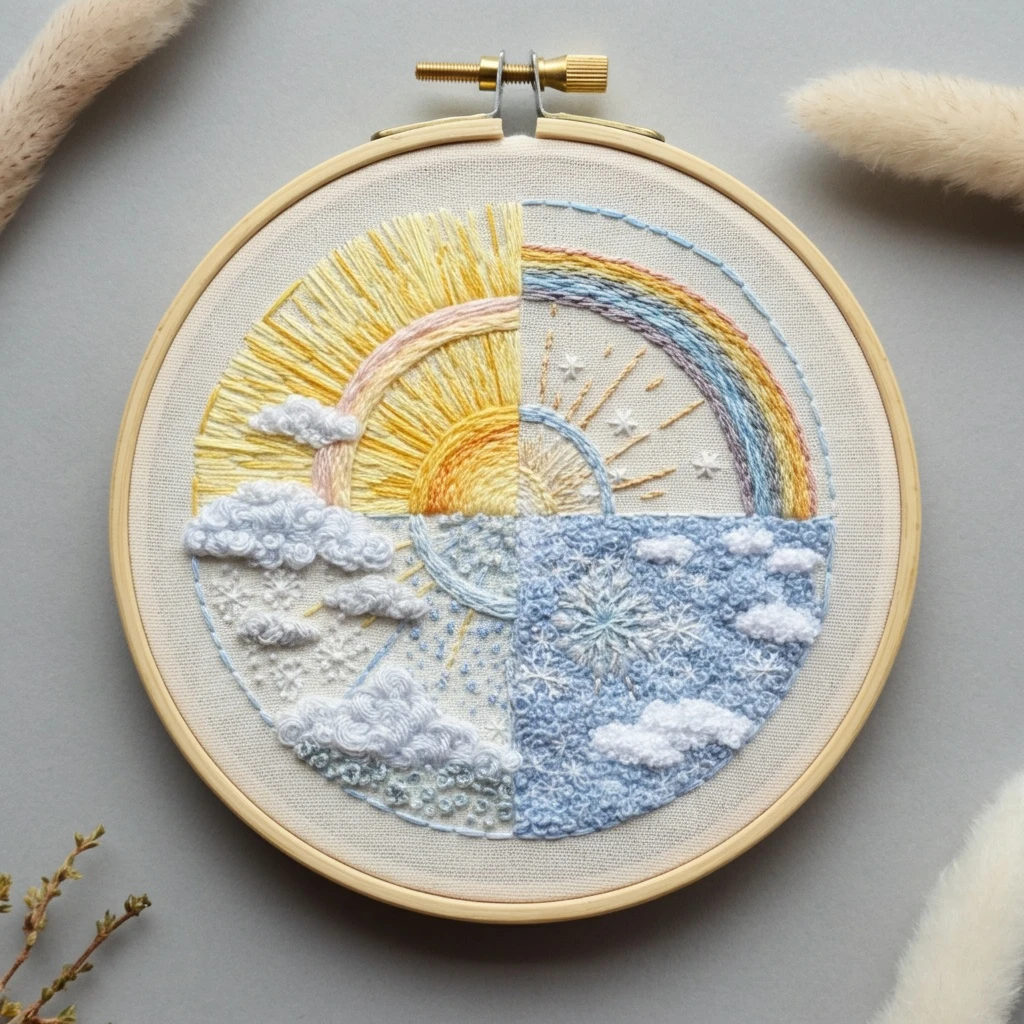
A polished thread guide for a circular seasonal design with spring blossoms, summer sun and sky, autumn leaves, and cool winter weather motifs. The palette balances fresh greens, golden light, warm foliage, cloud whites, and soft shadow tones so each quadrant feels distinct while the wheel remains cohesive.
Design read
The artwork is a round, storybook-style weather wheel divided into seasonal scenes. Expect tiny icons and curved borders: clouds, raindrops, sun rays, foliage, flowers, wind or snow marks, and small landscape accents. The strongest visual need is separation between seasons without making the hoop look patchy.
Suggested DMC palette
Use these colors as a practical hand embroidery palette rather than a strict chart. The notes explain where each floss color works best and how to combine it with neighboring tones for smoother miniature shading.
Thread-count guidance
- 1 strand: fine outlines, snowflakes, raindrops, tiny flower stems, and small inner weather marks.
- 2 strands: most filled motifs, leaves, clouds, sun rays, hills, and quadrant borders.
- 3 strands: raised accent knots, bold outer ring, fluffy cloud edges, or heavy autumn leaf clusters.
- Blending: combine one strand of a light color with one strand of its darker neighbor for gentle transitions on sky, leaves, and rust foliage.
Color blending ideas
- Spring greens: 1 strand DMC 772 + 1 strand DMC 732 for fresh leaves that are not too neon.
- Summer sky: feather DMC 3756 into DMC 3841, then add one edge line in DMC 3761.
- Autumn leaves: blend DMC 741 with DMC 921; reserve DMC 300 for stem notches and deepest folds.
- Winter clouds: use DMC 3865 on top edges, DMC 3024 below, and tiny DMC 645 stitches only where definition is needed.
Stitch map by design element
Shading and texture notes
For a compact weather wheel, shading should be controlled and readable. Work from the lightest value first, then add midtones, then finish with the darkest outline. This prevents tiny seasonal icons from becoming muddy.
- Use directional stitches that follow each shape: rays outward, leaves from base to tip, clouds around the curve.
- Place darker stitches at the inner corners of each quadrant to increase depth while keeping the perimeter bright.
- Use seed stitch sparingly in grass, snow, and autumn ground to suggest texture without overfilling the design.
- Keep white highlights last so they sit cleanly on top of sky, snow, and cloud sections.
Outlining details
Because the design contains many tiny seasonal symbols, outlines should be fine and selective. A full heavy outline around every object can flatten the wheel; instead, use darker lines only where two similar colors meet.
- Use DMC 645 for cool outlines around winter weather, clouds, raindrops, and snow marks.
- Use DMC 300 for warm outlines around autumn leaves, trunks, baskets, or earthy scenery.
- Use DMC 936 only in the deepest green areas, especially under leaves and inside evergreen shapes.
- For flowers, outline only the shadow side with one strand of DMC 3803.
Season-by-season stitching plan
| Section | Main colors | Best stitches | Practical tip |
|---|---|---|---|
| Spring | DMC 772, 732, 3716, 3803 | Lazy daisy, fishbone, French knots, stem stitch | Keep blossoms bright by using pink knots over green stems after all leaves are finished. |
| Summer | DMC 3841, 3761, 725, 741, 3865 | Satin stitch, straight stitch, split stitch | Work sun rays before the sky outline so they tuck neatly into the quadrant. |
| Autumn | DMC 741, 921, 300, 732 | Detached chain, seed stitch, back stitch | Alternate copper and tangerine leaves rather than grouping one color in a block. |
| Winter | DMC 3756, 3865, 3024, 645 | French knots, straight stitch, split stitch | Use fewer dark grey stitches than you think; winter reads best when airy and pale. |
Beginner-friendly order of work
Start with the circle and quadrant divider lines, then fill the largest background shapes, then stitch medium motifs, and finish with small details such as knots, raindrops, snowflakes, flower centers, and fine outlines. This order keeps the hoop tidy and reduces snagging on raised stitches.
Finishing tips
- Use a sharp embroidery needle for tight details and switch to a slightly larger needle for 3-strand texture stitches.
- Anchor thread away from pale winter and sky areas so dark tails do not show through light fabric.
- Trim thread tails frequently; compact wheel designs can become bulky on the back.
- Press face down on a towel after stitching to protect French knots and raised texture.
Compact palette summary
For a smaller hoop, reduce the palette to eight essentials: DMC 725, 741, 921, 300, 772, 732, 3841, and 3865. Add DMC 645 only for cool outlines and DMC 3803 only if the floral details need stronger contrast.