
Garden Insects Collection
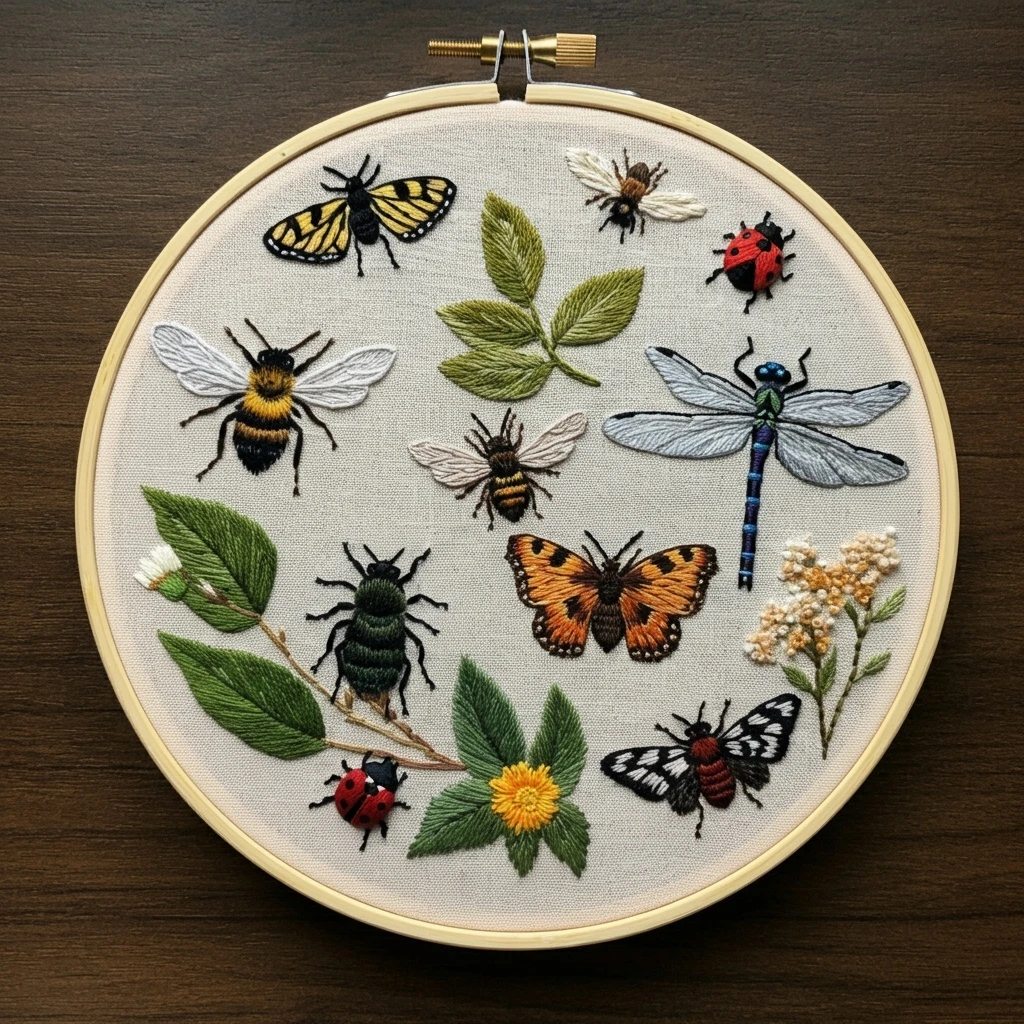
A lively sampler hoop of bees, butterflies, beetles, ladybugs, a dragonfly, leafy stems, white flower clusters, and a golden garden bloom. The reference image uses bold black outlines, warm insect markings, cool translucent wings, and many greens, so contrast and stitch direction are the keys to keeping every tiny creature readable.
Design read
The design is arranged like a naturalist's collection inside a hoop: individual insects float around central leaves and small blossoms, with negative space between each motif. The most visible elements are the yellow-and-black butterfly, fuzzy bees, red ladybugs, orange butterfly, blue-green dragonfly, black-and-white moth, green beetle, and layered foliage. Work the outlines first or early, then fill wings and bodies with controlled stitch direction so each small form remains crisp.
Suggested DMC floss palette
Use this palette as a practical match to the artwork rather than a rigid chart. The insects need strong dark lines, while wings and leaves benefit from one-strand tonal changes.
Stitch plan by motif
Butterfly wings
Outline with split stitch in 310, then fill panels with satin stitch or long-and-short in 743, 721, and 920. Keep stitches angled from wing base to outer edge for a natural fan shape.
Bees
Use turkey work, dense split stitch, or short padded satin for fuzzy thoraxes. Alternate 310, 898, 743, and 3821 bands; brush the thread lightly for softness only after finishing nearby details.
Dragonfly
Work wings with 1 strand of 3756 in long straight stitches, then add 927 vein lines. Stitch the body in small satin bands using 310, 3844, and 333 for iridescent blue-purple contrast.
Ladybugs
Padded satin stitch makes the red shells rounded. Use 321 in the center, 815 at the lower side, and 310 for the head, dividing line, dots, legs, and tiny antennae.
Green beetle
Use fishbone or split satin stitch in 699, 702, and 3844. A few blue stitches down the back create the shiny beetle effect seen in the reference.
Leaves
Fishbone stitch is ideal for large leaves. Start with 699 or 730 near the center vein, then work outward with 702 and 3012 highlights.
Flower clusters
Cluster French knots in Blanc, 739, 3821, and occasional 743. Use 1 wrap for tiny buds and 2 wraps for foreground blossoms.
Legs and antennae
Use 1 strand of 310 in backstitch, stem stitch, or couching. Keep these lines last when possible so they stay crisp over filled bodies and wings.
Thread-count guidance
Because this design has many small insects, changing strand count is more important than adding extra colors.
| Area | Suggested strands | Practical note |
|---|---|---|
| Fine legs, antennae, wing veins | 1 strand | Use a short needle path and avoid long floats. One strand keeps the insects delicate rather than cartoon-heavy. |
| Wing fills and translucent areas | 1 strand, occasionally 2 | Let the fabric show through pale wings. Add only a few 927 or 3756 strokes for veining. |
| Butterfly and ladybug bodies | 2 strands | Two strands provide saturated color while still allowing small black details to remain readable. |
| Leaf fills | 2 strands | Use a smooth tension and consistent stitch direction. Blend greens by changing one strand at a time. |
| Raised bee fuzz and flower knots | 2-3 strands | Use more strands only for texture areas. Keep knots compact so they do not crowd the surrounding motifs. |
Blending, outlining & shading
Blend one strand 743 with one strand 3821 for the large yellow butterfly when you want a softer, more natural yellow than solid 743.
Blend 721 + 920 at the butterfly wing bases, then switch to 721 alone near the outer wing edge for a glowing center.
For the dragonfly abdomen, alternate 3844 and 333 bands, then place one tiny Blanc stitch on the highest point of the head or thorax.
Use 699 for shadows, 702 for main leaf color, 3012 for light, and 730 when a leaf should feel olive rather than bright.
Do black dots, wing spots, and legs with a sharp needle and 1 strand after the main fills. This avoids fuzzy edges and keeps markings precise.
Instead of filling all white wings solidly, use Blanc and 3756 in spaced straight stitches. The linen showing through will make them look light.
Practical embroidery tips
- Use a hoop that keeps the fabric drum-tight; tiny insect legs become wobbly if the ground fabric slackens.
- Shorten strand lengths to about 35-40 cm when stitching black outlines so the floss stays smooth and does not fuzz.
- For paired wings, stitch both left and right wings in the same session so stitch angle and tension match.
- Do not overpack the dragonfly wings. A few clean vein lines look more realistic than a dense filled area.
- Use a laying tool or needle tip to smooth satin stitches on ladybugs and butterfly panels.
- Anchor dark threads away from pale wings; carrying black behind light stitches can show through on linen.
- When adding French-knot flower clusters, vary Blanc, 739, 3821, and 743 randomly to avoid a dotted grid effect.
- Press finished work face down on a towel so raised bee bodies and flower knots are not flattened.