
DMC palette & stitching notes
Goldenrod Yellow Floral
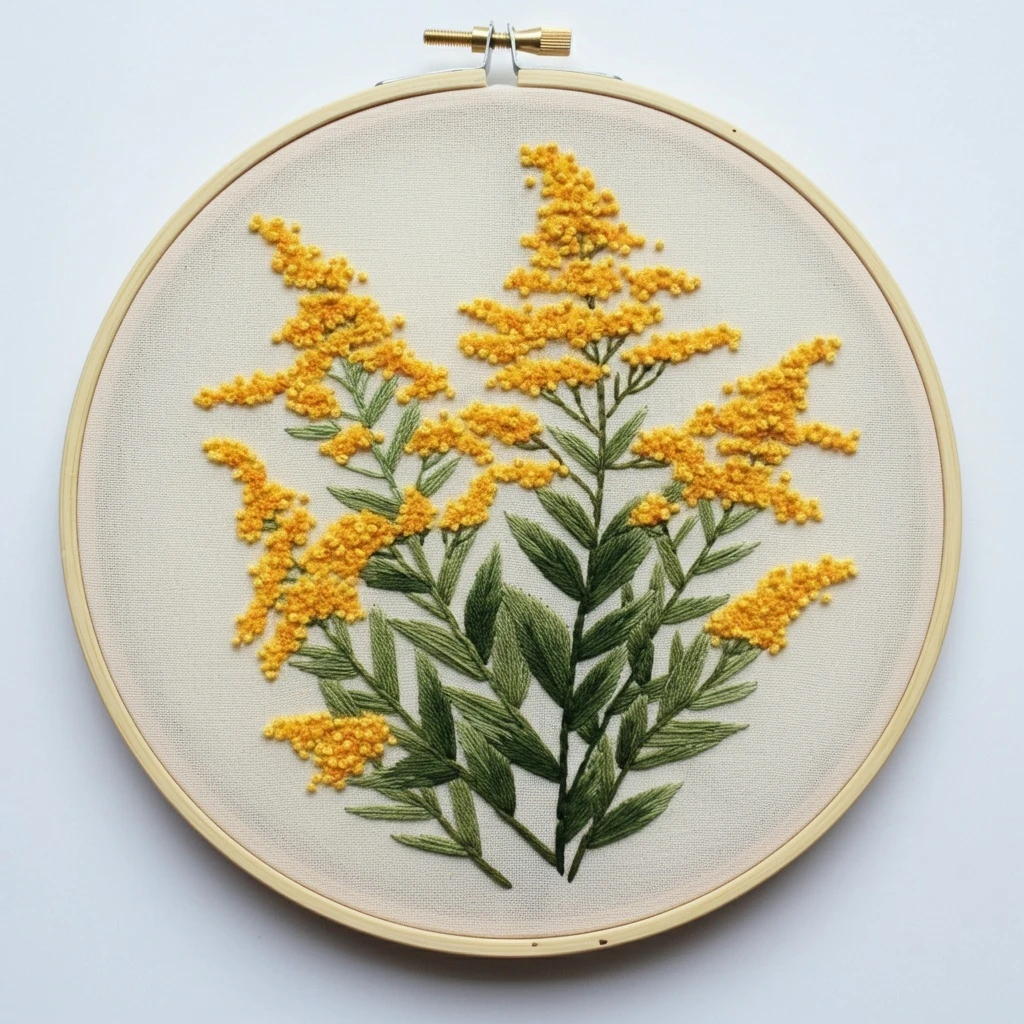
A bright botanical hoop with clustered goldenrod plumes, fine green stems, layered lance-shaped leaves, and soft natural linen showing through. The embroidery reads best when the flower heads are raised and stippled while the foliage stays sleek, directional, and slightly shaded.
Observed Color Story
The design is dominated by golden yellow flower clusters, muted olive leaves, deeper forest-green stems, a few warm brown shadow touches, natural cream linen, and pale wood hoop tones. Keep the yellow range lively but not neon: mix lemon highlights with goldenrod and honey shadows so the clustered blossoms look dimensional.
Stitch Map
The reference relies on contrast between nubby flower masses and smooth stitched greenery. Keep flower stitches raised and irregular; keep leaves neat and directional.
| Design area | Recommended stitches | Thread count | Practical notes |
|---|---|---|---|
| Goldenrod flower clusters | French knots, colonial knots, seed stitch | 2–3 strands | Use 2 strands for smaller dots and 3 strands for foreground clusters. Vary knot wraps from 1–2 so the blooms do not look mechanically even. |
| Large yellow plumes | Clustered French knots over light backstitch stems | 2 strands for stems, 2–3 for knots | Work the hidden green branch lines first, then add knots from darkest yellow at the base to brightest yellow on top edges. |
| Lance-shaped leaves | Fishbone stitch, long-and-short stitch, satin stitch | 1–2 strands | Angle stitches from the central vein outward. Use 3012 on one side, 3052 on the lit side, and 3362 near the base. |
| Main stems | Stem stitch, split stitch, whipped backstitch | 1–2 strands | Use 3362 or 934 for central stems. A whipped backstitch gives smooth botanical lines without bulk. |
| Fine leaf veins | Straight stitch, single-strand backstitch | 1 strand | Keep veins light and short. Too many dark veins can flatten the airy garden feel. |
| Tiny loose pollen dots | Single French knots or seed stitches | 1–2 strands | Scatter a few DMC 444/743 dots outside the flower heads to mimic the natural irregular silhouette. |
Blending & shading plan
- Flowers: Start with DMC 742 in the densest center areas, add DMC 743 across the main bloom, then place DMC 444 on the outer tips.
- Deep flower shadows: Add only a few DMC 780 knots underneath heavy clusters; one dark knot can suggest depth better than a full outline.
- Leaves: Blend one strand DMC 3012 with one strand DMC 3052 for mid leaves; switch to 3362 + 3012 for lower leaves.
- Stems: Use DMC 934 only in the very center or where stems overlap, then soften with 3362 beside it.
Texture suggestions
- Work flower clusters after all leaves and stems so the yellow knots sit proudly on top.
- Use a milliner needle for smoother French knots, especially with 3 strands.
- Leave tiny linen gaps between some knots; goldenrod should look airy and granular, not like a solid fill.
- For a plush focal bloom, add a few colonial knots over the French-knot layer near the front edges.
Thread-count guidance
1 strand
Fine veins, delicate side stems, small backstitch corrections, and the darkest outlining marks. Best for keeping the design refined.
2 strands
Main leaves, most stems, standard French knots, and the majority of the floral texture. This is the safest default.
3 strands
Use only for the largest foreground yellow knots or a few raised flower clusters. Too much 3-strand work can become bulky.
Beginner-friendly stitching order
Outlining details
Do not outline every flower head. The reference image looks soft because the blossom edges are formed by individual knots. Reserve outlining for stems, leaf midribs, and a few lower leaf edges. For leaves, a single-strand backstitch in DMC 3362 gives definition without a cartoon border.
Fabric & finishing tips
Natural cotton or linen in cream, oatmeal, or pale beige suits the warm botanical palette. Keep fabric drum-tight while making knots, and use short thread lengths to prevent the yellows from fuzzing. Press face down on a towel after stitching so raised knots are not flattened.