
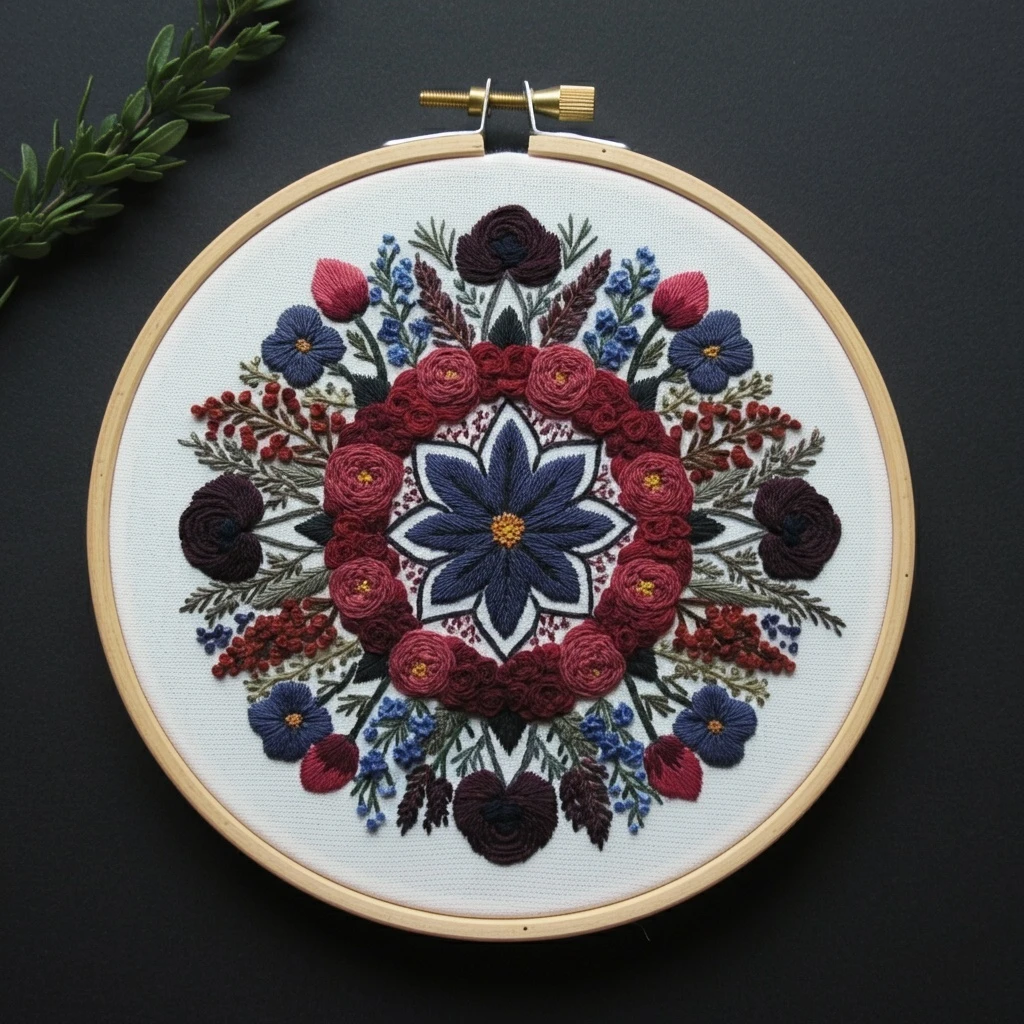
Gothic Floral Wreath in Jewel Tones
A dramatic symmetrical wreath built from garnet roses, midnight-blue petals, plum blossoms, berry clusters, blue sprigs, and dark olive greenery. The design reads ornate and gothic, but the stitching plan keeps it approachable: strong outlines, layered satin stitches, raised floral texture, and small seed details for sparkle.
Color read from the artwork
The reference image centers on a deep navy star-shaped flower surrounded by a dense wine-red rose ring. Outer motifs include black-plum flowers at the compass points, dusty rose buds, royal-blue blossoms and berries, muted pine fronds, wine seed clusters, and golden centers. A pale fabric ground and wooden hoop make the jewel tones feel saturated and crisp.
Natural or winter-white linen/cotton, 6–8 in hoop
Chenille #22–24 for 3 strands; embroidery #7–9 for 1–2 strands
Mix matte cotton with optional metallic gold for the flower centers
Polished DMC Palette
Use the darkest shades sparingly for gothic depth, then let the garnets, blues, and rose tones carry the floral richness. The palette below is intentionally practical: each shade has a job so the wreath stays organized while still looking lush.
Deep shadows inside rose spirals and the lower edge of burgundy clusters.
Primary red for the central rose wreath and berry clusters.
Outer rose rims, dramatic accents, and darker wine-red berries.
Dusty red buds and highlight strokes on raised roses.
Near-black plum flowers and moody shading in gothic petals.
Central flower shadows, blue flower outlines, and crisp graphic edges.
Main fill for the large blue center flower and lower blue petals.
Small blue blossoms, berry highlights, and petal tips.
Dark leaf bases and the deepest green separators between flowers.
Main fern stems, leaf outlines, and botanical framework.
Leaf highlights and softer frond tips so greenery does not go flat.
Flower centers, tiny golden dots, and warm accents in the hoop-like glow.
Low lights in centers; mix with 783 for a dimensional pollen texture.
Fine blackened outlines when pure black would feel too harsh.
Tiny deepest accents only: gothic petal clefts, under-stems, and final dots.
Optional light catching stitches on pale outlines or to clean up negative space.
Stitch Map for the Design Elements
Long & short satin shading
Work each petal from the outside toward the center using 823 and 939, then add 792 on the upper ridges. Follow the petal direction rather than stitching straight across.
Woven wheel or spiral rose
Use 815 as the body color, tuck 814 into the lower spirals, and finish with a few 326 stitches on petal lips for lifted rose texture.
Padded satin stitches
Lay a small foundation of 154 before satin stitching over it. Add one narrow 310 or 3799 line at the base to create the gothic almost-black look.
Fly stitch + straight stitch
Use 3362 for stems and 3363 for alternating leaf tips. Keep stitches long and tapered so the wreath stays delicate around dense flowers.
French knots
Use 2 wraps for small berries and 3 wraps for larger red clusters. Shade with 815 at the top and 902 at the bottom of each cluster.
Back stitch + whipped back stitch
Back stitch the geometric inner lines with 3799 or 939. Whip selected lines with matching blue or garnet for a smoother ornamental edge.
Thread Count, Blending & Shading
Thread-count guidance
- 1 strand: inner outlines, tiny veins, small stems, and delicate gothic linework.
- 2 strands: most petals, leaves, berry stems, and clean satin fills.
- 3 strands: raised woven roses, large berry knots, and bold outer accents.
- 4 strands only when needed: padded rose centers or heavy couching; avoid using it in fine areas.
Beginner-friendly order
- Start with the central navy flower so the design has a clear anchor.
- Stitch the circular rose wreath next, working opposite sides to keep tension even.
- Add leaves and stems before berries so small knots can sit on top.
- Finish with outlines, gold centers, and the darkest accent stitches last.
| Area | Blend | How to use it |
|---|---|---|
| Rose shadows | 1 strand 814 + 1 strand 815 | Use along lower rose spirals and where flowers overlap to create depth without making the wreath black. |
| Rose highlights | 1 strand 815 + 1 strand 326 | Add short strokes on the upper left of the rose coils for a velvet-petal glow. |
| Blue petals | 1 strand 823 + 1 strand 792 | Blend near tips and central ridges; keep 939 for the deepest separations. |
| Dark plum blooms | 1 strand 154 + 1 strand 939 | Use sparingly for blackened purple petals while retaining a jewel undertone. |
| Greenery | 1 strand 3362 + 1 strand 3363 | Alternate with solid 3362 stems for natural, softly variegated foliage. |
| Gold centers | 1 strand 783 + 1 strand 782 | Cluster tiny straight stitches or French knots; add optional metallic thread only as a top accent. |
Outlining & Detail Finishing
Because this design has a symmetrical ornamental structure, outlines matter. Use 3799 for soft gothic definition on pale fabric, 939 for blue/purple floral edges, and 500 for deep green separations. Reserve pure 310 for the smallest deepest marks; too much black can flatten the jewel tones.
Shading strategy
- Place darker stitches where petals tuck under the rose ring or meet the center.
- Use shorter highlight stitches at petal tips rather than long bright bands.
- On berries, keep the darkest knots toward the center line of each spray.
- For gothic drama, outline only one side of a petal instead of tracing every edge equally.
Practical tips
- Use a washable fine-tip transfer pen and mark the center axes first to preserve symmetry.
- Keep fabric drum-tight; raised roses distort loose fabric quickly.
- Use shorter floss lengths for dark colors to reduce fuzz and visible wear.
- Step back after each quadrant to check balance before filling every small berry or leaf.