
DMC palette & embroidery notes
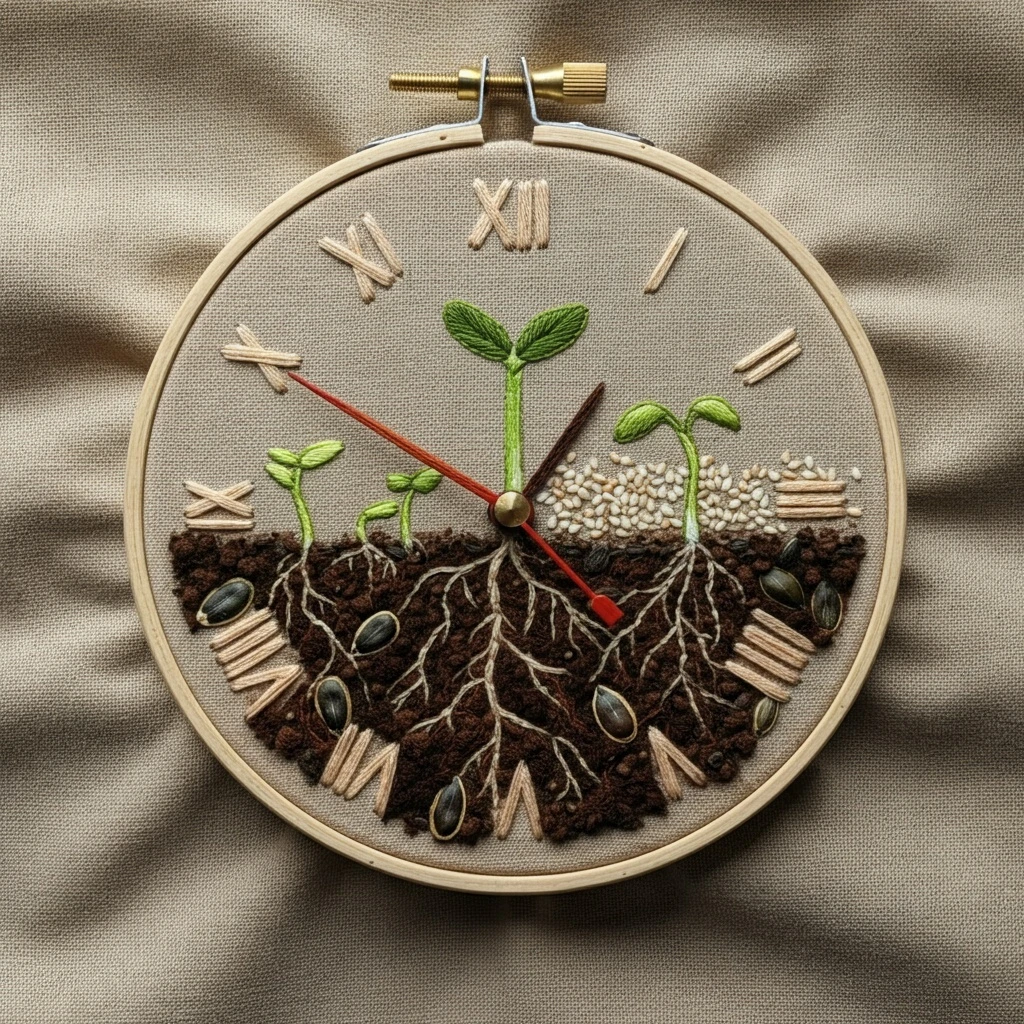
Growth Cycle Sprout Clock
A quiet botanical clock composition: linen background, cream Roman numerals, textured dark soil, pale tangled roots, glossy seeds, bright green sprouts, warm brass center pin, and red-brown clock hands. The palette below keeps the design natural, dimensional, and readable on neutral fabric.
Beginner-friendly detailsRoot texture & soil knotsFresh green sprout shadingClock-hand outlining
Suggested DMC floss palette
DMC 739 — Ultra Very Light TanRoman numerals, pale seed highlights, soft clock-face accents.
DMC 842 — Very Light Beige BrownHoop shadow, roots, dry straw strokes, and muted linen details.
DMC 3046 — Medium Yellow BeigeWarm wooden marks, brass glow around the clock center, and numeral shadows.
DMC 680 — Dark Old GoldCenter pin, warm clock hardware, tiny golden seed glints.
DMC 907 — Light Parrot GreenBright sprout edges, new leaf tips, and lively highlight stitches.
DMC 905 — Dark Parrot GreenMain stems and middle leaf veins; blend with 907 for soft growth.
DMC 3345 — Dark Hunter GreenDeep underside leaf shading and darker sprout bases.
DMC 938 — Ultra Dark Coffee BrownDeep soil base, root shadows, seed outlines, and darkest texture.
DMC 3371 — Black BrownSmallest soil knots, seed creases, and high-contrast underside details.
DMC 919 — Red CopperRed clock hand and warm rust accents in the moving-time motif.
DMC 3864 — Light Mocha BeigeRoot highlights, pale pebbles, and delicate seed cluster stitches.
DMC 3865 — Winter WhiteFinal bright specks on pebbles, roots, and numeral tops.
Stitch map
- Soil band: Work irregular French knots, colonial knots, and tiny seed stitches in 938 and 3371. Vary knot size so the soil looks crumbly rather than dotted.
- Roots: Use split stitch or stem stitch with 3864, then couch a few longer root lines with one strand of 842 for natural branching.
- Sprouts: Use satin stitch for leaf halves, placing stitches from vein to edge. Add a central stem stitch vein in 3345.
- Clock hands: Keep them sharp with whipped back stitch or couching; use 919 for the red hand and 938 for the dark hand.
Thread-count guidance
- 1 strand: Fine roots, seed shine, leaf veins, clock-hand tips, and small corrections.
- 2 strands: Main outlines, sprout stems, Roman numerals, seed borders, and most visible lines.
- 3 strands: Soil texture, chunky straw-like clock marks, and bold foreground root trunks.
- 4 strands or perle cotton: Optional for raised soil only; test first so the lower half does not overpower the sprouts.
Blending & shading ideas
- Blend one strand 905 with one strand 907 for fresh leaf mids; switch to 3345 near the base to show older, shaded growth.
- For the soil, mix 938 and 3371 in the needle on random knots. Add a few 842 knots sparingly for dry crumbs catching light.
- Use 3864 over 842 for roots: darker first, lighter on top, so the root web sits above the dark soil.
- For the brass center, stitch a small circle in 680 and add one short 3865 highlight at the upper-left edge.
Texture suggestions
- Keep the top clock area flatter and cleaner, then make the lower soil half more raised to emphasize the underground growth cycle.
- Angle leaf satin stitches like veins rather than filling straight across; it gives the leaves the ribbed look visible in the reference.
- Scatter seed cluster stitches with off-white beads or French knots if desired, but keep them low and tight.
- Use long-and-short stitch for the large center sprout stem so it fades from light at the top to darker near the soil.
Beginner-friendly stitching plan
Start with all clock marks and hands while the fabric is clean and taut. Next stitch the sprout stems and leaves, then the roots, and save the soil knots for last. This order prevents dark soil fibers from catching in pale roots and keeps the delicate clock details crisp.
Practical tips
- Use a water-soluble pen and mark only the main clock positions; leave tiny soil lumps freehand for a more organic finish.
- Keep the fabric drum-tight in the hoop before stitching the clock hands so straight lines do not bow.
- When stitching roots, stop and start often instead of carrying thread behind the dark soil; it prevents pale threads showing through.
- If a leaf looks too flat, add two single-strand 3345 stitches from the base toward the tip as shadow veins.
Finishing notes
- Trim jump threads behind the numeral area so shadows do not show through the linen.
- Gently steam from the back over a towel to preserve raised knots and seed texture.
- Frame with the soil line perfectly horizontal; the clock motif reads best when the root zone anchors the lower half.
- For a special finish, add one metallic gold sewing thread couched around the center pin only, not throughout the design.