
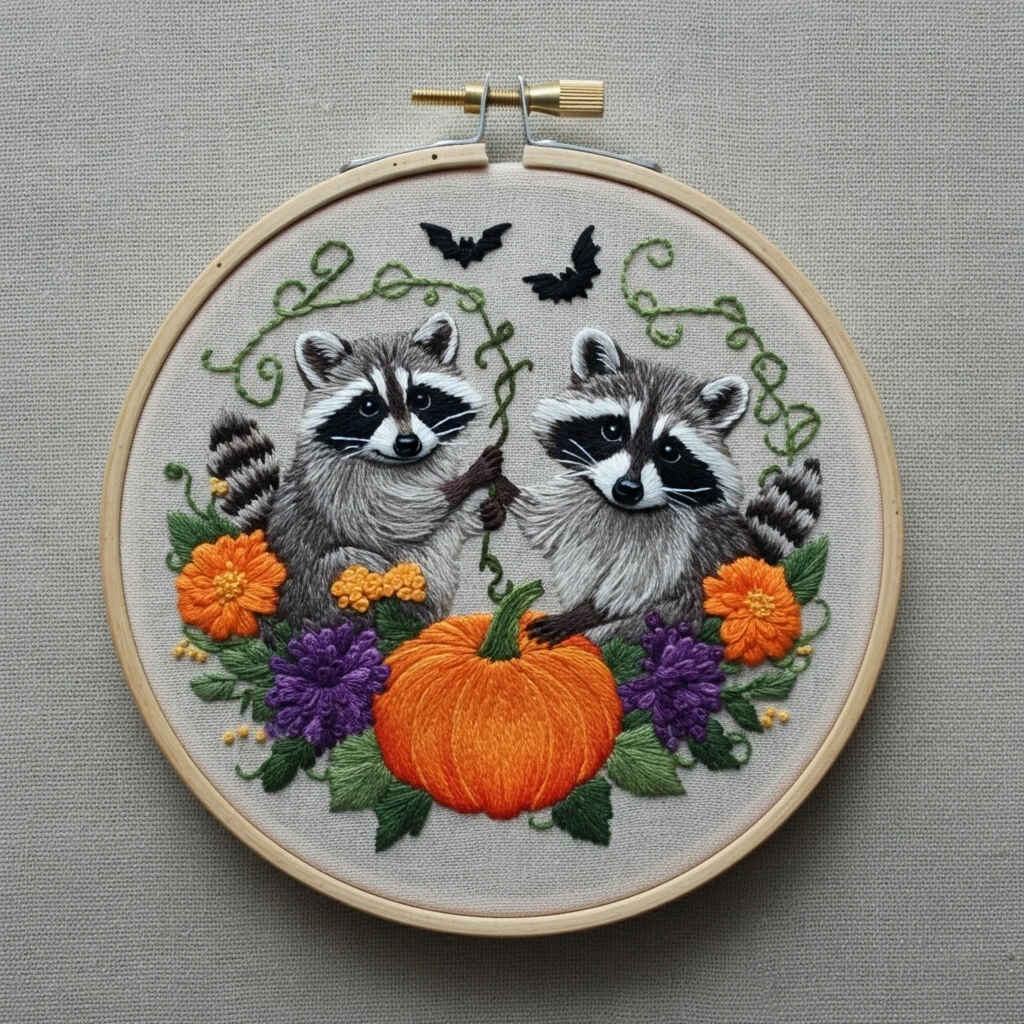
Halloween Raccoons and Pumpkin Wreath
A cheerful autumn hoop with two soft raccoons peeking from a pumpkin-and-flower wreath. The artwork balances realistic gray fur, a glowing orange pumpkin, deep purple chrysanthemums, marigold blossoms, mossy vines, striped tails, and tiny black bats for a playful Halloween finish.
Color read from the artwork
The reference image is stitched on warm natural linen. The raccoons use layered pewter, charcoal, white, and warm brown threads for fluffy faces and ringed tails. The wreath is vivid and seasonal: saturated pumpkin orange, darker rib shadows, yellow-orange flower centers, purple mums, leafy greens, olive vine curls, and small black bat silhouettes above the animals.
Natural linen or cotton-linen, 7–8 in hoop
Embroidery #7–9 for 1–2 strands; chenille #22 for thicker flowers
Keep fur stitches directional and let the pumpkin and flowers sit slightly raised in front.
Polished DMC Palette
This palette keeps the design readable: neutral grays for raccoon faces, hot harvest oranges for the pumpkin and marigolds, deep violet for the mums, and layered greens for the wreath. Use the darkest shades only for eyes, masks, tail rings, bats, and final definition.
Bat silhouettes, raccoon pupils, nose tips, deepest face mask shadows, and final tail-ring accents.
Soft black alternative for mask edges, ears, tail bands, and fur creases.
Main medium-gray raccoon fur, especially cheeks, shoulders, and tail stripes.
Secondary fur strokes and transitional shading around ears and muzzles.
Bright muzzle, brow flashes, ear rims, and highlights between darker fur strokes.
Tiny eye shine, clean muzzle tips, and final bright whisker marks.
Branch handle, paws, warm shadows in tails, and muted outlines where black is too stark.
Main pumpkin body and large orange flower petals.
Bright upper pumpkin highlights, petal tips, and warm glow on marigold petals.
Pumpkin rib shadows, lower petal bases, and autumn warmth under the flower heads.
Yellow-orange flower centers, small berries, and dotted pollen texture.
Deeper knot centers for marigolds and small warm highlights in the wreath.
Deep centers and shaded undersides of the purple chrysanthemums.
Main purple mum petals and rounded flower volume.
Dark leaf bases behind the pumpkin and flower clusters.
Main leaves, pumpkin stem highlights, and medium foliage fills.
Curly vine outlines and olive-toned tendrils around the top wreath.
Leaf highlights and lighter vine tips to keep the greenery from looking heavy.
Stitch Map for the Design Elements
Long & short fur stitch
Use 317 and 414 as the base, tuck 3799 into mask shadows, and add 762/3865 in short strokes around brows, cheeks, and muzzles. Always stitch in the direction the fur grows.
Curved satin shading
Fill each rib separately with 721, blend 741 through the center, and place 922 in the grooves. Curving the stitches vertically makes the pumpkin look round.
Detached chain petals
Build petals with lazy daisy stitches in 721 and 741. Add 742 or 783 French knots in the center for a raised marigold texture.
Layered straight stitches
Work dense short stitches from the outer edge inward, alternating 552 and 550. Let some stitches overlap for fluffy chrysanthemum volume.
Fishbone + stem stitch
Use 895 for the leaf base, 699 for the main fill, and 3012 for one side of the vein. Curly vines look best in neat stem stitch with 3011.
Back stitch and satin fill
Outline each bat with one strand of 310, then fill with tiny satin stitches. Finish eyes, noses, whiskers, and paw tips after the larger areas are complete.
Thread Count, Blending & Shading
Thread-count guidance
- 1 strand: whiskers, eye shine, vine curls, bat outlines, and the finest fur marks.
- 2 strands: raccoon fur, pumpkin satin ribs, leaves, and most flower petals.
- 3 strands: French knot flower centers, full purple mum clusters, and raised pumpkin stem texture.
- 4 strands only sparingly: padded knots or bold dimensional accents; avoid thick thread on facial details.
Beginner-friendly order
- Start with the large pumpkin and leaves so the foreground framework is established.
- Stitch raccoon faces before the surrounding flowers; it is easier to keep expressions clean.
- Add flowers and berries next, working from the center outward for balance.
- Finish with vines, bats, tail rings, noses, whiskers, and eye highlights.
| Area | Blend | How to use it |
|---|---|---|
| Soft gray fur | 1 strand 317 + 1 strand 414 | Use for middle fur on cheeks and shoulders; scatter short stitches so it looks fluffy rather than striped. |
| Raccoon mask depth | 1 strand 3799 + 1 strand 310 | Reserve for the darkest areas around eyes, nose, and tail bands; use very short strokes. |
| Bright muzzle | 1 strand 762 + 1 strand 3865 | Place lightly on top of gray fur around the mouth and brows to create a clean expressive face. |
| Pumpkin glow | 1 strand 721 + 1 strand 741 | Blend down the center of each rib, then stitch solid 922 in the grooves for strong autumn contrast. |
| Purple chrysanthemums | 1 strand 550 + 1 strand 552 | Use inside dense petal clusters so the flowers feel deep without turning black. |
| Layered foliage | 1 strand 699 + 1 strand 3012 | Best for top leaf highlights and brighter vine tips; keep 895 behind the flowers for depth. |
Outlining, Texture & Practical Finishing
The design succeeds when the small details stay crisp. Use 3799 instead of pure black for most animal outlines, then save 310 for eyes, noses, bat shapes, and the deepest tail rings. The pumpkin can be boldly stitched, but the fur needs light, broken stitches with visible changes in direction.
Shading strategy
- Make the darkest raccoon marks shortest; long black stitches can look harsh on the face.
- Shade the pumpkin grooves from bottom to top so the lower edge feels heavier and rounded.
- Add leaf shadows behind flowers, not on top of them, to keep the wreath layered.
- Use slightly brighter orange on the upper flower petals and deeper copper near the centers.
Beginner-friendly tips
- Transfer the raccoon eyes, noses, and pumpkin ribs carefully; these guide the whole expression.
- Use short floss lengths for 310 and 3799 to avoid fuzzy dark outlines.
- Hoop the linen drum-tight before making French knots so the knots sit on the surface.
- Work in mirrored sections of the wreath so the left and right sides remain visually balanced.