
DMC palette & hand embroidery notes
Hand Embroidered Cantaloupe Harvest
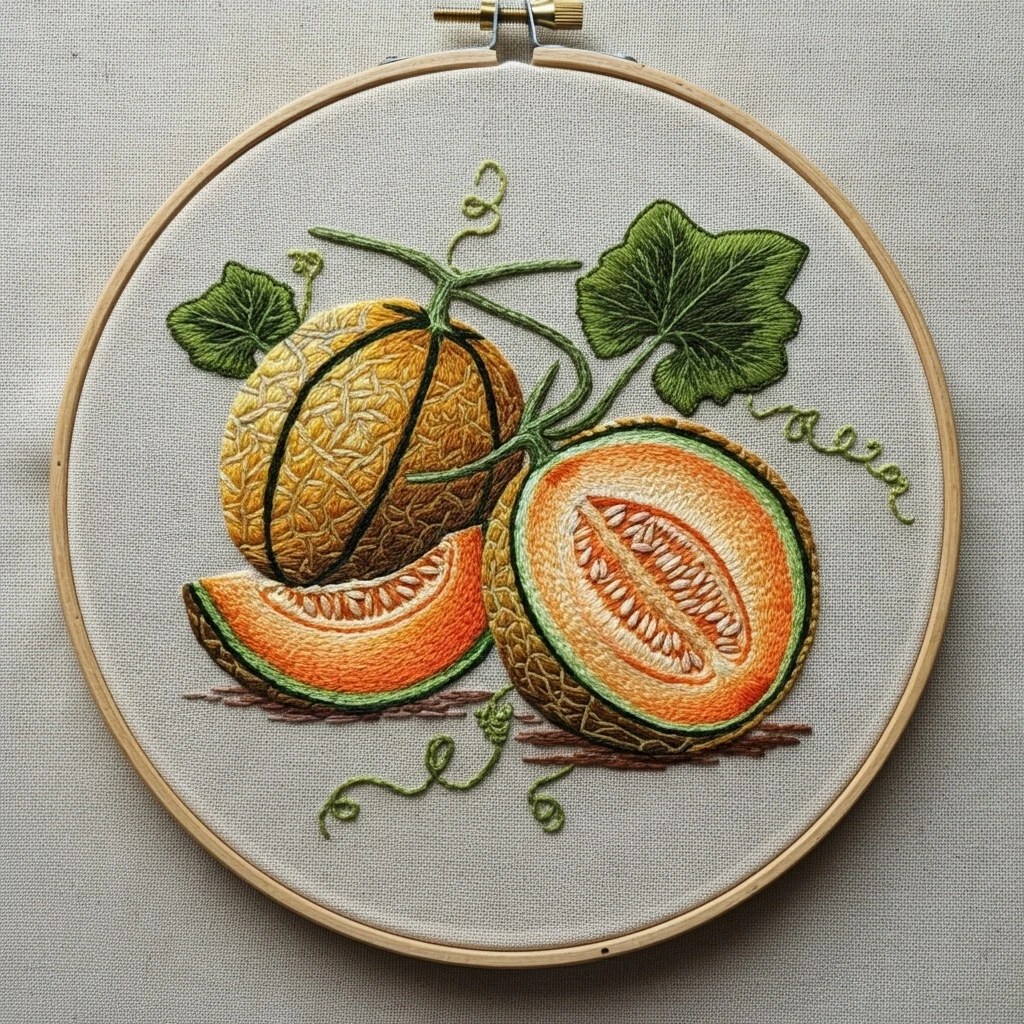
A warm harvest hoop with textured netted melon rind, glowing orange fruit flesh, curled tendrils, leafy vines, and soft linen negative space. This guide translates the design into practical DMC choices, stitch direction, thread counts, and beginner-friendly finishing tips.
Design read
The reference centers on whole and sliced cantaloupes. The strongest colors are honeyed rind golds, apricot-orange flesh, creamy highlights, deep green vine outlines, olive leaf shading, and brown ground shadows. The embroidery effect depends on contrast: crisp dark rind grooves and seed lines against softly blended satin/long-and-short fill.
Quick stitching plan
- Outline vines, rind grooves, and melon silhouettes first.
- Fill fruit flesh with curved long-and-short stitches following the round form.
- Add rind netting last with raised, broken lines for texture.
- Keep seed details delicate: 1 strand for veins, 2 strands for teardrop seeds.
Suggested DMC color palette
Use these as close, stitch-friendly matches for the visible artwork. The palette is intentionally layered from highlight to shadow so the cantaloupe looks rounded rather than flat.
Bright rind highlights and creamy flesh glow near the center.
Golden rind base and sunny transitions on raised netting.
Warm cantaloupe flesh and brighter orange rind sections.
Deep fruit edges, slice shadows, and saturated orange contours.
Seed cavity shadows and warm underside of sliced melon.
Rind shadow, brown netting, and earthy cast shadows.
Darkest cracks, rind grooves, and grounding accents.
Soft seed highlights and pale inner flesh blending.
Leaf base color and broad vine stems.
Leaf shadows, rind edges, and shaded vine crossings.
Deep outlines in leaves, tendril anchors, and melon seams.
Leaf highlights and tiny light touches on curling tendrils.
Stitch types by design area
Cantaloupe flesh
Use long-and-short stitch in curved rows, moving from DMC 3823 and 745 near the pale center into 742, 721, and 922 at the orange rim. Keep stitches slightly irregular for a juicy, painterly surface.
Netted rind
Fill the rind base with split stitch or short satin stitches in 743/742, then add the raised web using stem stitch, whipped backstitch, or couching in 745, 977, and 938 for shadowed texture.
Leaves and vines
Outline with stem stitch in 3362. Fill leaves with fishbone stitch or long-and-short stitch radiating from the center vein, blending 472, 3347, 3346, and 3362.
Seeds and seed cavity
Use 1 strand for the fine central oval lines and 2 strands for lazy daisy or detached chain seeds. Add a tiny straight stitch highlight in 3823 on the upper edge of selected seeds.
Ground shadow
Use loose horizontal straight stitches in 938 and 977 with scattered 922. Leave small gaps so the linen shows through and the shadow stays light.
Curling tendrils
Use stem stitch or whipped backstitch with 1-2 strands. Taper the ends by switching from 2 strands to 1 strand at the last curl.
Thread-count and blending guidance
| Area | Recommended strands | Practical note |
|---|---|---|
| Main fruit fills | 2 strands | Gives good coverage while still allowing smooth color transitions and curved stitch direction. |
| Rind netting | 2 strands, occasionally 3 | Use 3 strands only on the foreground melon where texture should stand proud. |
| Fine leaf veins | 1 strand | Fine veins look cleaner and more botanical when they do not overpower the leaf fill. |
| Dark outlines | 1-2 strands | Use 2 strands for outer silhouettes; 1 strand for internal grooves and seed lines. |
| Highlights | 1 strand | Add last with short, bright stitches so highlights sit on top of the fill. |
Order of work
Beginner-friendly tips
- Use a sharp embroidery needle for the rind netting; repeated passes through filled areas are easier with a fine point.
- Keep satin areas short. For wide melon sections, long-and-short stitch is safer than very long satin stitches because it will not snag as easily.
- Rotate the hoop while stitching curved fruit sections so your needle angle follows the melon shape.
- Do not overfill the linen background. The open fabric is part of the rustic harvest look.
- When the design feels too dark, add a few single-strand highlights in 745 or 3823 rather than removing stitches.