
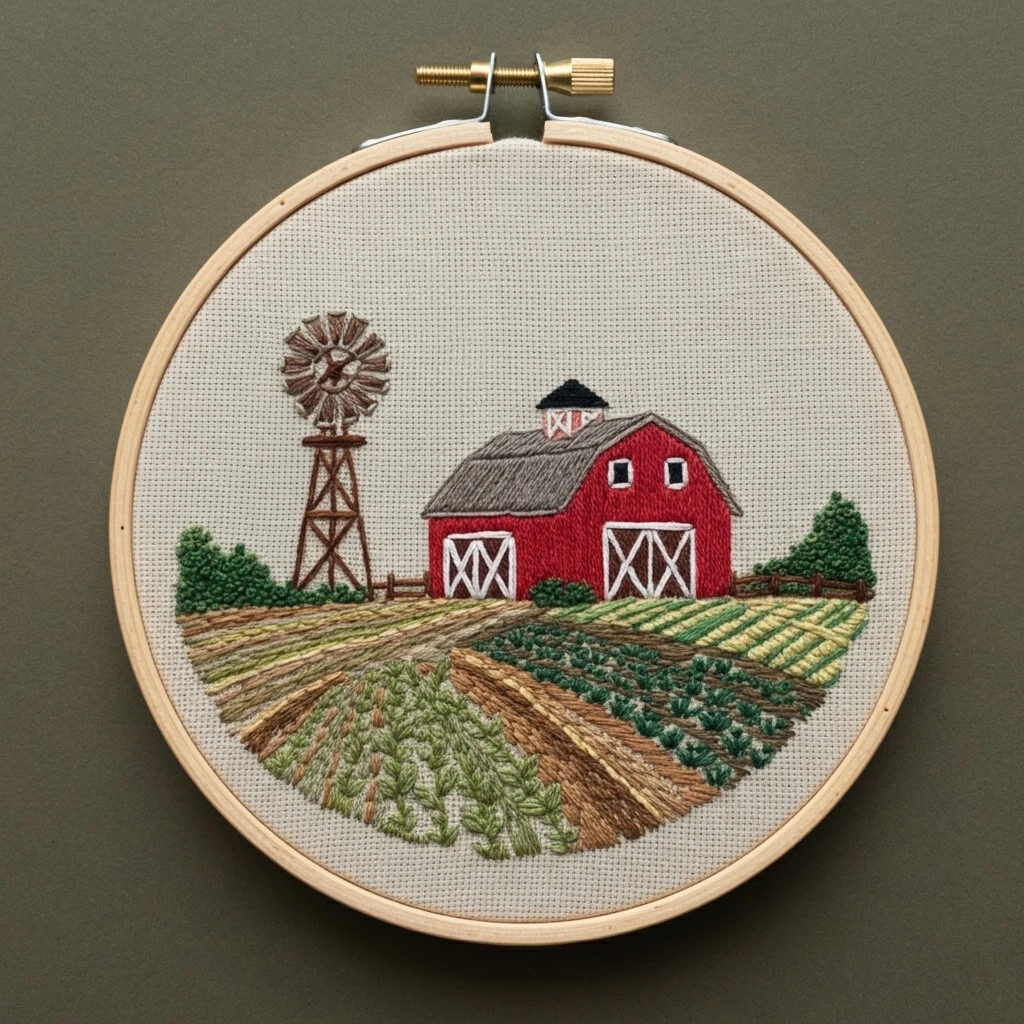
Hand Embroidered Farm Landscape in Hoop
A polished thread plan for a small rural hoop: red barn, windmill, evergreen trees, tilled rows, golden paths, leafy crops, white barn trim, and soft oatmeal fabric showing through as sky and ground breaks.
Design color read
The reference has a classic farm-hoop balance: a saturated barn anchors the center, grey-brown roof stitching sits against natural linen, and the foreground is built from angled crop-row bands. The important visual contrast is not huge color variety, but controlled value changes: deep greens against straw yellows, warm soil browns against cooler taupes, and clean white barn trim that keeps the miniature architecture readable.
Suggested DMC floss palette
Thread-count guidance
For a small hoop, avoid overfilling every area. Let the fabric breathe between field rows to preserve the illustrated, hand-drawn quality.
Blending & shading plan
- Barn walls: blend one strand 815 + one strand 814 along the right edge and under the roof; switch to two strands of 815 in the lit center.
- Roof: mix 535 with 842 for warm grey, then add single-strand 3371 or 801 lines for shingles.
- Fields: alternate 3012, 702, 3822, 3829, 780, and 801 in narrow rows. Keep row angles consistent so the eye travels toward the barn.
- Tree clusters: start with 699 as the base, add 702 knots on top, and leave tiny fabric gaps for sparkle.
Outlining details
Use split stitch around the barn silhouette before filling; it creates a neat edge for the red satin or long-and-short stitches to tuck into. Use one-strand back stitch for doors, windows, fence posts, and the windmill frame. Reserve 3371 for the tiniest anchor points only.
Texture suggestions
Make each field section feel different: straight stitch for plowed rows, fly stitch for leafy crops, seed stitch for distant grass, and couching for thicker golden paths. Vary stitch length slightly in the foreground to avoid a flat striped look.
Beginner-friendly tips
Start with the barn and roof so the main landmark is secure, then stitch from the horizon forward. Complete one crop band at a time, checking that all rows point toward the same vanishing area. Press from the back on a towel to protect raised knots.
Practical stitching sequence
- Transfer only essential outlines: barn, roof, windmill, fence, tree masses, and major crop-row divisions.
- Outline the barn with split stitch, then fill walls with 815, blending in 814 where the roof casts shade.
- Work roof stitches diagonally in muted greys and taupes; add a few short dark shingle lines after the fill is complete.
- Stitch the windmill tower with one strand of brown using back stitch; keep the blade spokes light and open.
- Fill trees and shrubs with loose detached chain, French knots, or seed stitch, layering dark green first and lighter green last.
- Finish foreground fields from back to front, using longer stitches in distant rows and more broken texture at the bottom edge.