
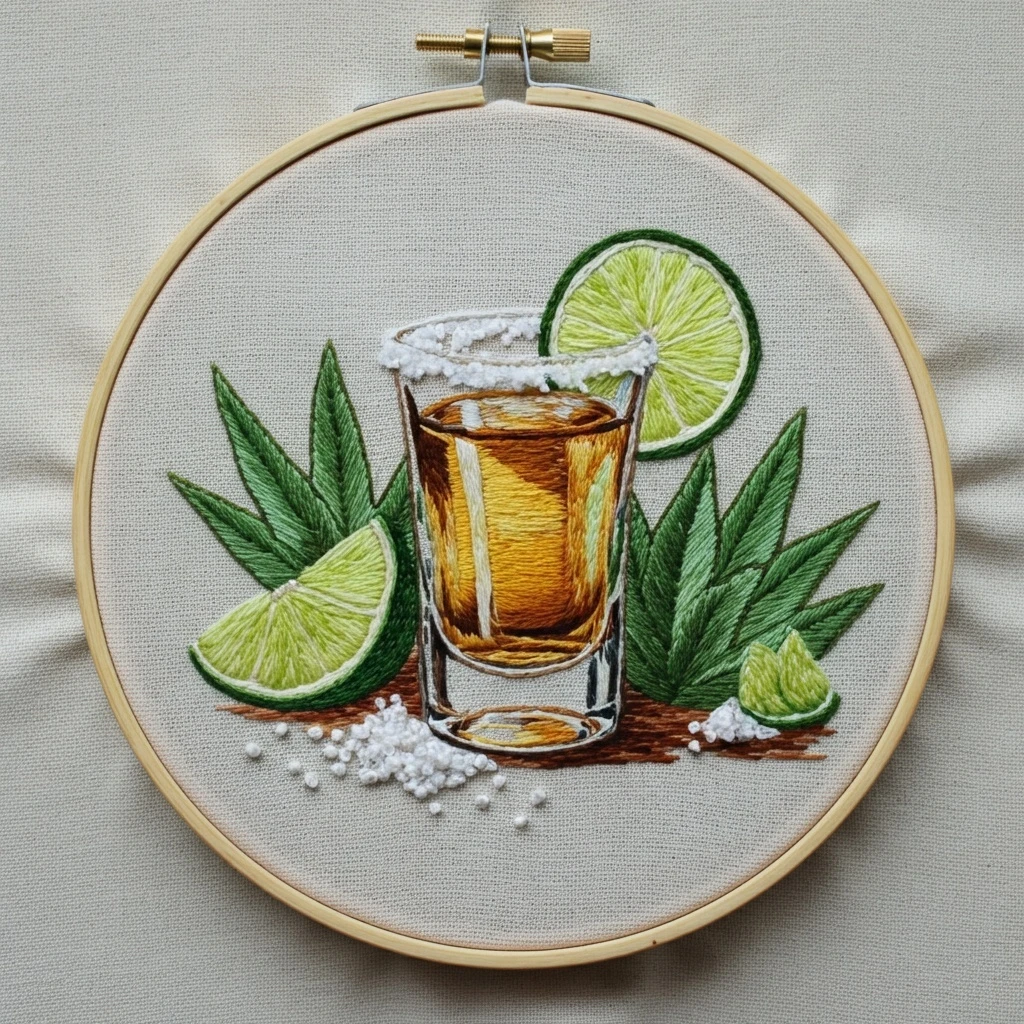
Hand Embroidered Tequila Shot With Lime And Salt Art
This design centers on a crisp tequila shot with translucent glass edges, warm golden liquor, a bright lime wedge, and sparkling salt accents. The look is clean, playful, and graphic, so the best embroidery approach is to keep the outlines tidy, the liquid luminous, and the garnish fresh and juicy.
Suggested DMC Floss Palette
The palette works best with a small set of strong contrasts: warm honey-golds for the tequila, cool grays and whites for the glass and salt, lively greens for the lime, and a few earthy neutrals for outlines and cast shadows. If your fabric is warm-toned, keep the whites slightly creamy instead of stark.
DMC 310 — Black
Use sparingly for the tiniest outline accents, the darkest edge of the glass base, and any tiny pupils or micro-details if the design includes decorative motifs. A little goes a long way.
DMC 3371 — Black Brown
A softer alternative to black for outer contouring, cast shadows under the glass, and subtle linework that still feels refined rather than harsh.
DMC 415 — Pearl Gray
Perfect for cool glass edges, transparent sidewalls, and shadowing beneath the salt pile. Blend with white to avoid heavy-looking glass.
DMC 762 — Pearl Gray Very Light
Use as the light gray layer on the inner rim of the shot glass and for the first transition between bright white highlights and the fabric color.
DMC 3865 — Winter White
Main salt and glass-highlight white. It is softer than a brilliant white, making it ideal for dense French knots or seed stitch without looking too stark.
DMC B5200 — Snow White
Reserve for the brightest sparkle points: the rim highlight, strongest salt glints, and one or two sharp reflective streaks on the glass.
DMC 744 — Pale Yellow
Use for light passing through the tequila and for top highlights where the liquid meets the glass. This shade keeps the drink looking fresh and luminous.
DMC 676 — Old Gold Light
The main tequila body color. It reads like a warm golden pour and works beautifully in satin stitch or long-and-short stitch inside the glass silhouette.
DMC 3821 — Straw
Deepen the bottom of the drink and the side away from the light source. Blend with 676 for a convincing translucent gradient.
DMC 909 — Emerald Green Very Dark
Best for the lime rind shadow, dark wedge edge, and any tiny cut marks or segment separators. Use only in fine lines and shadow pockets.
DMC 907 — Parrot Green Light
Main lime-rind color. It gives the garnish a fresh citrus feel and is also useful for small decorative accents if the art includes leaves or greenery.
DMC 3348 — Yellow Green Light
Use for the juicy inner flesh of the lime wedge or for rind highlights. Pair it with 744 in tiny stitches if you want an extra zesty glow.
DMC 436 — Tan
Good for any tabletop shadow, warm background accent, or to ground the shot glass if the design includes a surface or decorative border.
DMC 801 — Coffee Brown Dark
Use for the darkest cast shadow under the glass or behind the lime wedge. It adds depth without fighting the brighter focal colors.
Stitch Map by Design Area
Shot glass outline
- Use split stitch or stem stitch in 415 or 3371 for the outer contour so the glass reads clean but not cartoon-heavy.
- Keep vertical edges straight and slightly lighter on the lit side.
- Add one or two narrow B5200 highlight lines after filling the drink so the glass sits on top visually.
Tequila fill
- Fill the liquid with satin stitch or short long-and-short stitch worked horizontally or slightly curved to follow the glass shape.
- Use 3821 at the base, 676 in the middle, and 744 where light passes through the drink.
- Leave tiny breaks near the rim so the liquid still looks transparent rather than flatly opaque.
Lime wedge
- Outline the wedge edge lightly in 909, then fill the rind with 907 and the flesh with 3348.
- Use straight stitches radiating from the center to suggest citrus segments.
- A single 744 or B5200 highlight line helps the lime look moist and fresh.
Salt accents
- Use seed stitch, tiny French knots, or scattered colonial knots in 3865 for the main salt texture.
- Add only a few B5200 stitches for bright sparkle points.
- Use 762 or 415 underneath to create a grounded shadow so the salt reads crystalline, not fluffy.
Cast shadow and grounding
- Use short angled straight stitches in 436 and 801 beneath the base of the glass and under the lime wedge.
- Keep the shadow soft and wider than the base for a natural look.
- If the design is very graphic, reduce the shadow to just a few slim stitches so the motif remains crisp.
Decorative finishing details
- If the art includes a border, stars, dots, or playful accent lines, use 676, 907, and B5200 in 1 strand.
- Detached chain stitches can make tiny splash or citrus-leaf motifs.
- Keep embellishment secondary so the tequila glass remains the main focal point.
Thread Counts, Blending & Texture
| Area | Recommended strands | Practical guidance |
|---|---|---|
| Fine contours | 1 strand | Best for glass edges, lime segment lines, and tiny reflective marks. One strand keeps the design elegant and readable. |
| Main fills | 2 strands | Ideal for the tequila body and lime wedge. Two strands give enough coverage but still allow shape and sheen to show. |
| Salt texture | 1–2 strands | Use 1 strand for seed stitch and 2 strands for French knots if you want chunkier salt crystals. Keep it irregular. |
| Blended needle | 1 + 1 strands | Blend 3821 with 676 for the lower liquid transition; blend 907 with 3348 for a softer shift between the rind and lime flesh. |
| Bright highlights | 1 strand | Place B5200 last and very sparingly. Too many bright white lines can make the glass look scratched instead of shiny. |
Beginner-Friendly Stitching Sequence
Transfer only the key shapes
Trace the outside of the shot glass, the fill line of the tequila, the lime wedge, and the placement of the salt. Avoid marking every tiny highlight because those are easier to place by eye later.
Stitch the tequila body first
Filling the golden liquid early gives you a clear center point. Work from dark at the base toward lighter top highlights so the drink looks luminous.
Add the lime wedge
Work the rind and flesh separately, using directional stitches to suggest citrus segments. Add one bright highlight line near the juicy edge.
Build the glass around the fill
Use light gray and white to create the transparent walls and rim. This keeps the glass from getting lost against the fabric while still looking clear.
Finish with salt and shadow
Add scattered knot and seed-stitch salt, then ground the composition with a soft cast shadow. Place the final B5200 sparkle stitches last for the cleanest shine.
Practical Tips for a Polished Result
Glass realism
- Do not outline every edge in dark thread. Real glass is mostly defined by highlights and slight shadow shifts.
- Leave a few open fabric gaps if your cloth color supports the design; this can enhance the transparent feel.
- Keep highlight lines vertical and tidy so the glass looks reflective.
Lime texture
- Use short straight stitches like tiny spokes for the inside wedge sections.
- Make the rind darker than the center so the garnish looks dimensional.
- A few tiny white or pale yellow accents make the wedge feel freshly cut.
Salt control
- Vary knot size slightly to mimic coarse salt.
- Concentrate the brightest white at the top of the pile or rim, then taper outward with softer whites and gray.
- Avoid crowding the salt texture so each stitch still reads as a crystal.
Beginner-friendly finish
- Use a hoop that keeps the fabric drum-tight so satin stitches on the glass and drink stay smooth.
- Trim jump threads often because clear, simple designs look best when the back stays neat.
- Press face-down on a towel after stitching to protect knots and raised texture.
Finishing Notes
The success of this design comes from contrast and restraint: a warm tequila glow, a crisp lime wedge, sparkling salt, and just enough cool gray stitching to describe the glass. If you want a cleaner modern look, keep outlines soft and let the highlights do the work. If you prefer a more illustrated style, strengthen the silhouette with 3371 and use slightly denser seed stitch for the salt. Either way, the final hoop should feel bright, fresh, and playful.