
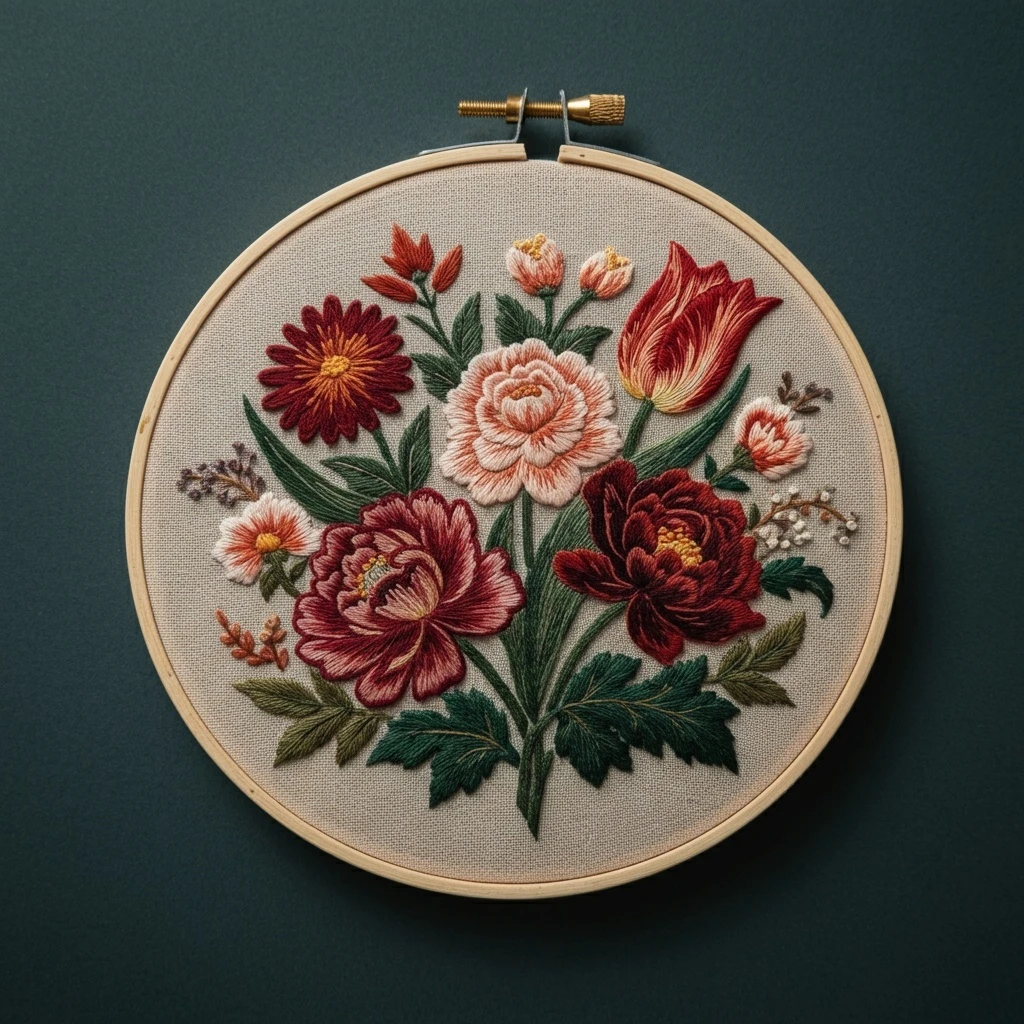
Hand Stitched Autumnal Arrangement
A warm seasonal arrangement built around copper leaves, golden berries, wheat-like stems, seed pods, and muted green foliage. The design works best when the stitches feel layered and organic: crisp outlines for stems, textured knots for berries, and blended long-and-short shading for turning leaves.
Suggested DMC Floss Palette
This palette emphasizes burnt orange, russet brown, harvest gold, muted berry, and olive-sage greens. Use the stronger warm shades for focal leaves and berries, then soften the arrangement with beige, straw, and gray-green transition colors.
DMC 921 — Copper
Main color for rich orange leaves and pumpkin-like warm details. Excellent for satin stitch and long-and-short leaf fills.
DMC 922 — Copper Light
Use on the sunlit side of leaves or petals. Blend with 921 for a smooth autumn-orange gradient.
DMC 920 — Copper Medium
Great for mid-tone leaf sections, curled edges, and small accent petals that need a bright harvest glow.
DMC 976 — Golden Brown
Use for seed pods, acorn-like caps, and warm shadowing inside orange leaves. It also grounds the bouquet visually.
DMC 801 — Coffee Brown Dark
Strong stem outlines, dark pod centers, and the deepest creases in curled leaves. Keep it mostly to 1 strand.
DMC 782 — Topaz Dark
Golden berry shading, wheat heads, and warm highlights between rust and yellow areas.
DMC 743 — Yellow Medium
Brightest harvest highlights for berry tips, small flower centers, and the tops of wheat-like stitches.
DMC 3828 — Hazelnut Brown
Soft straw, dry grasses, and lighter seed heads. Use with straight stitches for a delicate dried-botanical look.
DMC 422 — Hazelnut Brown Light
Neutral mid-tone for pods, flower centers, branch bends, and shading where gold meets brown.
DMC 814 — Garnet Dark
Deep berry color and dramatic autumn accents. Use for French knots or small satin-filled berries.
DMC 902 — Garnet Very Dark
Berry shadows and wine-toned leaf tips. Blend with 814 for darker clusters that stand out against the gold foliage.
DMC 730 — Olive Green Very Dark
Deepest leaf stems and shadowed foliage. Use for vein lines and background greenery that should recede.
DMC 3011 — Khaki Green Dark
Main muted autumn green for leaves, stems, and small sprigs. It keeps the bouquet natural rather than spring-bright.
DMC 3012 — Khaki Green Medium
Foliage highlights and lighter stems. Combine with 3011 in a blended needle for soft sage transitions.
DMC 738 — Tan Very Light
Dry leaf highlights, pale seed fluff, and the lightest edges of beige botanical elements.
DMC 3865 — Winter White
Small highlight knots, pale flower centers, and final sparkle stitches. Warmer and softer than bright white.
Stitch Map by Design Area
Autumn leaves
- Use long-and-short stitch from the central vein outward so each leaf turns naturally.
- Shade from 801 or 976 at the base into 921, 922, and 920 along brighter tips.
- Back stitch or split stitch the center vein with 1 strand for clean definition.
Berries and round pods
- Use French knots for small berry clusters and padded satin stitch for larger berries.
- Place 902 or 814 on the shaded side and add a tiny 3865 highlight stitch on the lit edge.
- Keep knots slightly irregular so the arrangement feels hand-gathered and natural.
Stems and branch structure
- Stem stitch is the most graceful option for curved stems and bouquet arcs.
- Use 801 for the darkest branches, 976 or 422 for warm stems, and 3011 for green stems.
- Stitch main stems first so leaves and berries can sit neatly on top.
Wheat, grasses, and seed heads
- Use straight stitch, fly stitch, and detached chain in 3828, 782, and 738.
- Angle each small grain away from the stem for a feathery dried-flower texture.
- Add a few 743 highlights only at the tips to avoid making the wheat too yellow.
Muted greenery
- Fishbone stitch works well for small oval leaves; lazy daisy suits tiny sprigs.
- Blend 3011 and 3012 for sage leaves, then add 730 only at the base or underside.
- Keep background foliage in softer greens so the warm leaves remain the focal point.
Fine decorative accents
- Use seed stitch for scattered texture around the bouquet without overfilling the design.
- Small colonial knots in 738 and 3865 can suggest dried flower centers.
- Use a few couching stitches if long grass stems need to stay smooth and controlled.
Thread Counts, Blending & Texture
| Area | Recommended strands | Practical guidance |
|---|---|---|
| Fine veins and outlines | 1 strand | Use 801, 976, 730, or 3011 for narrow leaf veins, stem tips, and pod outlines. One strand keeps the botanical details delicate. |
| Main leaf fills | 2 strands | Long-and-short stitch with two strands gives good coverage while still allowing color blending and directional texture. |
| Berries and knots | 2 strands | Use two strands for French knots and colonial knots so berries feel rounded. For tiny faraway dots, switch to one strand. |
| Wheat and grasses | 1–2 strands | Use one strand for airy grass tips and two strands for thicker seed heads. Vary strand count for natural movement. |
| Blended needle | 1 + 1 strands | Combine 921 with 922 for warm leaves, 976 with 782 for golden pods, and 3011 with 3012 for soft sage greenery. |
Beginner-Friendly Stitching Sequence
Transfer the main bouquet skeleton
Mark the largest leaves, major stems, berry clusters, and seed heads. Leave the tiniest filler dots flexible so you can place them after the main areas are stitched.
Stitch the stems and branches
Use stem stitch for the long curves and split stitch for sharper bends. Completing the structure first makes it easier to layer leaves and pods naturally.
Fill the large autumn leaves
Work from the center vein outward with long-and-short stitch. Start with darker browns near the base, then blend into copper, rust, and golden highlights.
Add greenery and wheat
Use fishbone stitch for green leaves, fly stitch for wheat grains, and straight stitch for fine grasses. Keep these elements lighter and airier than the focal leaves.
Finish with berries and highlights
Add French knots, tiny seed stitches, and final pale highlights last. This prevents raised stitches from being flattened by later thread movement.
Practical Tips for a Polished Result
Color balance
- Keep the deepest browns and garnets concentrated near the center and underside of the arrangement.
- Use gold and pale tan sparingly on tips and upper edges so the bouquet looks sunlit.
- Repeat each major color in at least two spots for a cohesive composition.
Natural texture
- Vary stitch lengths on leaves to avoid a flat striped look.
- Let grasses and seed heads lean at slightly different angles.
- Use small gaps of fabric between filler stems so the bouquet stays light and breathable.
Neat outlines
- Outline only after fills are complete if you want crisp edges.
- Use matching dark tones rather than black for a softer botanical finish.
- Short back stitches work better than long ones around curved leaves and berries.
Beginner safeguards
- Keep the fabric drum-tight so satin and long-and-short stitches lie smoothly.
- Use shorter thread lengths with rust and dark red colors to reduce fuzzing.
- Press face-down on a towel to protect raised berry knots and seed textures.
Finishing Notes
For an elegant autumnal hoop, aim for layered contrast rather than perfectly flat color. The stems should feel fine and graceful, the leaves should shift from brown shadow to copper-gold light, and the berry clusters should sit raised on top like small seasonal accents. Finish by checking the overall color rhythm: if one side feels too heavy, add a few pale seed stitches or sage-green sprigs to balance the arrangement.