
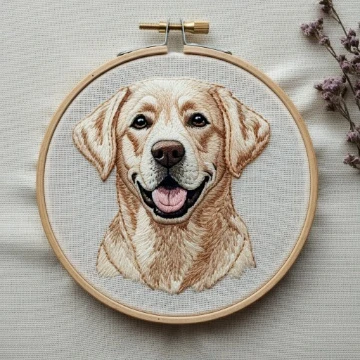
Happy Labrador Retriever Portrait
A warm, cheerful Labrador portrait benefits from soft golden-brown fur shading, expressive dark eyes, a clean nose highlight, and gentle directional stitches that follow the muzzle, ears, and chest. Keep the palette honeyed and natural, with small bright highlights to capture the dog’s friendly expression.
Suggested DMC Floss Palette
This Labrador palette moves from cream highlights through honey and caramel mid-tones into warm browns for the ears, nose, mouth, and deep facial shadows. Use fewer colors in the eyes and nose, but place them carefully for life-like expression.
DMC 3865 — Winter White
Softest chest, muzzle, and forehead highlights. Use in 1 strand for glints and 2 strands for pale fur tufts.
DMC 822 — Beige Gray Light
Gentle bridge color between cream highlights and tan fur; ideal for the muzzle and pale chest transitions.
DMC 437 — Tan Light
Main light golden coat color. Use for cheeks, brow, and sunlit planes of the face.
DMC 434 — Brown Light
Primary Labrador fur mid-tone. Work in directional long-and-short stitches following hair growth.
DMC 435 — Brown Very Light
Warm caramel shading for ears, lower cheeks, and the curves around the mouth.
DMC 433 — Brown Medium
Deeper folds inside ears, lower muzzle shadows, and warm contour around the face.
DMC 801 — Coffee Brown Dark
Darkest warm fur shadows, smile line, nostril edges, and deeper ear pockets.
DMC 3371 — Black Brown
Nose, eye rims, mouth corners, and the deepest facial details. Softer than pure black for pet portraits.
DMC 310 — Black
Tiny accents only: pupils, nostril centers, and one or two crisp points in the mouth.
DMC 414 — Steel Gray Dark
Cool nose shading and subtle under-eye shadow. Blends well with 3371 for a realistic wet nose.
DMC 415 — Pearl Gray
Nose highlight transitions and soft reflected light around the eyes and whisker pads.
DMC B5200 — Snow White
Reserve for tiny eye catchlights, nose shine, and the brightest fur sparkles. Use very sparingly.
Stitch Map by Design Area
Face and forehead
- Use long-and-short stitch in 437, 434, and 435, radiating outward from the brow and muzzle.
- Keep stitches shorter near the eyes and longer across broad forehead planes.
- Blend 3865 or 822 into the center highlight for a sunny, friendly face.
Ears
- Work the ears with curved rows of split stitch or long-and-short stitch.
- Place 433 and 801 inside folds, then soften the outside edges with 434 and 435.
- Let stitch direction droop downward to suggest soft floppy fur.
Eyes
- Outline with 3371, fill pupils with a tiny 310 area, and add one B5200 catchlight last.
- Use 801 or 433 around the lid to keep the expression warm.
- Avoid bulky knots in the eye unless the design is very small.
Nose and mouth
- Use satin stitch or tiny split stitches in 3371 and 414 for the nose.
- Add a narrow 415 transition and a tiny B5200 shine spot at the top curve.
- Back stitch the smile line in 3371, softened with 801 where it meets fur.
Chest and neck fur
- Use loose feather stitch, split stitch, or staggered straight stitches in 3865, 822, and 437.
- Keep the chest less dense than the face so it reads soft and fluffy.
- Layer pale highlights last along the most raised tufts.
Whiskers and final details
- Use 1 strand of 415 or 3865 for whisker dots and subtle whiskers.
- Whiskers should be few and light; overdoing them can distract from the expression.
- Finish with tiny fur flicks around the cheeks to soften the silhouette.
Thread Counts, Blending & Texture
| Area | Recommended strands | Practical guidance |
|---|---|---|
| Fine facial details | 1 strand | Use for eyes, nose edges, mouth line, whisker dots, and individual fur flicks around the muzzle. |
| Main fur fills | 2 strands | Best for long-and-short shading across the cheeks, forehead, ears, and neck. |
| Soft chest texture | 2–3 strands | Use looser stitches for fluff; avoid packing the chest too tightly or it will compete with the face. |
| Blended fur needle | 1 + 1 strands | Blend 437 with 434 for light golden fur, 434 with 435 for caramel transitions, and 435 with 433 for ear shadows. |
| Catchlights | 1 strand | One small B5200 stitch in each eye is usually enough to make the portrait feel alive. |
Beginner-Friendly Stitching Sequence
Transfer main landmarks
Mark the eyes, nose, mouth line, ear edges, chest boundary, and large highlight zones. Do not draw every hair; stitch direction will create the fur texture.
Start with the eyes and nose
Establish the expression first using clean dark stitches and tiny highlights. This gives you an anchor for the rest of the portrait.
Build mid-tone fur
Fill the face with 434 and 437 in the direction the fur grows, leaving space for darker shadows and lighter highlight layers.
Add ears and warm shadows
Use 435, 433, and 801 to deepen ears, cheek curves, and the lower muzzle. Feather the edges into the mid-tone fur.
Finish with highlights and whiskers
Add 3865, 822, and B5200 at the end: muzzle shine, chest tufts, eye catchlights, and a few subtle whisker marks.
Finishing Notes
For the happiest Labrador expression, keep the eyes bright, the mouth line relaxed, and the muzzle softly shaded rather than heavily outlined. Directional long-and-short stitch is more important than perfect coverage: staggered stitches create believable fur and make the portrait feel warm, friendly, and handmade.