
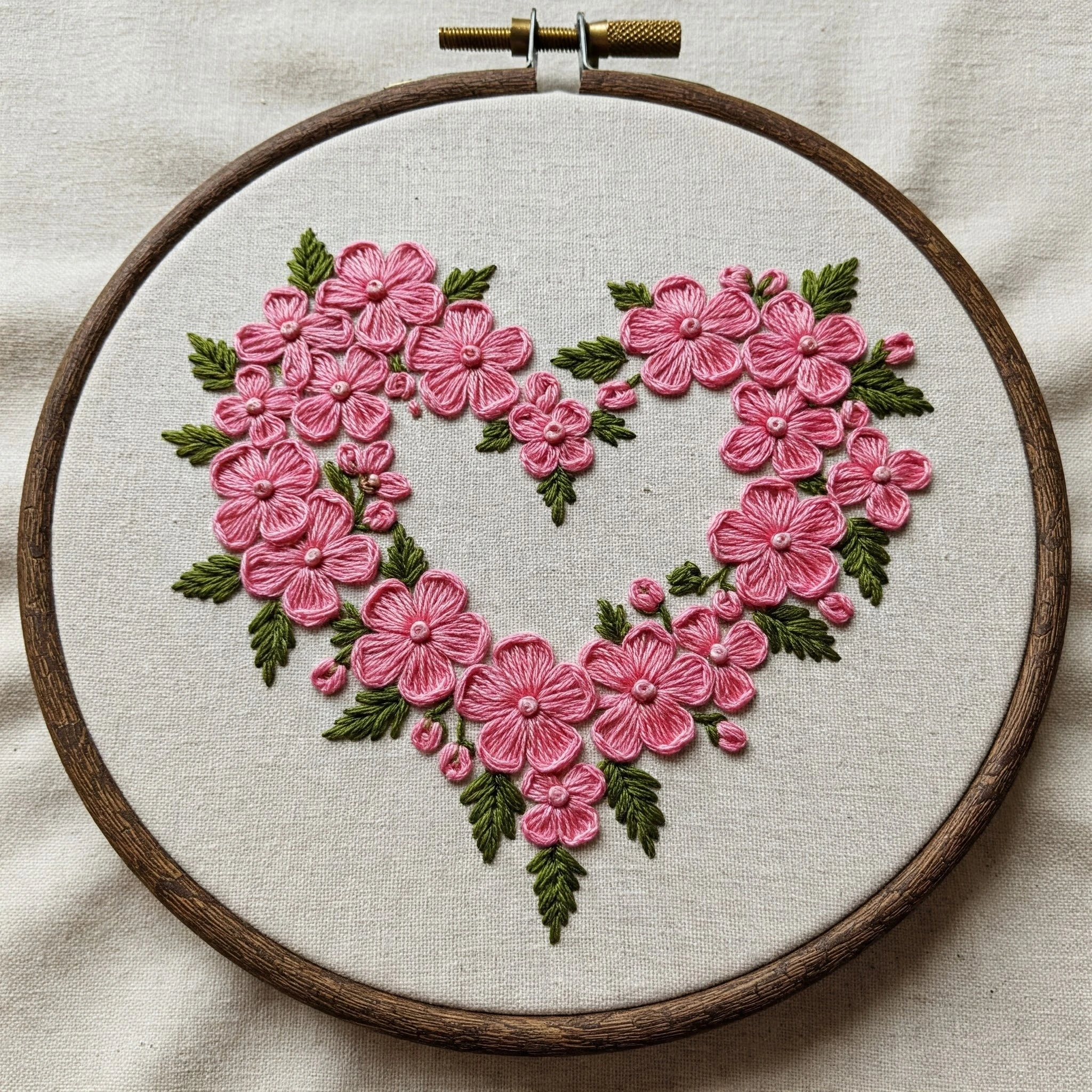
Heart Shaped Floral
A romantic wreath of pink five-petal blossoms, tiny buds, and deep green fern-like leaves arranged into an airy heart. The sample reads as soft, dimensional, and beginner-friendly, with satin-filled petals, raised centers, tidy outlines, and textured greenery on natural linen.
Fresh pink garden blooms, soft cream fabric, olive foliage, and a warm wood-hoop finish. Keep the heart outline light and organic rather than perfectly symmetrical: the charm comes from clustered blossoms, varied bud sizes, and leaves peeking between petals.
Suggested DMC floss palette
The image is dominated by dusty pink blossoms with pale highlights, deeper rose edges, olive-green leaves, and a neutral linen background. The palette below keeps the flowers lively without becoming neon, while giving enough contrast for petal ridges and leaf texture.
Petal highlights
Use for the lightest satin stitches inside each petal, especially near the petal centers and on upper ridges that should catch light.
Main blossom pink
The best all-purpose flower shade for most petal filling, small buds, and the soft outer glow of the heart shape.
Petal depth
Work along petal bases, lower curves, and areas tucked under neighboring blossoms to create rounded, layered flowers.
Outlines and accents
Use sparingly for split-stitch outlines, underside shadows, bud tips, and a few darker long-and-short stitches at petal folds.
Flower centers
Add to French knots or small padded dots for the pale pearl-like centers visible in the sample.
Leaf highlights
Use on one side of each leaf vein and for the tips of fern-like leaflets where the green appears brighter.
Main foliage
Ideal for most leaf filling, small stems, and the dense greenery that frames the pink blossoms.
Leaf shadows
Use for central veins, bases of leaves, and shadowed foliage behind flowers to increase definition.
Soft glints
Add one strand into selected petal highlights or center knots for a delicate sheen on natural fabric.
Optional hoop/stem warmth
Not necessary for the flowers, but useful if adding tiny exposed branch stems or a stitched hoop-shadow detail.
Stitch plan by design area
Satin + long-and-short
Outline each petal first in split stitch with 1–2 strands, then fill with 2-strand satin stitches following the petal direction. For larger petals, blend DMC 3326 with 818 toward the center and 899 or 335 near the edges.
Detached chain petals
Use lazy daisy stitches for the tiniest five-petal flowers. Anchor each loop with a short straight stitch in DMC 899 so the petals stay crisp and rounded.
Granitos or padded satin
Work compact oval buds with 2–3 straight stitches over a tiny split-stitch base. Darken the lower side with DMC 335 and highlight the top with 818.
French knots
Use 2 wraps with 2 strands for small centers, or 3 wraps for the larger blossoms. Mix DMC 963 with a touch of 818 for the soft raised pink dot in the sample.
Fishbone stitch
Fishbone stitch gives the leaves their neat fern-like ribbed texture. Use DMC 730 as the base, DMC 733 for one bright side, and DMC 936 for shadowed bases.
Stem stitch
Use 1–2 strands of DMC 936 or 730. Keep stems thin so the wreath remains floral and airy instead of heavy.
Thread-count guidance
- Petal outlines: 1 strand for delicate split stitch; 2 strands if you want the darker pink rim seen in the image.
- Petal fills: 2 strands for smooth satin coverage on linen or cotton. Use 1 strand for long-and-short shading on very small petals.
- Flower centers: 2 strands, 2–3 wraps for French knots. Add a second knot only on the largest flowers.
- Leaves: 2 strands for fishbone stitch. Use 1 strand for fine central vein accents.
- Buds and tiny details: 1 strand keeps the curves clean and prevents small shapes from becoming bulky.
Blending ideas
- Soft petal blend: 1 strand DMC 3326 + 1 strand DMC 818 for luminous mid-pink petals.
- Deeper rose blend: 1 strand DMC 899 + 1 strand DMC 335 for shadowed petal edges and underside folds.
- Fresh leaf blend: 1 strand DMC 730 + 1 strand DMC 733 for visible leaf texture without harsh contrast.
- Dark foliage blend: 1 strand DMC 730 + 1 strand DMC 936 for leaves tucked beneath flowers.
Shading, outlining, and texture notes
| Element | Best stitch choice | Color handling | Practical note |
|---|---|---|---|
| Rounded petals | Split outline, satin fill, optional long-and-short | 818 at center, 3326 main, 899/335 at edges | Angle stitches from outer petal edge toward the center knot so every petal looks radial and plump. |
| Petal ridges | Single-strand straight stitches | 818 or 3865 mixed with 3326 | Add 2–4 fine highlight strokes per petal after the fill is finished; do not overwork. |
| Leaf clusters | Fishbone or fly stitch | 730 base, 733 tips, 936 vein | Alternate leaf lengths to keep the heart outline natural. Let some leaves peek beyond the flower edge. |
| Small buds | Padded satin, granitos, or tiny lazy daisy | 3326 top, 335 lower edge | Place buds in the gaps between large flowers to maintain the heart silhouette. |
| Flower centers | French knots or colonial knots | 963 with 818, optional 899 shadow knot | Make centers raised but small; oversized knots can flatten the delicate floral look. |
Beginner-friendly practical tips
- Transfer lightly. Use a pale washable pen or heat-erasable pen; the open center of the heart makes any dark guide marks more noticeable.
- Keep tension relaxed. Satin stitches should lie flat, not pull the fabric. Re-tighten the hoop before each stitching session.
- Shorten satin spans. For wide petals, divide the shape mentally and use long-and-short stitch instead of one long satin span to avoid snagging.
- Rotate the hoop. Turn the hoop as you stitch so petal stitches always travel comfortably toward the center.
- Balance the heart. Stitch the largest blossoms on the left, right, and bottom first, then fill gaps with buds so the shape stays even.
- Finish with highlights last. A few pale strokes on top of darker pink fill will instantly add the raised, dimensional look shown in the sample.