
DMC palette & hand embroidery guide
Hot Air Balloon Cityscape
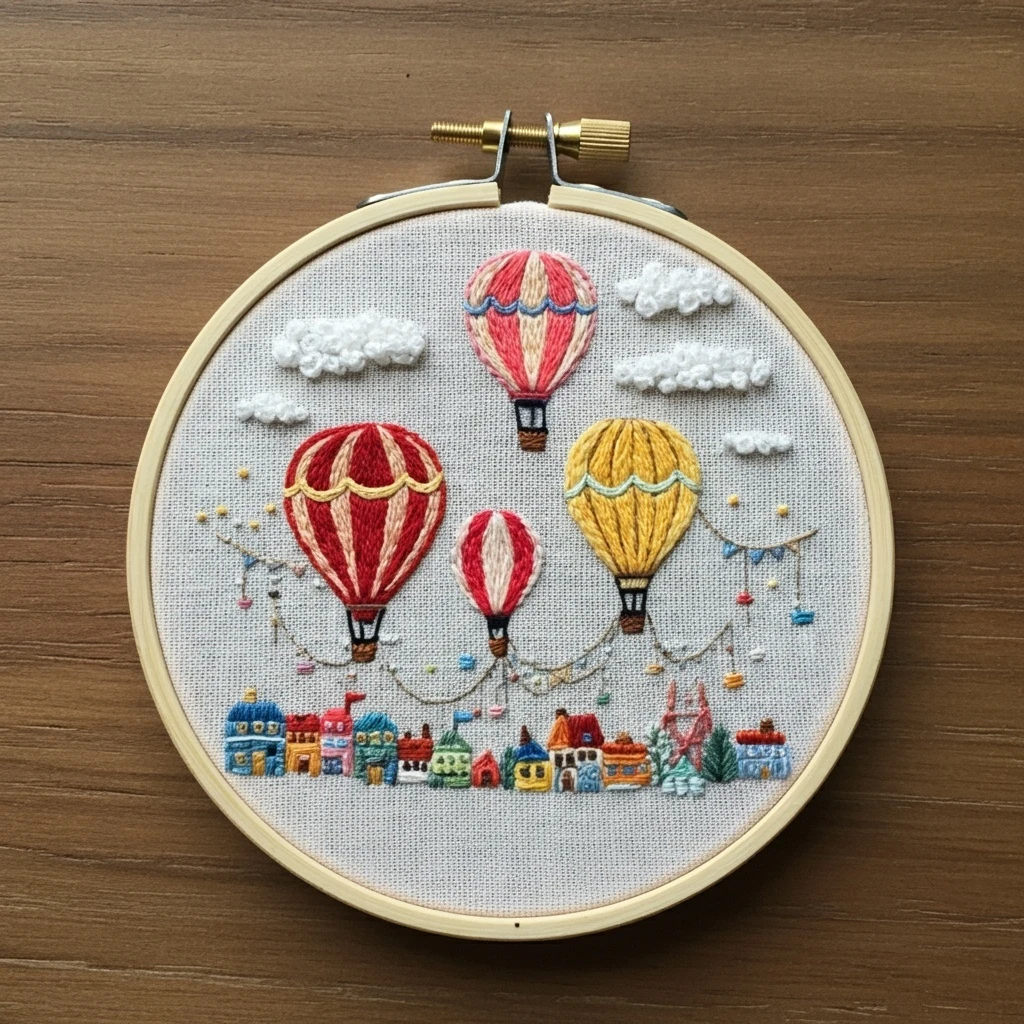
A cheerful hoop scene with floating striped balloons, fluffy textured clouds, tiny bunting, and a storybook row of houses. The best finish comes from clear outlines, gentle satin shading, and lively texture rather than heavy fill everywhere.
Design read: what to emphasize
The composition is built around three large balloons in red, coral-pink, and golden yellow, with a smaller red balloon between them. Below, a miniature city line uses saturated blues, reds, mint greens, oranges, and soft neutrals. White clouds sit high in the hoop and appear fluffy, almost raised, while the garlands and little lights add delicate movement across the lower sky.
Balloons
Use clean satin wedges with couched or stem-stitched ribs so each balloon keeps its rounded form.
Clouds
Make them dimensional with French knots, turkey work, or clustered colonial knots over soft padding.
Cityscape
Keep the houses crisp: one or two strands, strong outlines, and small blocks of fill prevent muddiness.
Suggested DMC floss palette
This palette matches the playful reds, warm yellows, sky blues, mint greens, browns, grays, and cottony whites visible in the design. Use it as a practical stitching map rather than a strict rule; small substitutions still work well in this folk-art style.
Stitch map by design area
| Area | Recommended stitches | Thread count | Practical notes |
|---|---|---|---|
| Large balloon panels | Long-and-short stitch, satin stitch, split stitch ribs | 2 strands for fill; 1 strand for rib lines | Work from the outer curve toward the basket so stitches follow the balloon’s rounded wedge shape. Keep satin sections short enough to avoid snagging. |
| Scalloped balloon bands | Stem stitch, whipped backstitch, couching | 1-2 strands | Use pale yellow or turquoise over red/yellow panels. Whip the line with a lighter thread for a raised decorative trim. |
| Balloon baskets | Satin stitch, straight stitch, backstitch | 1-2 strands | Use DMC 433 with small DMC 938 shadows; reserve black for the tiniest framework so baskets do not look heavy. |
| Clouds | French knots, colonial knots, turkey work, padded satin | 2-3 strands | Pad with a few loose straight stitches in Blanc, then knot over the top with Blanc and 762 for a fluffy clustered edge. |
| City houses | Satin stitch, brick stitch, backstitch, tiny straight stitches | 1 strand for details; 2 strands for small fills | Stitch one building at a time and outline last. Alternate red, blue, mint, and yellow houses to keep the row playful and readable. |
| Garlands and bunting | Backstitch, couching, detached chain, French knots | 1 strand lines; 2 strands knots | Use a single gray-brown line for strings, then add colored knots or tiny lazy-daisy flags after the main elements are complete. |
Blending, shading & outlining guidance
Balloon dimension
- Blend red panels with one strand DMC 321 plus one strand DMC 816 near the side edges.
- For the pink balloon, combine DMC 352 with Blanc on highlights, then use solid 352 toward the lower curve.
- For the yellow balloon, use DMC 744 on raised ribs, DMC 742 for the main fill, and DMC 3852 near the basket.
Clean outlines
- Outline balloon ribs with split stitch instead of heavy backstitch for smoother curves.
- Use DMC 938 or one strand of 310 only where strong separation is needed, such as basket bottoms.
- Outline houses after all fill is complete so roofs, windows, and doors stay crisp.
Texture tip: The design works best when textures contrast: smooth satin balloons, nubbly clouds, crisp tiny houses, and airy single-strand garlands. Avoid filling every sky detail heavily; negative space keeps the balloons feeling light.
Beginner-friendly stitching order
Fabric, needle & finishing notes
Thread-count guidance
For a 6-inch hoop, use 1 strand for miniature windows, bunting strings, roof outlines, and balloon rib details. Use 2 strands for most satin fill and long-and-short shading. Use 3 strands only for cloud knots or deliberately bold roof blocks.
Needle choice
A size 7-9 embroidery needle handles most areas. Switch to a sharper, smaller needle for the cityscape so window and door stitches land neatly without distorting the fabric.
Hoop tension
Keep the fabric drum-tight before satin stitching balloons. Re-tighten after each large filled area; loose fabric makes balloon panels ripple.
Back neatness
Because the buildings are tiny and colorful, avoid carrying thread across open sky. Start and stop often with small waste knots or woven tails to prevent shadowing on light fabric.