
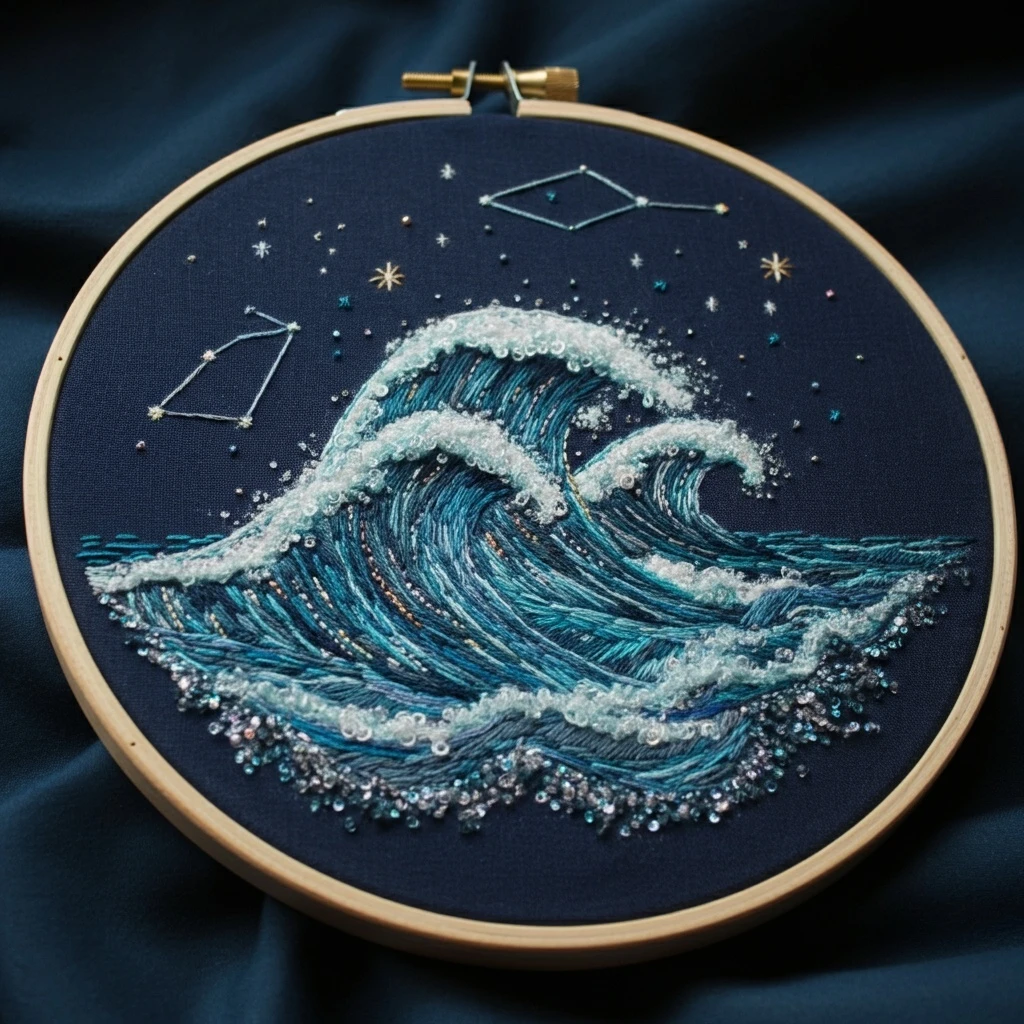
DMC palette & hand embroidery guide
Icy Blue Winter Tree
A cool, serene winter composition centered on a branching tree worked in layered icy blues, frosted white highlights, and slate shadows. The design reads as a crisp seasonal silhouette: a sturdy trunk, elegant branch spread, and a halo of snow-dusted blue foliage or clustered frost that gives the tree a magical wintry glow.
Design color read
The design appears to rely on a restrained winter palette rather than many contrasting hues. Expect a cool family of pale icy blue, soft aqua, sky blue, and deeper teal-blue shadow, all lifted with bright white or near-white accents to suggest frost, snow, and crystalline light. A brown-to-gray trunk or branch structure grounds the composition so the blue crown does not float visually.
Think in layers: a dark branch skeleton, mid-tone blue structure, pale frosty fill, then white sparkle on top. That order gives the tree depth without losing the airy winter feel.
Thread-count snapshot
- Tree trunk & branches: 2 strands for main lines; 1 strand for slim twig extensions and shadow edges.
- Frost clusters / blue canopy: 2 strands for detached chain, satin, or long-and-short fill.
- Snow highlights: 1 strand for white accent stitches; 2 strands only on larger snowy patches.
- Sparkle details: 1 strand French knots, seed stitches, or tiny straight stitches so highlights stay crisp.
Suggested DMC palette
Stitch suggestions
Best order of work
Blending & shading guidance
For a luminous icy effect
Start each area with the darker color nearest the branch: 803 or 826 close to the trunk, 3761 through the middle, and 3841/775 toward the outer edge. Top the coldest points with 3756 and then B5200. This dark-to-light build makes the canopy look like frost catching winter light.
Soft blending combinations
Blend one strand of 3841 with one strand of 3761 for the smoothest mid-tone. For delicate highlights, combine 775 with 3756. Where white feels too stark, blend one strand of B5200 with one strand of 3865 so the transition is softer and more realistic.
Shading the trunk
Use 3782 as the body of the trunk, then tuck in short lines of 3031 on the lower or shadow side. If the design looks especially cool-toned, add tiny 414 accents rather than more brown. That cool gray note helps the bark sit naturally in the snowy palette.
Texture notes
- Mix stitch length slightly in blue fill areas so the frosted crown looks organic, not blocky.
- Cluster French knots in small groups rather than scattering them evenly; snow gathers irregularly.
- Keep twig ends thin and tapering. Thick branch tips can make the tree feel heavy.
- Use more white on top-facing sections and lighter blue on the outer rim to suggest wintry light.
- Leave tiny fabric gaps in a few places if you want airy, crystalline texture instead of a dense filled canopy.
Outlining details
Outlining should be subtle in this design. Use 414 or 803 to reinforce only the deepest overlaps between blue clusters, and 3031 sparingly for bark cracks. Avoid outlining all frosty forms in a single dark line; the magic of a winter palette comes from soft value changes rather than graphic contour. If a section loses definition, add a few one-strand split stitches instead of a full border.
Beginner-friendly practical tips
- Trace the trunk and major branch placement carefully; that structure does most of the visual work.
- Test your blue family on a scrap before stitching so the lightest shades do not disappear into the fabric.
- Work from dark to light. It is much easier to brighten a winter tree than to recover lost shadows later.
- Reserve pure white for the final pass. Adding it too early makes it harder to judge balance.
- If you are new to shading, complete one branch cluster fully before moving on to the next; repeating the same formula builds confidence.
Compact stitch plan
Trunk & main limbs: stem stitch and split stitch in 3782, shaded with 3031 and a touch of 414. Icy canopy / frosted clusters: long-and-short fill, detached chain, or short satin groupings in 803, 826, 3761, 3841, 775, and 3756. Snow highlights: B5200 and 3865 in seed stitch, French knots, or tiny satin caps. Finishing: selective one-strand backstitch for fine twig ends and inner separation where needed.