
DMC palette & hand embroidery guide
Icy Snowflake Fairy
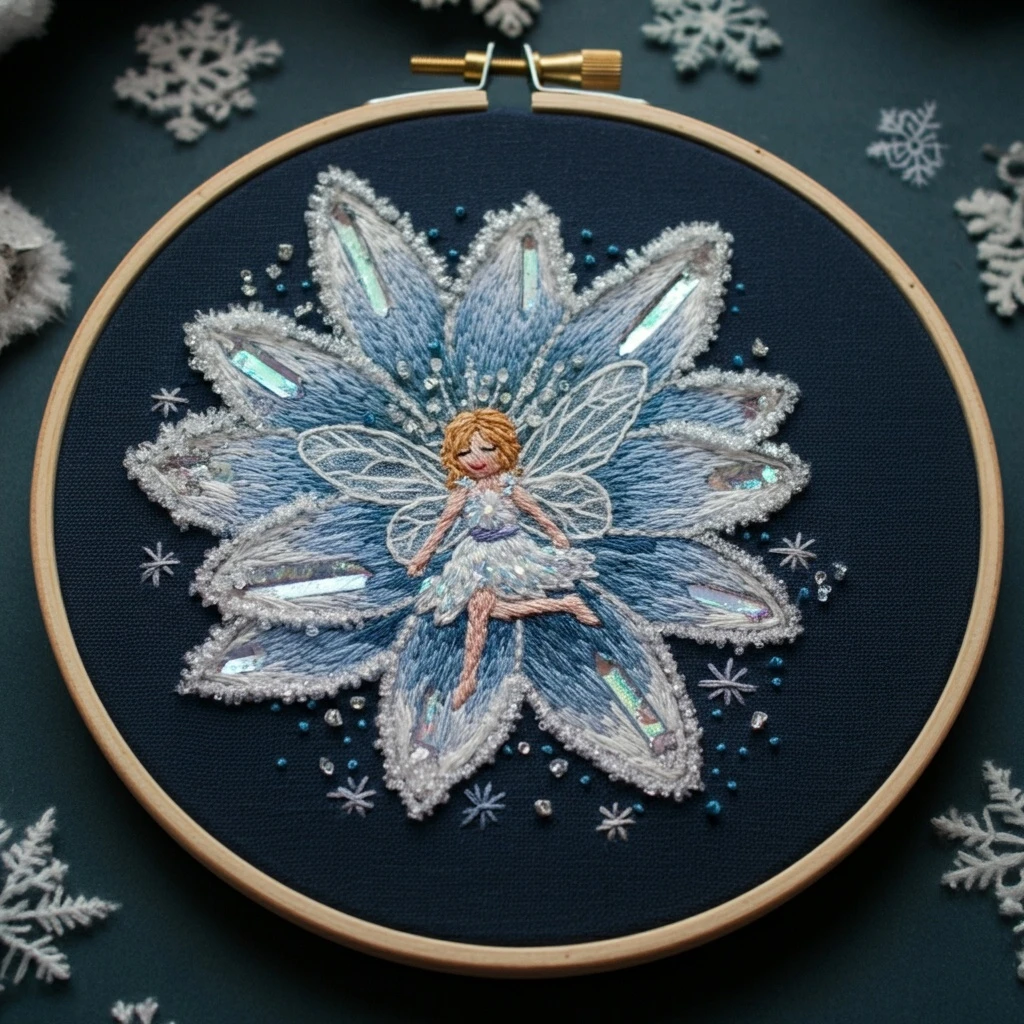
A sparkling winter hoop with a small fairy seated in the center of a large icy snowflake bloom. The reference image uses a dark navy ground, frosted blue and silver-white petals, crystal-like reflective shards, pale stitched wings, blue beads, tiny snow stars, peach skin, and golden-brown hair for a magical cold-weather focal point.
Design color read
The reference is built like a snowflake flower behind the fairy: long pointed icy petals radiate from the center, each filled with blue-gray threads and rimmed with thick frosted white texture. The dark navy fabric makes pale floss, silver-gray outlines, blue beads, and iridescent shard details stand out sharply. The fairy remains warm and delicate with peach skin, honey-brown hair, pale white-blue dress, translucent wings, and a small blue-violet waist accent.
The strongest visual contrast comes from three layers: dark fabric left open, cool blue stitched petal shading, and raised white or silver texture on top. Keep the fairy lighter and smaller so she reads as a charming center detail rather than competing with the snowflake.
Thread-count snapshot
- Snowflake petals: 2 strands for long-and-short fill; 1 strand for inner veins and dark blue separation lines.
- Frosted edges: 2 strands for split stitch or whipped backstitch; 3 strands only for raised couching on the outer rim.
- Wings: 1 strand for fine white linework; 2 strands only on the wing outlines closest to the body.
- Fairy skin and face: 1 strand for all facial features; 2 strands for limbs if you want smoother coverage.
- Beads and snow dots: 1 strand doubled through the bead or one-strand French knots for tiny stitched alternatives.
Suggested DMC palette
Stitch suggestions
Best order of work
Blending & shading guidance
Snowflake petal gradient
Start the base of each petal with one strand of 932 and one strand of 3761 where it tucks under the fairy. Move into a blend of 3761 and 3841 through the middle. Finish the tip with 775, 3756, and a few B5200 strokes. Keep the direction of the stitches radiating outward so every petal feels like a crystalline ray.
Silver frosted outline
Use 415 as the shadow side of the rim and 762 or 3865 on the light side. A final couching line of B5200 over the outermost edge gives the puffy snow texture visible in the reference image. If you want extra sparkle, replace a few B5200 stitches with a white or pale silver metallic thread.
Fairy color balance
The fairy is warm against the cold background, so keep her skin and hair clear but small. Use 948 for most skin, 754 only under limbs and at joints, 3826 for the hair mass, and 782 for the smallest shadow curls. The dress should stay white-blue, with 3865 and 3756 as the main tones and 333 only for the tiny sash or deepest fold.
Texture notes
- Use irregular rim stitches around the snowflake points; a perfectly smooth border will look less frosty.
- Place blue knots and beads in loose arcs around the fairy rather than evenly spaced rows.
- Keep wing lines thin and airy. Heavy wing fill can hide the snowflake underneath.
- Add a few tiny straight stitches shaped like asterisks on the dark fabric to echo the background snowflakes.
- Let some dark fabric remain visible between petals, wings, and snow dots for strong winter-night contrast.
Outlining details
Use tone-on-tone outlines rather than black. The snowflake petals can be defined with 415, 762, and B5200; inner blue separation lines work best in 932 or a single strand of 3761. For the fairy, outline skin with a very small amount of 754, hair with 782, and the dress with 775 or 762. The wing veins should be the finest lines on the piece, so use one strand and a small needle.
Beginner-friendly practical tips
- Transfer the petal outlines, fairy body, and main wing shapes. Add snow dots by eye after stitching the main design.
- Use shorter floss lengths for white and pale blue so they stay bright and do not pick up dark lint from the fabric.
- Work with relaxed tension on raised edges; tight stitches can pucker the fabric around the snowflake points.
- If using beads or sequins, attach them after pressing the embroidery from the back so they stay shiny and secure.
- Step back often. The design should read first as a glowing snowflake, then as a fairy when viewed closer.
Compact stitch plan
Snowflake petals: long-and-short stitch in 932, 3761, 3841, 775, and 3756, with B5200 tip highlights. Frosted edges: split stitch, whipped backstitch, couching, or tiny French knots in 415, 762, 3865, and B5200. Fairy: 948 and 754 for skin, 3826 and 782 for hair, 3865 and 3756 for the dress, and 333 for the sash. Wings and sparkle: one-strand backstitch in 3865/762, plus scattered knots or beads in B5200 and 3844.