
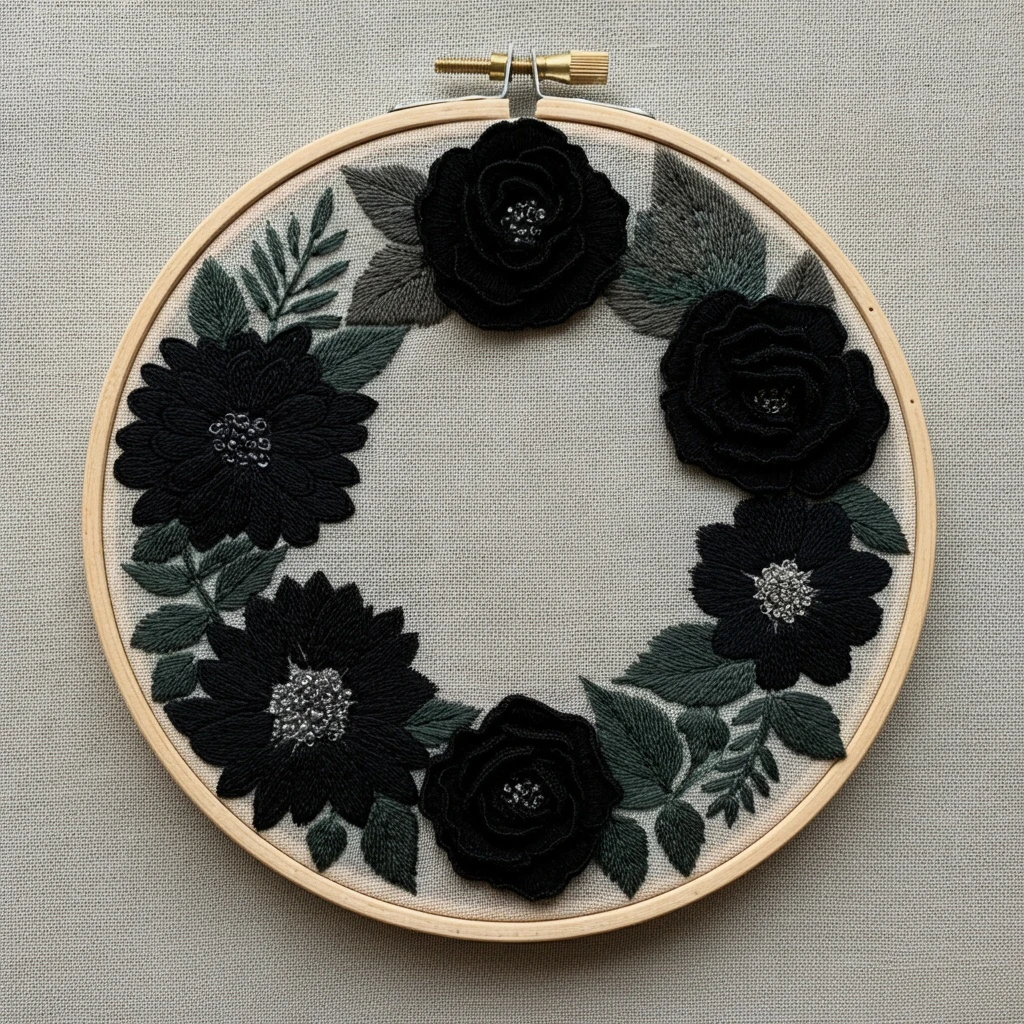
DMC palette & hand embroidery guide
Jeweled Floral Bouquet On Black
A dramatic bouquet stitched for black fabric, with saturated gemstone flowers glowing against a dark ground. The design reads as a compact floral arrangement: ruby and magenta blossoms, violet and blue accent blooms, emerald foliage, tiny gold centers, and selective pale highlights that make each petal sparkle rather than disappear into the background.
Design color read
This design is built for high contrast: the black ground acts as the deepest shadow, so the stitched areas should be bright, clean, and intentionally placed. The bouquet likely combines full statement blooms in ruby, berry, plum, violet, and turquoise with smaller accent flowers, golden centers, and green leaves that range from deep emerald to yellow-green highlights. On dark fabric, value separation matters as much as hue; every flower needs a light edge, a saturated middle, and a dark-but-visible shadow tone.
Let some black fabric remain between petals and leaves. Those small gaps make the bouquet look crisp and jewel-like instead of overfilled.
Thread-count snapshot
- Main petals: 2 strands for satin, long-and-short, or woven-wheel roses; 3 strands only for raised accents.
- Dark fabric outlines: 1 strand in tone-on-tone dark shades; avoid heavy black outlines because the ground already supplies shadow.
- Leaves & stems: 2 strands for stem stitch and leaf fill; 1 strand for veins, tips, and small serrated edges.
- Centers & sparkle: 1 strand French knots for delicate dots, or 2 strands for raised golden beads of texture.
Suggested DMC palette
Stitch suggestions
Best order of work
Blending & shading guidance
Ruby and berry flowers
Build red flowers with 815 nearest the center or underside, 321 through the main petal body, and 602 where the red shifts toward berry-pink. For a glowing edge, blend one strand of 321 with one strand of 602, then add a few single-strand B5200 or 3823 stitches only at the highest points.
Violet and plum flowers
Use 550 and 154 for dark folds, 552 for the main violet body, and 209 for the petal tips. Purple can disappear on black if it is too dark, so keep 550 limited to small recesses and let 552 carry most of the visible area.
Turquoise and teal accents
Turquoise gives the bouquet its jewel-box contrast. Use 3809 close to the black background or under petals, 3843 for the main blue bloom areas, and a touch of B5200 or 3823 to catch light. For teal leaves, blend 3847 with 699 so the foliage relates to both blue and green flowers.
Texture notes
- On black fabric, a clean edge matters more than a dense fill; keep petal outlines tidy and intentional.
- Let the black ground act as natural separation between small petals, buds, and leaves.
- Use a laying tool or the side of your needle to smooth satin stitches, especially in bright reds and blues.
- Cluster gold French knots unevenly so the centers look botanical, not like a dotted grid.
- Vary leaf lengths and angles to make the bouquet look gathered rather than symmetrical.
Outlining details
Avoid outlining every shape with black; the fabric already creates a hard boundary. Instead, use tone-on-tone darker shades: 815 for red petals, 154 for plum petals, 550 for violet petals, 3809 for turquoise, and 895 for green. A few one-strand split stitches along the tucked side of each petal will define the bouquet while keeping the soft embroidered look.
Beginner-friendly practical tips
- Use a fresh needle; black fabric can show fuzz and drag marks if the needle is dull.
- Keep thread lengths shorter than usual, about 12-15 inches, so bright floss stays smooth and glossy.
- Test-transfer marks on scrap fabric first; some light pencils are difficult to remove from black cloth.
- Stitch one complete flower before moving to the next so you can repeat the same dark-mid-light formula.
- Step back from the hoop often. Jewel tones should read clearly as separate flowers from a distance.
Compact stitch plan
Flowers: long-and-short, satin, woven wheel, and detached-chain petals in 815/321/602 for ruby, 154/550/552/209 for plum-violet, and 3809/3843 for turquoise. Centers: French knots in 3852 and 3823, with tiny B5200 sparkle where needed. Leaves: fishbone and long-and-short stitch in 895, 3847, 699, and 704. Stems: stem stitch or whipped backstitch in deep green. Finishing: one-strand tone-on-tone outlines, a few white glints, and carefully preserved black gaps for drama.