
DMC palette & hand embroidery guide
Kitchen Herbs
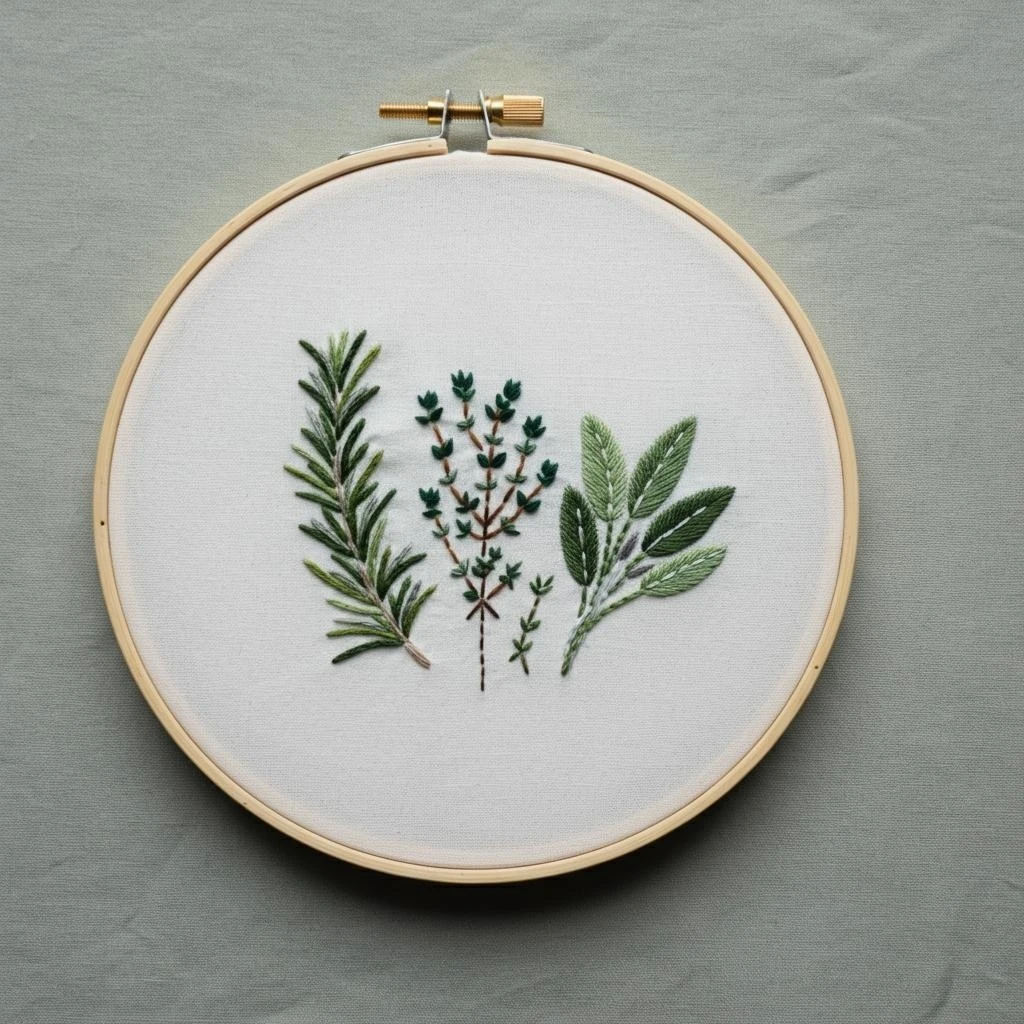
A calm beginner greenery sampler built around delicate kitchen herb sprigs: rounded basil and mint leaves, fine rosemary needles, tiny thyme leaves, soft parsley fronds, and warm natural stems. The design is mostly green, but the interest comes from changing leaf shapes, thread counts, and value shifts rather than bright floral contrast.
Design color read
The reference design reads as a greenery-focused kitchen herb sampler with several small sprigs arranged like a tidy botanical study. The palette is dominated by fresh and muted greens: deep pine at the stems, medium leafy green for the main leaves, sage-gray for softer herbs, and yellow-green highlights along leaf tips and veins. Warm beige-brown stems and a few cream accents keep the composition natural and readable on light fabric.
Because the design is mostly green, the key is contrast by value and stitch direction. Let each herb have a distinct texture: broad, smooth basil leaves; pointed mint leaves; needle-like rosemary; small dotted thyme; and feathery parsley or cilantro.
Thread-count snapshot
- Main stems: 2 strands in stem stitch or split stitch for a clean botanical line.
- Fine herb stems: 1 strand backstitch for thyme, rosemary, and tiny side shoots.
- Broad leaves: 2 strands for fishbone, satin, or long-and-short stitch; 1 strand for vein detail.
- Needle leaves: 1 strand straight stitches; switch to 2 strands only for foreground needles.
- Seeds or tiny blossoms: 1 strand French knots so accents do not overpower the greenery.
Suggested DMC palette
Stitch suggestions
Best order of work
Blending & shading guidance
Fresh green leaves
Use 3346 as the main green, shade the base with 3345, and highlight the tip with 3347 or 3348. For a smooth beginner-friendly blend, thread one strand of 3346 with one strand of 3347 on the middle of the leaf, then switch to two strands of 3348 only for the very brightest tip stitches.
Muted herb sprigs
Sage, thyme, and background greenery should be quieter than the basil or mint. Work these with 3051, 3052, and 3053. Add just a few stitches of 3363 near the stem if a sprig needs more definition, but avoid over-outlining the pale gray-green leaves.
Warm olive undertones
Use 730 and 732 in lower leaves, older growth, and places where the design needs warmth. A blend of one strand 732 with one strand 3347 makes a lively olive-green transition that still feels natural for kitchen herbs.
Texture notes by herb type
- Basil: broad fishbone leaves with a soft center vein and rounded tips.
- Mint: slightly jagged edges; add tiny 1-strand side stitches after the main fill.
- Rosemary: straight stitches angled away from a thin stem, darkest near the base.
- Thyme: many tiny detached-chain leaves; use muted greens so the sprig stays delicate.
- Parsley/cilantro: fly stitch branches, seed stitches, and small forked tips for airy movement.
Outlining details
Keep outlines tonal and light. Use 3362 or 3345 for the shadow side of fresh leaves, 3051 for muted herb leaves, and 420 only on woody stems. Avoid a heavy black outline; the design should feel like soft botanical embroidery rather than a cartoon. For broad leaves, outline only one side and the center vein, then let the satin or fishbone fill define the other edge.
Beginner-friendly practical tips
- Transfer the main stems and leaf outlines, but do not worry about marking every tiny thyme or rosemary leaf.
- Work with 12-16 inch lengths of floss to prevent fuzzy, dull-looking greenery.
- Keep tension relaxed on detached-chain leaves so the loops stay plump and herb-like.
- Use a sharp needle when stitching through filled leaves to add veins or edge details cleanly.
- Step back between sprigs. In a mostly green design, spacing and silhouette matter as much as individual stitches.
Compact stitch plan
Stems: stem stitch in 3363, 3362, or 420, with 1-strand side branches. Broad leaves: fishbone, satin, or long-and-short stitch in 3345, 3346, 3347, and 3348. Muted herbs: detached chain and tiny straight stitches in 3051, 3052, and 3053. Needle herbs: rosemary-style straight stitches in 3362, 3051, and 3052. Final accents: 734 or 738 seed stitches, tiny 3041 blossoms if desired, and selective tone-on-tone backstitch for veins.