
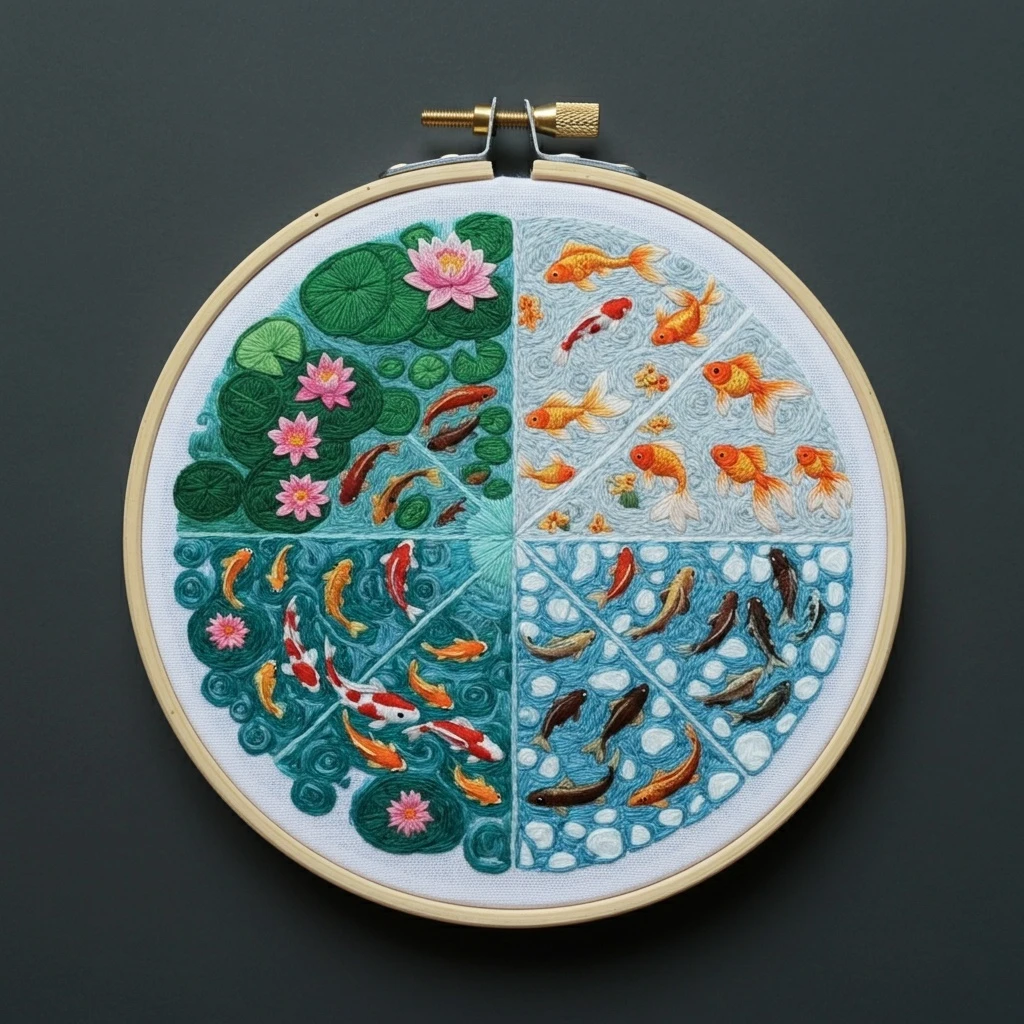
Koi and Goldfish Seasons Hoop
A richly textured circular pond embroidery guide with lily pads, waterlilies, swirling blue water, orange goldfish, red-and-white koi, and darker koi grouped into four calm seasonal sections.
Preview
The visible design is a round hoop divided into four pond-like wedges. The upper-left area is dense with dark green lily pads, teal water, and pink waterlilies. The upper-right section is pale, airy blue with orange goldfish and small floating floral accents. The lower-left wedge uses darker teal swirls with red-and-white koi and warm orange fish, while the lower-right wedge has bright blue water, white pebble or bubble shapes, and several darker koi. Fine radial dividers meet near the center, giving the design a clean seasonal-wheel structure.
Likely DMC Color Palette
Use this as a practical starting palette. The design has strong water and foliage coverage, with fish and flower colors used as lively accents. Percentages are visual coverage estimates from the preview image, not exact skein quantities or pattern thread usage.
| DMC | Approx. Hex | Official-style Thread Name | Est. Coverage | Where It Appears |
|---|---|---|---|---|
| 3865 | #F6EED8 | Winter White | 9% | White koi bodies, pale fish fins, pebble/bubble shapes in the lower-right water, and soft highlights on the fabric-facing areas. |
| 747 | #DBE9E8 | Very Light Sky Blue | 11% | Pale water in the upper-right quadrant, light ripples, center glow, and cool water highlights around the goldfish. |
| 598 | #8CCBD3 | Light Turquoise | 12% | Mid-light water sections, radial divider highlights, soft ripples, and the brighter open pond areas. |
| 597 | #49A7B1 | Turquoise | 11% | Main blue-green pond fill, lower-right water, circular swirl outlines, and mid-tone wave texture. |
| 3809 | #167F88 | Very Dark Turquoise | 8% | Deep teal water swirls in the lower-left quadrant and shadowed pond texture under the lily pads. |
| 3810 | #0E5F64 | Dark Turquoise | 6% | Darkest water curls, outlines around the lily-pad section, and deeper blue-green shading behind the koi. |
| 699 | #0B6B42 | Green | 9% | Large lily pads, leaf rims, green pond plants, and the stronger foliage masses in the upper-left quadrant. |
| 500 | #064536 | Very Dark Blue Green | 6% | Deep leaf shadows, dark lily pad veins, shaded edges around the green quadrant, and contrast beneath flowers. |
| 704 | #83B35B | Bright Chartreuse | 3% | Lighter lily pad highlights, small fresh green leaves, and bright accents on round pond plants. |
| 3688 | #F6A6BD | Medium Mauve | 4% | Pink waterlily petals and small blossom accents in the green pond areas. |
| 3806 | #D9578C | Light Cyclamen Pink | 3% | Darker petal tips, flower centers, and stronger pink shading on the visible waterlilies. |
| 972 | #FFB000 | Deep Canary | 7% | Goldfish bodies, yellow-orange koi fins, small golden floating accents, and warm highlights on fish tails. |
| 740 | #FF7A00 | Tangerine | 7% | Bright orange goldfish, orange koi patches, fish heads, and saturated tail details. |
| 817 | #C92A1F | Coral Red | 4% | Red patches on koi, small red fish markings, and bold warm accents in the lower-left pond section. |
| 433 | #7A3B23 | Medium Brown | 4% | Brown koi bodies, fish shadows, eye details, and warm contouring in darker fish. |
| 3371 | #2B1B16 | Black Brown | 3% | Darkest koi, fish eyes, mouth details, and the deepest contour lines on the lower-right fish. |
| 415 | #B7C4C7 | Pearl Gray | 3% | Cool shadows on white koi, pale pebble edges, and subtle shading within lighter water areas. |
Stitching Suggestions
The design will look best with a mix of smooth fish fills, textured water movement, and crisp plant details. Work with lighter strand counts in the small fish and darker outlines so the pond stays delicate rather than bulky.
Swirling Water Sections
- Ripples: use split stitch, back stitch, or loose stem stitch to follow the circular wave lines.
- Water fill: build soft texture with short running stitches or scattered seed stitches instead of heavy satin fill.
- Practical note: alternate pale and mid turquoise so each quadrant keeps a separate water mood.
Lily Pads and Water Plants
- Large pads: fishbone stitch, satin stitch, or long-and-short stitch following the leaf veins.
- Veins: add fine straight stitches or back stitch after the leaf fill is complete.
- Small round pads: tiny satin stitches or padded satin can give a raised pond texture.
Goldfish and Koi
- Fish bodies: use satin stitch or long-and-short stitch, changing direction with the curve of the body.
- Fins and tails: use feather stitch or fine straight stitches radiating outward for a translucent look.
- Markings: place red, orange, brown, and dark patches after the pale body fill so details stay sharp.
Waterlilies and Small Blossoms
- Petals: lazy daisy stitches work well for small flowers; use satin stitch for larger petals.
- Centers: tiny French knots or short straight stitches in yellow/orange keep the flowers lively.
- Practical note: leave a little breathing room around flower shapes so pink petals stand out against the green.
Radial Dividers and Center Point
The pie-slice dividers are important to the composition. Stitch them early with back stitch or whipped back stitch in pale turquoise, keeping the fabric well-hooped so the center point does not pucker. For the lower-right pebble shapes, outline each white oval lightly before adding nearby water texture.
Where to Start
- Transfer the circle and quadrant lines first. Lightly mark the center point where the four sections meet.
- Stitch the main divider lines. This gives the design structure and keeps the four pond scenes organized.
- Work the water backgrounds by section. Start with the pale upper-right water, then move to deeper teal sections so darker floss does not fuzz into lighter areas.
- Add lily pads and flowers. Complete the larger green shapes before stitching small pink blossoms and yellow centers.
- Finish with fish details. Fill the fish bodies, then add fins, red patches, eyes, and fine dark contours last.
Helpful Notes
- Use one strand for tiny outlines. Fish eyes, mouths, and small fins will look cleaner with a single strand of dark brown or black-brown.
- Keep water stitches directional. Curved stitches help create movement around the fish and prevent the background from looking flat.
- Do not overfill the white pebbles. The lower-right section relies on light shapes against blue water, so preserve the pale ovals and outline them gently.
- Balance warm fish colors across the hoop. A few orange stitches in each section help the eye travel around the circle.
- Substitute thoughtfully. Any close turquoise, lily-pad green, bright orange, and deep red can work if you do not have the exact DMC numbers listed above.
Encouraging Finish
This is a wonderfully satisfying design because the details build up gradually: first the calm water, then the lily pads, then the fish and flowers that bring the pond to life. Take it one quadrant at a time, keep your stitches relaxed, and let the small color accents sparkle at the end. Even with simplified shading, the circular movement and bright koi will make the finished hoop feel full, peaceful, and handmade.