
Lace Style Petal Mandala

Lace Style Petal Mandala — DMC Palette & Stitching Guide
Lace Style Petal Mandala
DMC palette & embroidery tips

Lace Style Petal Mandala

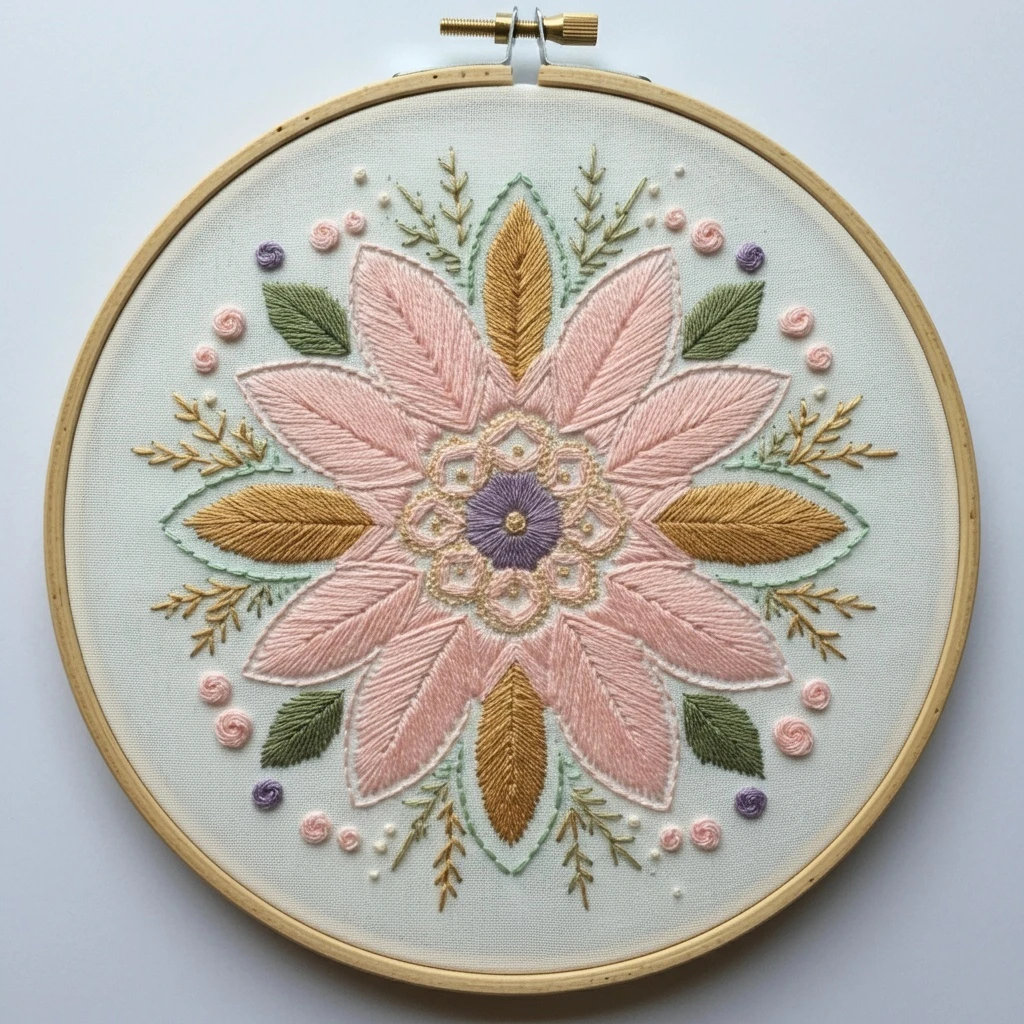
A soft, airy floral mandala with lace-like symmetry: blush satin petals radiate around a purple center, while wheat-gold leaves, sage foliage, mint outlines, tiny pearl knots, and small rosette accents create a delicate heirloom-hoop feeling. The palette below keeps the design gentle but still dimensional.

Mood: delicate botanical lace Best fabric: warm ivory linen Skill level: beginner to confident beginner

Color read from the artwork

The reference is built on muted, graceful contrasts rather than bright saturation. The main flower is a dusty blush pink with pale highlights and slightly deeper rose-pink inner shading. Four wheat-gold leaves add warmth, sage green leaves sit between the petals, mint stitching outlines the outer lace shapes, and a dusky violet center plus small purple rosettes give the composition quiet depth.

DMC 152
Shell Pink Medium Light
Main blush petal fill; ideal for the broad satin-stitched petals.
DMC 223
Shell Pink Light
Petal shadows, inner fold lines, and lower petal edges.
DMC 225
Shell Pink Ultra Very Light
Soft petal highlights and pale rosette tops.
DMC 3865
Winter White
Pearl dots, lace breaks, and subtle outlines on ivory fabric.
DMC 782
Topaz Dark
Golden leaf fills and warm feathered veins.
DMC 729
Old Gold Medium
Leaf highlights, tiny flower centers, and gold branch tips.
DMC 469
Avocado Green
Deepest sage leaves and short dark veins.
DMC 472
Avocado Green Ultra Light
Main green leaf fill and softened foliage transitions.
DMC 3813
Blue Green Light
Mint lace outlines around outer leaves and petal points.
DMC 209
Lavender Dark
Central purple flower fill and small lavender rosettes.
DMC 340
Blue Violet Medium
Deeper center ridges, rosette shadows, and accent knots.
DMC 822
Beige Gray Light
Subtle shadow outlines when white would look too stark.
Optional heirloom touch: For a more lace-like finish, use DMC 3865 or 822 for fine split-stitch outlines instead of strong dark outlines. The softer edge keeps the mandala elegant and vintage.

Stitch map by design element

Large blush petalsUse long-and-short stitch or satin stitch in the direction of each petal point. Start with 223 along the inner crease and transition into 152, adding a few 225 stitches near the upper center of each petal for lift.
Central violet bloomWork radial satin stitches from the outside toward the center, alternating 209 and 340 for ribbed depth. Add one small French knot or padded dot in 729 at the center.
Golden feather leavesUse fishbone stitch for the four wheat-gold leaves. Put 782 near the center vein and 729 along the outer edges so each leaf looks warm and dimensional.
Sage side leavesUse fishbone stitch or closely angled straight stitches. Stitch the center vein first in 469, then fill each side with 472, letting the diagonal stitches form a tidy herringbone texture.
Mint lace outlinesUse 1-strand stem stitch or split stitch in 3813 around the pale outer leaf shapes. Keep these stitches small and even so the outline reads as delicate lace rather than a heavy border.
Rosettes and pearl dotsUse whipped woven wheel or spiral stem stitch for the pink and lavender rosettes. Work pearl dots as single-wrap French knots in 3865 or 822, placed after all filling is complete.

Thread-count and blending guidance

Petal fills

Use 2 strands for most satin and long-and-short work. Drop to 1 strand for the final pale highlight stitches so the petal ridges do not become bulky.

Fine lace lines

Use 1 strand for mint outlines, white pearl details, and small branch stems. This preserves the airy negative space that makes the design look lace-inspired.

Leaves

Use 2 strands for fishbone leaves. Blend 782 + 729 in the needle for softer gold transitions, or 469 + 472 for natural sage shading on the darker green leaves.

Raised accents

Use 2 strands for French knots and rosettes; use 3 strands only for the largest pink spiral rosettes if you want a padded, bead-like texture.

Suggested stitching order

Mark the symmetry first. Transfer the center, petal points, and four compass leaves carefully. A mandala looks polished when the repeated shapes line up before stitching begins.
Stitch the center flower. Complete the violet center and tiny gold middle first. This anchors the radial direction for every petal and leaf around it.
Fill the large blush petals. Work opposite petals in pairs to keep tension balanced across the hoop. Angle stitches toward each petal tip and avoid pulling too tightly.
Add gold and green leaves. Stitch the fishbone leaves next, then the olive branch sprigs. Keep leaf veins crisp because they are a major decorative texture in the artwork.
Finish with lace details. Add mint outlines, small rosettes, French knots, and cream dots last so they sit cleanly on top of the filled areas.

Shading and texture tips

Petal direction matters

Let every satin or long-and-short stitch radiate from the mandala center toward the petal tip. Consistent direction creates the soft feathered texture visible in the reference.

Keep the lace airy

Do not overfill the mint outer shapes. A single fine outline with a few tiny straight stitches is enough to suggest lace and keep the fabric background visible.

Use knots sparingly

Cluster pearl knots near the rosettes and branch ends, but leave open space between them. The scattered dots should feel like tiny beads, not a solid border.

Beginner-friendly shortcut: If long-and-short stitch feels difficult, fill each large petal with satin stitch in two halves, meeting along a center vein. Outline the vein with one strand of 223 to disguise uneven joins.

Practical finishing notes

Use a clean, tightly hooped ivory or oatmeal linen so the pale pinks and creams do not disappear. Press the finished embroidery face-down on a fluffy towel to protect the French knots and rosettes. Trim dark thread tails behind pale petals, and avoid carrying violet or green thread across the back where it could shadow through the fabric.

Needles

Crewel size 7–9 works well for 1–2 strands. Use a slightly larger needle for woven rosettes so the floss glides without abrasion.

Fabric pairing

Warm ivory linen, cotton-linen, or tightly woven muslin suits the soft palette. For extra vintage charm, choose a natural fabric with a visible weave.

Leave a Reply

Your email address will not be published. Required fields are marked *