
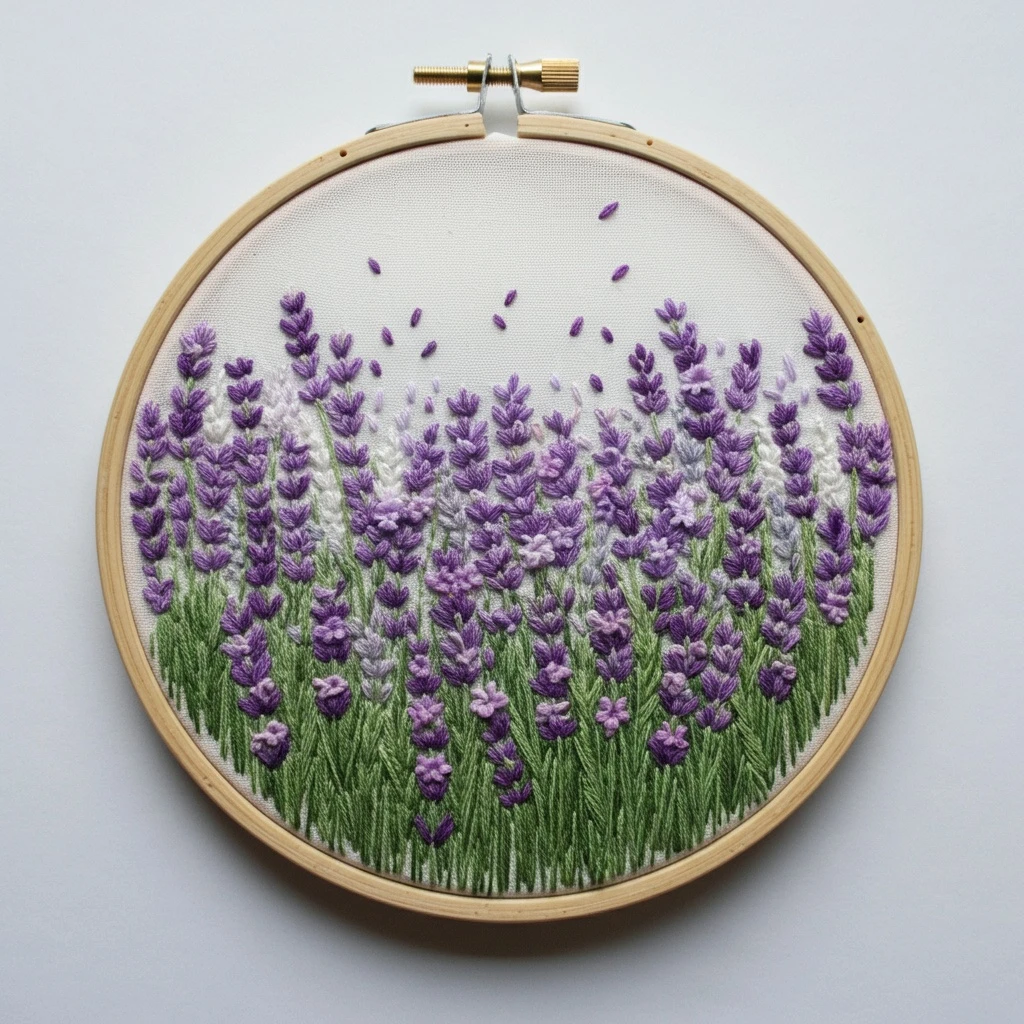
Lavender Field Serenity

Lavender Field Serenity — DMC Palette & Stitching Guide
Lavender Field Serenity Embroidery Art
DMC palette & embroidery tips

Lavender Field Serenity

A peaceful landscape-inspired embroidery plan built around rows of lavender, soft green stems, distant meadow tones, and a warm serene light. The palette emphasizes violet depth, silvery sage foliage, airy sky highlights, and restrained golden accents so the field feels calm, layered, and luminous.

Mood: tranquil lavender meadow Best fabric: natural linen, pale cream, or soft blue Skill level: beginner to confident beginner

Color read from the artwork

The design is best approached as a layered field rather than a single bouquet: dark violet marks anchor the deepest lavender clusters, medium lavender builds the main flower mass, pale lilac catches the tips, and greyed greens keep the stems natural. A small amount of cream, blue-grey, and warm yellow helps suggest open sky, distance, and mellow sunlight without distracting from the purple field.

DMC 3865
Winter White
Soft sky gaps, pale field highlights, and gentle glints between lavender rows.
DMC 162
Blue Ultra Very Light
Cool atmospheric background touches and quiet distant haze.
DMC 211
Lavender Light
Sunlit lavender tips, distant blossoms, and soft edge highlights.
DMC 210
Lavender Medium
Main lavender flower rows and most visible bloom clusters.
DMC 209
Lavender Dark
Mid-to-deep blossoms, row separation, and shaded flower masses.
DMC 333
Blue Violet Very Dark
Deepest lavender shadows, foreground accents, and small contrast knots.
DMC 3042
Antique Violet Light
Muted transition purple for softer, dustier field areas.
DMC 3041
Antique Violet Medium
Natural shadow tone when bright violets feel too saturated.
DMC 522
Fern Green
Silvery foliage highlights and distant stems in the field rows.
DMC 520
Fern Green Dark
Main lavender stems, meadow texture, and greenery under the blooms.
DMC 3363
Pine Green Medium
Foreground stem shadows and darker base strokes between rows.
DMC 3822
Straw Light
Tiny warm sunlit flecks, dry grass accents, and horizon warmth.
Palette balance: Keep 210 and 209 as the dominant purples, then use 211 only at the tops of the rows. Too much pale lilac can flatten the field, while a few well-placed 333 accents make the foreground feel closer.

Stitch map by design element

Lavender rows
Use staggered detached chain, tiny lazy daisy stitches, or clustered seed stitches. Angle the marks slightly in the same direction to create the feeling of planted rows moving across the field.
Foreground blooms
Work with 2 strands and mix 210, 209, and 333. Place darker stitches at the lower side of each cluster, then add a few 211 stitches on top for sunlit tips.
Distant lavender
Use 1 strand in 211, 210, or 3042 with very short seed stitches. Keep the marks smaller and more widely spaced so they recede naturally.
Stems and foliage
Use stem stitch, split stitch, or fine straight stitches in 520. Blend 522 with 520 for lighter stems, and add 3363 only at the foreground base or under dense blooms.
Meadow texture
Layer irregular straight stitches in greens and occasional 3822 straw. Vary stitch length so the bottom edge feels organic rather than like a solid filled band.
Sky and light
Leave most open areas unstitched. Add sparse one-strand 3865 or 162 stitches only where you want a misty, airy highlight, keeping them subtle and horizontal.

Thread-count and blending guide

Recommended strands

Foreground flowers: 2 strands for visible texture. Distant flowers: 1 strand for scale. Stems: 1 strand for fine field lines or 2 strands for foreground stems. Meadow base: 2 strands for body, then 1 strand for final grasses.

Needle and fabric

Use a size 7 or 8 embroidery needle for most two-strand work and a size 9 for fine one-strand details. Natural linen, cream cotton, pale blue, or pale grey fabric gives the landscape room to breathe and suits the serene theme.

Blending ideas

Blend one strand 210 with one strand 209 for rich lavender clusters. Blend one strand 522 with one strand 520 for soft sage stems. For muted shadows, combine 3041 with 209 instead of using only dark violet.

Outlining details

A landscape like this should not have heavy outlines. Use fine split stitch only for the most important row guides, then cover those guides with flower stitches so the finished field feels painterly and soft.

Shading and texture suggestions

Create depth by scale

Make foreground stitches larger, darker, and closer together. As rows move upward or into the distance, switch to one strand, paler purples, and more negative space.

Use directional movement

Angle lavender buds and green stems in a gentle shared slant. This simple consistency makes the field look wind-brushed and calm without complicated shading.

Reserve warm accents

Use DMC 3822 sparingly as tiny dry-grass flecks or horizon warmth. A few warm stitches make the violets glow, but too many will pull focus away from the lavender.

Texture upgrade: Add a few French knots in 333 and 209 only in the closest lavender clusters. Keep the background clusters flatter with seed stitch so the foreground subtly rises from the fabric.

Beginner-friendly stitching order

Transfer only the main row directions and large shapes. Avoid drawing every blossom; the field will look more natural if many flower marks are stitched freely.
Stitch the background haze first with one strand of 162, 3865, 211, or 3042. Keep these marks sparse and light.
Add the main green row structure using 520 and 522. Use short stem stitches or straight stitches that follow the field direction.
Build lavender from back to front: pale 211 and 3042 in the distance, then 210 and 209 in the middle, then dark 333 accents in the foreground.
Layer meadow grasses at the base with 520, 3363, and a few 3822 stitches. Let some grasses cross over purple blooms for a natural field texture.
Finish with highlights. Add tiny 211 tips on the brightest lavender and a few 3865 glints only where the composition needs lift.

Practical tips for a clean finish

Avoid overfilling

Lavender fields need breathing room. Let the fabric show through between rows; this negative space becomes light and distance.

Keep thread lengths short

Purple floss can fuzz when repeatedly pulled through textured linen. Use 14-18 inch lengths and let the needle dangle occasionally to untwist.

Control the dark violet

Place 333 last and step back before adding more. It is excellent for contrast, but too much can make the field look heavy or patchy.

Work with the hoop relaxed

Dense seed stitches and knots can pucker fabric. Keep the fabric taut while stitching, but loosen the hoop between sessions and press from the back over a towel when finished.

Leave a Reply

Your email address will not be published. Required fields are marked *