
Little Gnome in the Daisy Patch
A cheerful beginner-friendly embroidery plan for a storybook gnome nestled among fresh spring daisies: warm cap tones, creamy petals, sunny flower centers, soft beard shading, and lively meadow greens.
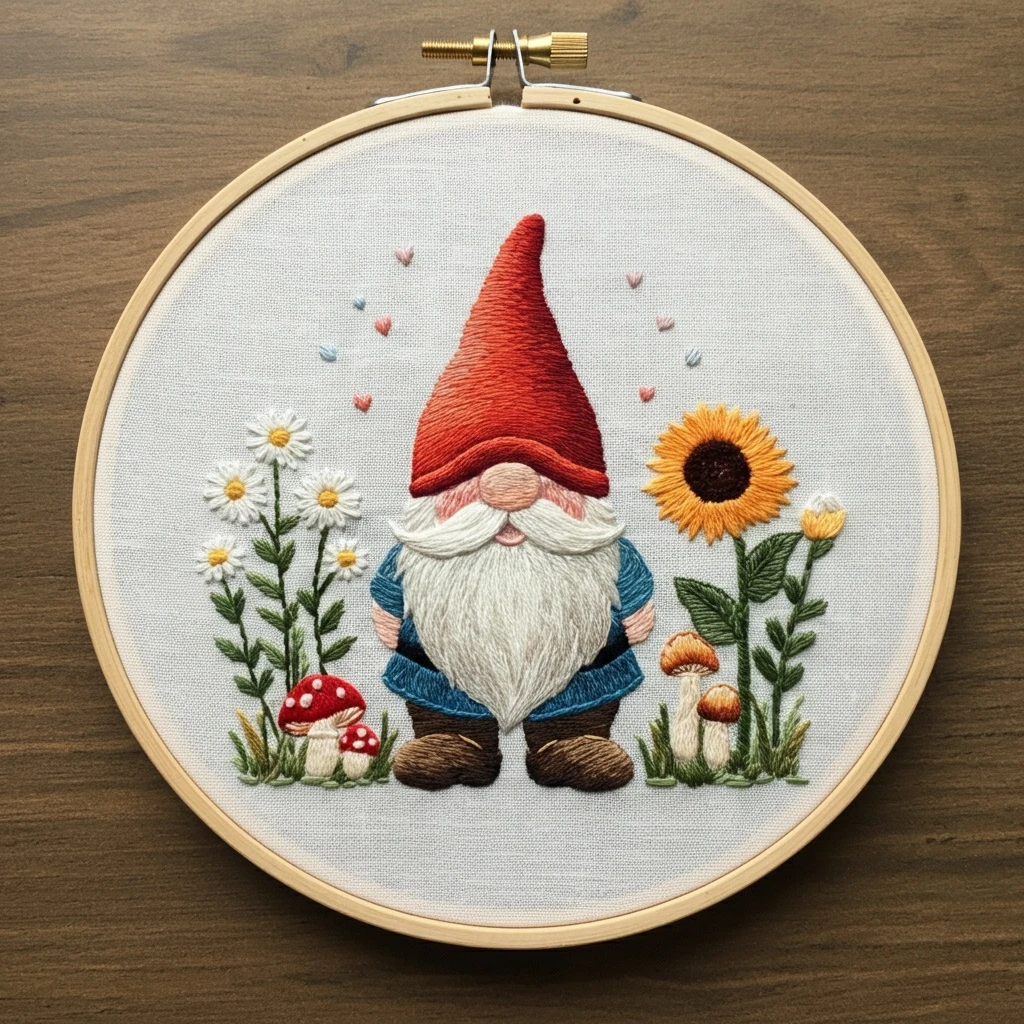
Design read
This motif works best when the gnome stays crisp and charming while the daisy patch feels airy and textured. Keep the face, hat edge, hands, boots, and flower outlines neat; then let the grass, stems, and tiny meadow fillers loosen up with small directional stitches.
Suggested DMC color palette
Stitch map
Thread-count guidance
| Area | Recommended strands | Why it works |
|---|---|---|
| Fine outlines, eyes, cap seams | 1 strand | Keeps the expression cute and avoids heavy cartoon lines. |
| Hat fill and clothing | 2 strands | Good coverage without bulky ridges in curved long-and-short sections. |
| Daisy petals | 2 strands | Soft petal body with enough brightness on natural fabric. |
| Flower centers | 2 strands, double-wrap knots | Creates raised dotted texture and a sunny focal point. |
| Grass and meadow fillers | 1–3 strands | Varying thickness makes the patch look natural and layered. |
Blending & shading ideas
- Hat depth: stitch the underside and left fold with 347, mid areas with 351, and the cap tip/high ridges with 352.
- Petal softness: use 745 for most petals, then add a single B5200 stitch along outer tips that catch the light.
- Greenery layers: place darker 469 stems behind the gnome, 470 for main leaves, and tiny 472 strokes at the tips.
- Beard texture: alternate 642 and B5200 in thin curved strokes. Avoid filling it solid; the empty fabric can act as highlight.
- Grounding: add short 3862 and 469 stitches beneath the boots so the character feels planted in the daisy patch.
Suggested stitching order
Texture tips
Make the daisies dimensional: vary petal length and leave tiny gaps between petals instead of creating perfect circles.
Keep the gnome cozy: couch one or two subtle darker lines along the hat brim and add a few short beard stitches over the clothing edge.
Use knots sparingly: French knots are perfect for centers, but too many in the grass can compete with the daisies. Reserve knots for flower centers and a few tiny buds.
Beginner-friendly practical tips
- Hoop the fabric drum-tight before starting; loose fabric makes satin petals and cap shading look uneven.
- Use shorter thread lengths, about 14–16 inches, especially with pale petal colors that can become fuzzy from overhandling.
- Start and end threads under nearby stitches rather than bulky knots where the daisy petals are light.
- Rotate the hoop while stitching curved areas; your stitches will follow the cap and petal direction more naturally.
- Check contrast from arm’s length. Add one-strand brown outlines only where shapes disappear.
Outlining details
- Hat edge: backstitch with 801 or a 347/801 blend for a softer folk-art outline.
- Daisy stems: split stitch in 470, with occasional 469 on the shadow side.
- Petals: avoid dark outlines on every petal. Use 745/B5200 contrast and a few tiny 642 shadow stitches instead.
- Face: one strand is enough for eyes and mouth. Tiny details look sweeter when understated.
- Foreground grass: add final straight stitches over the gnome’s shoes and lower stems for a tucked-in meadow effect.