
DMC palette & hand embroidery notes
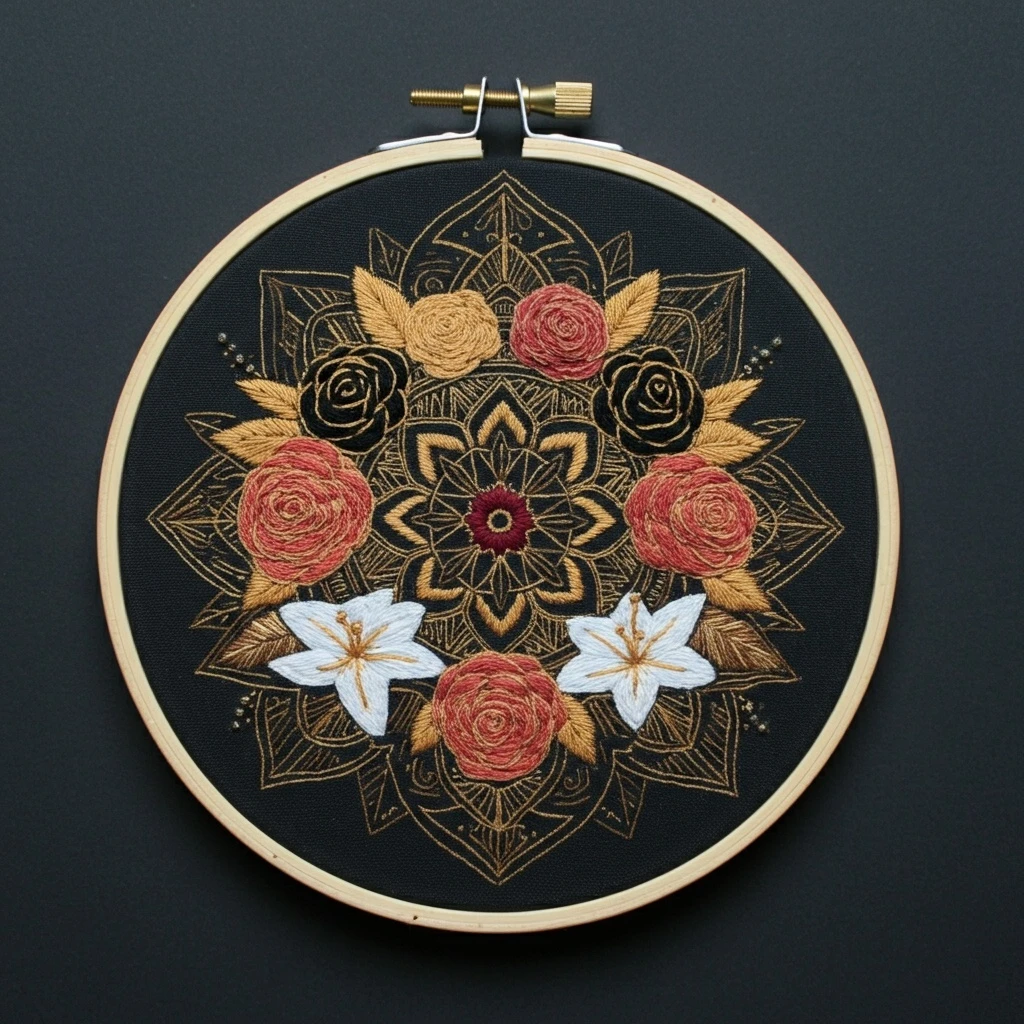
Luxury Floral Chakra
A dramatic black-ground hoop with a radiant gold chakra mandala, sculptural roses, pale lilies, warm wheat-like leaves, and a burgundy floral center. The look is ornate, luminous, and best stitched with careful contrast: glowing metallic-gold effects against matte black, soft white petals, and richly shaded rose spirals.
Suggested DMC Color Palette
These floss choices match the visible palette: antique gold outlines, straw-gold leaves, brick and burgundy roses, ivory-white lilies, and subtle charcoal depth. Use matte cotton floss for most areas; add metallic thread only as an accent if desired.
Ground-shadow outlining, cat-eye-level dark rose gaps, and reinforcing tiny negative spaces on black fabric.
Main antique-gold mandala lines, leaf veins, lily stamens, and warm decorative arcs.
Darker gold for shadowed leaf edges, mandala depth, and lower petals in the gold ornamental forms.
Bright gold highlights on leaf tips, rose centers, and the most illuminated chakra points.
Primary rose petal tone for the coral-red blossoms; excellent in spiral satin or split stitch rows.
Deeper rose folds, outer petal shading, and the lower side of each spiral bloom.
Center flower, rose accents, and the strongest burgundy contrast near the chakra core.
Lily petals and clean highlights; use sparingly so the white flowers glow against the black ground.
Cool lily shadows and pale petal dimension, especially along folds and undersides.
Optional muted botanical shadow where leaves tuck under roses; keeps the foliage sophisticated.
Hoop-toned accents, tiny seed dots, and softening gold lines when 3046 feels too bright.
Optional: couch only a few central arcs or outer star points for luxury sparkle; avoid overusing it.
Stitching Strategy by Design Area
1Gold chakra mandala
- Use 1 strand for fine back stitch or split back stitch so the geometry stays delicate.
- For heavier arcs, couch 2 strands of 3046 with a single strand of 729.
- Keep stitches short around curves to preserve the ornate symmetry.
2Spiral roses
- Start each rose with tiny whipped back stitches or stem stitch spirals.
- Blend 3722 + 3803 in the needle for mid petals; add 3821 highlights in broken stitches.
- Use 2 strands for the body and 1 strand for final petal creases.
3White lilies
- Fill petals with long-and-short stitch using 3865, feathering 3756 at the folds.
- Outline with one strand of 3756 or very light grey-blue rather than black.
- Stitch stamens in straight stitches with 3046 and French knots at the tips.
4Golden leaves & wheat forms
- Use fishbone stitch for broad leaves and fly stitch for pointed botanical shapes.
- Shade from 729 at the base to 3046, then 3821 at the tips.
- Angle stitches outward from the vein to create a raised, satin leaf surface.
Thread Count, Blending & Shading
Thread-count guide
- 1 strand: mandala linework, tiny dots, petal veins, final outlines.
- 2 strands: roses, leaves, lily fills, bolder ornamental arcs.
- 3 strands: only for raised central rose knots or padded leaf accents; too much bulk can overwhelm the fine chakra lines.
Blending ideas
- Rose glow: 1 strand 3722 + 1 strand 3803 for shaded petal rows.
- Antique gold: 1 strand 3046 + 1 strand 729 for aged metallic warmth without using metallic floss.
- Lily softness: 1 strand 3865 + 1 strand 3756 in the cooler petal shadows.
| Effect | How to stitch it | Practical note |
|---|---|---|
| Raised rose centers | Use tight stem-stitch spirals or a tiny woven wheel. | Keep the center compact; increase stitch length gradually as the spiral expands. |
| Glowing gold geometry | Back stitch with 1 strand, then add selective couching on major lines. | Do not fill every line with metallic; a few accents look more elegant. |
| Dimensional lilies | Long-and-short fill from petal edge inward, then add central gold stamens. | Leave small black gaps between petals so the flower silhouette remains crisp. |
| Shadow on black fabric | Use 310 or 3799 only to tidy edges and deepen rose gaps. | Black-on-black stitches are subtle; use them as texture, not as main detail. |
Beginner-Friendly Practical Tips
Transfer cleanly
Fine chakra lines are the hardest part. Use white transfer paper, a chalk pencil, or printed water-soluble stabilizer. Mark only the lines you truly intend to stitch.
Work symmetrically
Complete matching petals or leaves opposite each other before moving on. This keeps color balance consistent around the circular hoop.
Control tension
Black fabric shows puckering quickly. Keep the hoop drum-tight, avoid long carries on the back, and re-hoop if the fabric loosens.
Use short lengths
Gold and dark red floss can look fuzzy after too much pulling. Cut 14–16 inch lengths and let the needle dangle occasionally to untwist.
Outline last
After filling flowers, add the thinnest outlines and petal veins. This sharpens the luxury illustrative look without making the design heavy.
Test metallics
If adding DMC metallic, test it on scrap black fabric first. Couching metallic thread is smoother and more beginner-friendly than stitching through the fabric repeatedly.