
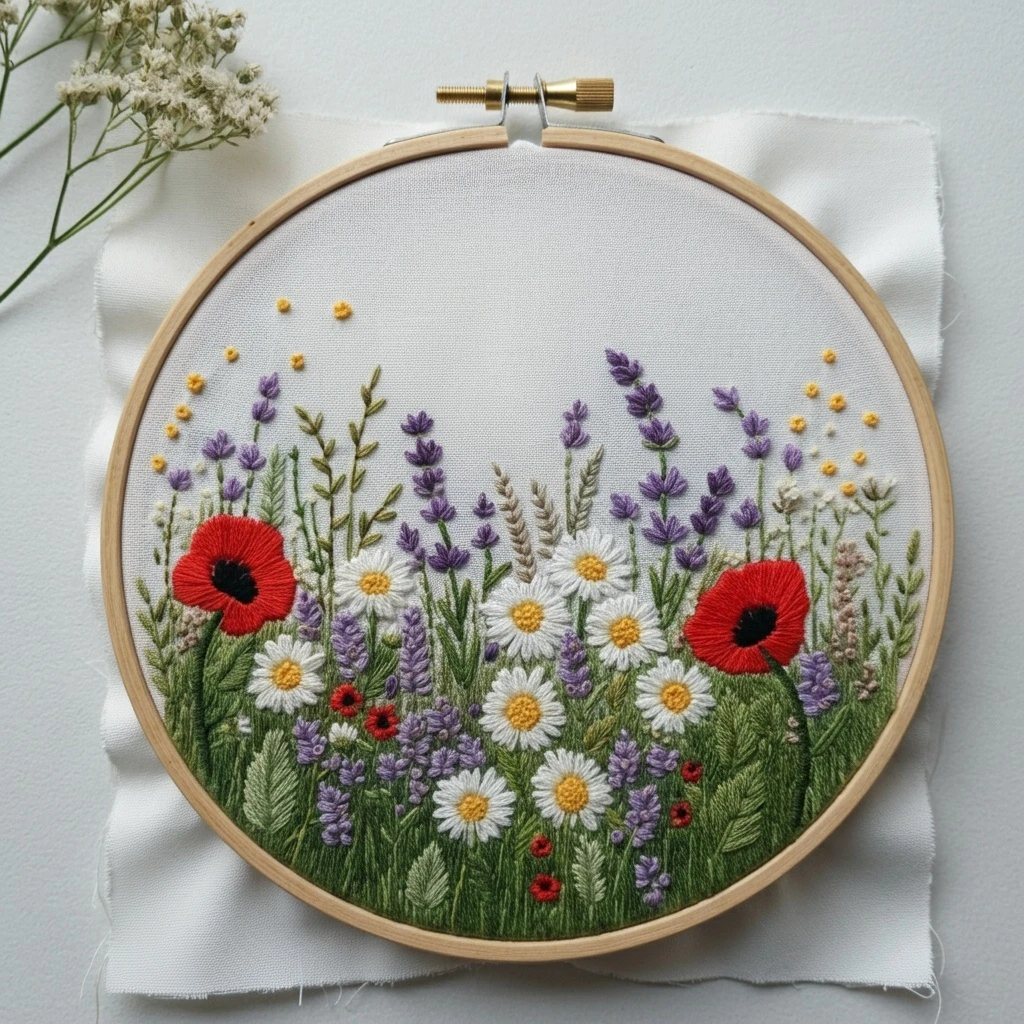
Meadow Wildflower
A fresh hoop of poppies, daisies, lavender spikes, yellow seed dots, and layered meadow grasses. The design reads airy and natural: saturated red focal blooms sit low in the composition while fine green stems and purple florals build height and movement.
Design color read
The palette is garden-bright but still natural: deep poppy red and black centers anchor the eye, white daisy petals add sparkle, golden yellow centers and small French-knot flowers create warmth, and the meadow base uses many greens rather than one flat shade.
Main impression
Low, dense grasses with taller sprigs rising above; keep the lower third textured and the upper area lighter so the hoop does not feel crowded.
Focal contrast
Use clean red satin stitches for the poppies, then soften with darker red near the centers and black seed stitching for depth.
Airy details
Tiny yellow knots, pale gray-green stems, and lavender buds should be stitched sparingly with 1–2 strands to preserve the meadow’s delicate spacing.
Suggested DMC palette
These DMC choices match the visible red poppies, crisp daisies, lavender-purple flower spikes, warm yellow centers, olive stems, and shadowed meadow greens.
Stitch map & practical use notes
| Area | Recommended stitches | Thread count & notes |
|---|---|---|
| Red poppies | Long-and-short stitch or satin stitch, with split-stitch outline first. | Use 2 strands for petals. Work from the outer rim toward the dark center so the stitch direction mimics soft fan-shaped petals. Add DMC 816 at the base before filling with 321. |
| Poppy centers | French knots, seed stitch, or dense satin oval. | Use 2 strands of 310. For a plush center, make several small knots rather than one large knot. |
| Daisy petals | Lazy daisy stitches, detached chain, or short satin stitches. | Use 2 strands B5200. Add a single strand of 762 at the underside of a few petals to keep white flowers visible on pale fabric. |
| Daisy centers | French knots or tight colonial knots. | Use 2 strands 728; make clustered knots in a round shape. Add one or two darker gold knots if you want extra dimension. |
| Lavender spikes | Detached chain, fly stitch, or small straight stitches stacked along stems. | Use 2 strands for buds. Alternate 333 and 340, then place 209 on the side that catches light. |
| Grasses and stems | Stem stitch, back stitch, straight stitch, and couching for long blades. | Use mostly 1 strand for high stems and 2 strands for lower grass. Mix 895, 367, 730, and 522 so the base looks layered. |
| Fine seed dots | French knots, tiny straight crosses, or single seed stitches. | Use 1–2 strands of 728 for yellow flowers; vary knot size and spacing for a natural scattering. |
| Taupe wild sprigs | Fishbone stitch, fly stitch, or small angled straight stitches. | Use 1 strand of 642 or 730. Keep them thinner than the daisies so they act as background texture. |
Thread-count, blending & shading guidance
Strand plan
- 1 strand: tall stems, leaf veins, small grasses, distant dots.
- 2 strands: most flower petals, lavender buds, daisy centers, main leaves.
- 3 strands: optional only for foreground grass clumps or extra-bold poppy centers.
Blending ideas
- Blend one strand 321 + one strand 816 at the base of poppies for a soft red shadow.
- Blend one strand 333 + one strand 340 for varied lavender heads.
- Blend one strand 367 + one strand 522 for fresh green highlight blades.
Beginner-friendly stitching order
Mark only the major stems and flower centers. For grasses, add extra freehand stitches later rather than transferring every blade.
Use 1 strand of olive and fern greens for the tallest stems, working from back to front.
Stitch red poppies and white daisies before dense foreground grass so their edges stay clean.
Build purple clusters with tiny detached chains, then sprinkle yellow French knots at varied heights.
Add straight stitches in several greens around the stems to integrate the flowers and hide travel threads.
Finishing and texture suggestions
Fabric
White cotton or natural linen shows the daisies and pale stems well. If using cream fabric, outline daisy petals with a whisper of 762.
Needles
Use a size 7 or 8 embroidery needle for 2 strands; switch to size 9 for fine 1-strand grass and delicate outlines.
Hoop tension
Keep the fabric drum-tight while stitching satin poppies. Re-tighten before French knots to prevent puckering.